Why in News?
Advances in portable ultrasound and AI have renewed debate over the PCPNDT Act. While the law restricts ultrasound use to prevent prenatal sex determination, it also limits community-based cancer diagnosis in rural areas. The key issue is whether regulation should distinguish foetal-imaging devices from high-frequency probes used for superficial conditions such as breast lumps.
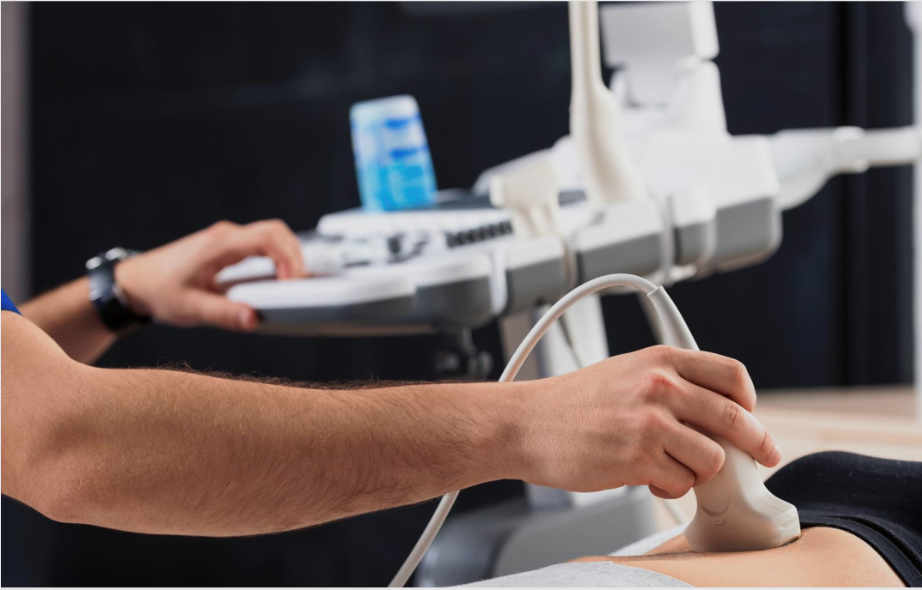
Why Was the PCPNDT Act Enacted?
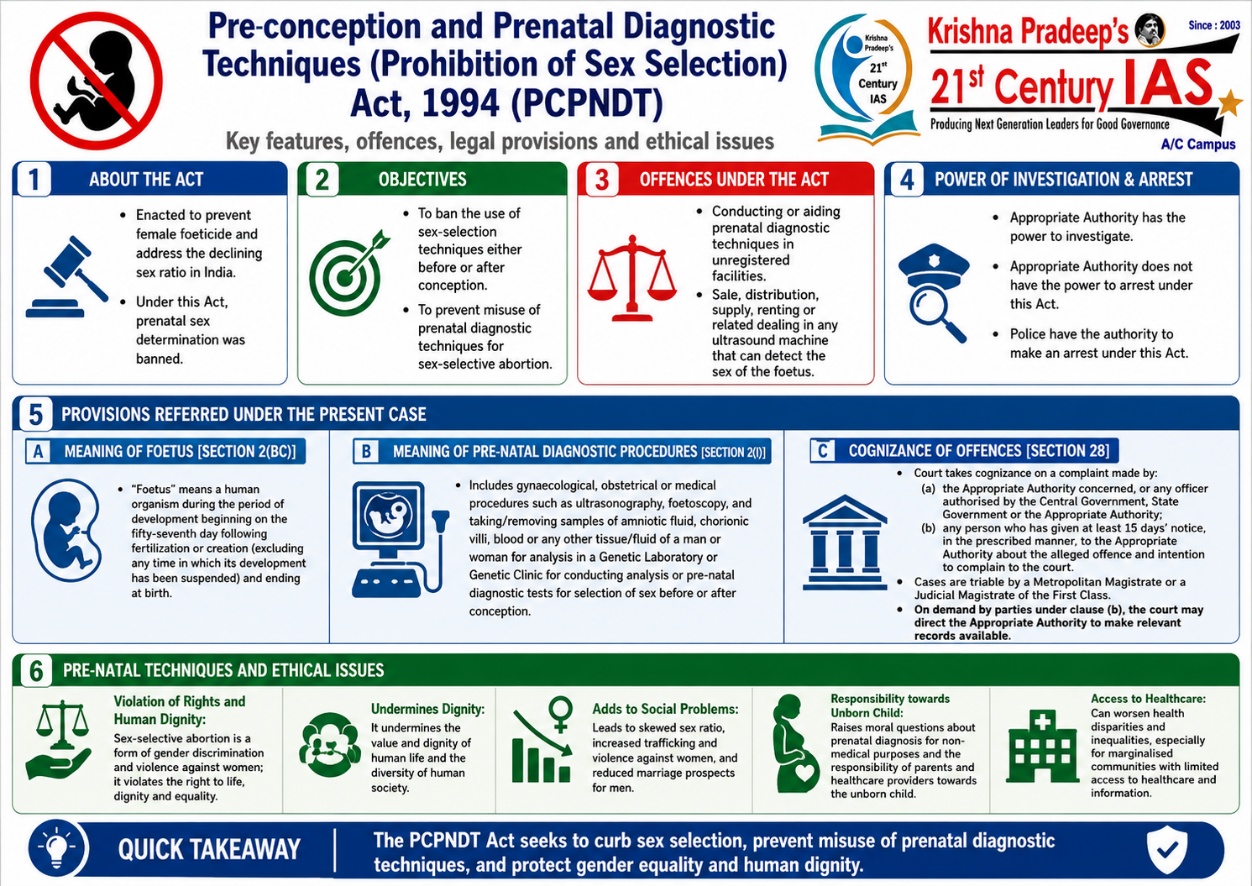
- The PCPNDT Act was introduced in 1994 amid a sharp decline in India’s child sex ratio.
- The growing availability of ultrasonography from the 1980s enabled prenatal sex determination, which was followed in some cases by sex-selective abortion of female foetuses.
The legislation sought to:
- Prevent misuse of diagnostic technology
- Prohibit prenatal sex determination
- Stop disclosure of the sex of the foetus
- Address gender discrimination and son preference
- Regulate genetic clinics, laboratories and ultrasound centres
Thus, the law combines medical regulation with the wider objective of protecting the girl child.
What are its Major Provisions?
Mandatory Registration
- All genetic clinics, ultrasound centres and laboratories must be registered with the district authorities.
Regulation of Machines
- A clinic must obtain registration before purchasing an ultrasound machine.
Manufacturers and dealers must:
- Verify the buyer’s registration
- Obtain an undertaking against sex determination
- Match invoices with the registered centre
- Report the transaction to authorities
Location Restriction
- Once installed, the machine must remain at the approved location. Moving it outside the registered facility can attract serious legal penalties.
Record-Keeping
- Registered centres must maintain detailed records for every ultrasound examination.
Prohibition on Sex Disclosure
- Communication or disclosure of the sex of the foetus is strictly prohibited.
What Has Been the Impact of the Law?
Improvement in Sex Ratio
- India’s sex ratio at birth has gradually improved after the law’s introduction. However, this improvement cannot be conclusively attributed to the PCPNDT Act alone.
Continuing Illegal Practices
Sex-selective practices have not disappeared. Illegal networks continue to operate outside formal healthcare systems using:
- Portable ultrasound devices
- Informal providers
- Covert arrangements
- Unregistered locations
The discovery of an illegal prenatal sex-determination network in Karnataka in 2025 highlighted the persistence of such practices.
Unintended Social Consequences
Evidence cited in the article suggests that restricting prenatal sex selection did not automatically remove son preference.
Some families with a firstborn girl:
- Had additional children in the hope of having a son
- Reduced investment in girls’ health and education
- Experienced higher mortality among firstborn girls
- Faced greater dilution of household resources
These effects were reportedly stronger among poorer rural households unable to access illegal sex-selection services.
The experience shows that legal prohibition alone cannot eliminate deeply rooted gender discrimination.
Why is the Existing Framework Being Questioned?
Uniform Treatment of Different Technologies
- The law regulates ultrasound machines largely as a single category, even though modern probes have different technical capabilities and medical uses.
Restrictions on Portability
- Portable devices cannot ordinarily be taken into communities because ultrasound machines must remain at their registered locations.
Chilling Effect on Healthcare
- Fear of prosecution and extensive compliance requirements may discourage doctors and institutions from offering ultrasound-based services in underserved areas.
Technological Change
- The law was framed when ultrasound machines were large, facility-based systems. Today, handheld devices can connect to smartphones or tablets and be used close to a patient’s home.
- The regulatory framework has not fully adapted to this technological shift.
How Can Portable Ultrasound Improve Cancer Care?
Patients in rural areas often face:
- Long travel distances
- Limited access to specialists
- High travel costs
- Lack of family support
- Delayed diagnosis and treatment
Portable ultrasound can bring services such as:
- Breast imaging
- Assessment of superficial lumps
- Ultrasound-guided biopsies
- Early referral of suspicious cases
closer to the community.
- This is particularly relevant in India, where nearly 70% of the population lives in rural areas and specialist radiologists and imaging facilities are unevenly distributed.
- Early diagnosis can prevent patients with treatable breast lumps from reaching hospitals only after the disease has advanced.
Why are High-Frequency Linear Probes Important?
High-frequency linear probes are commonly used to examine superficial body structures such as:
- Breast tissue
- Thyroid
- Muscles
- Tendons
- Soft-tissue swellings
The article argues that such probes cannot be used for foetal sex determination but remain subject to the same restrictions as conventional ultrasound equipment.
Allowing their controlled community use could therefore improve cancer diagnosis without undermining the central objective of the PCPNDT Act.
What Role Can Artificial Intelligence Play?
AI-enabled ultrasound systems can assist with:
- Image acquisition
- Identification of suspicious lesions
- Pattern recognition
- Automated interpretation
- Generation of preliminary reports
- Referral decisions
A pilot study cited in the article combined portable ultrasound scans performed by minimally trained individuals with AI analysis. The system reportedly identified suspicious breast lesions with high accuracy and flagged all confirmed cancer cases.
Potential Role of Frontline Workers
With suitable training and safeguards, frontline health workers could:
- Scan patients presenting with breast lumps
- Identify cases requiring urgent referral
- Reassure patients with apparently benign findings
- Reduce delays in reaching specialist facilities
AI can help address shortages of trained radiologists, but it should assist rather than replace qualified medical decision-making.
What Reforms Have Been Suggested?
Distinguish Between Use Cases
The law should differentiate between:
- Obstetric ultrasound capable of foetal imaging
- Superficial diagnostic ultrasound used for cancer and other conditions
Permit Community-Based Screening
Community use of approved high-frequency linear probes could be legalised under controlled conditions.
Regulate by Capability
Regulation should be based on what a device can technically do rather than treating every ultrasound machine identically.
Recognise AI-Enabled Systems
The Act should address emerging systems that:
- Restrict foetal imaging
- Prevent sex determination or disclosure
- Generate purpose-specific reports
- Maintain secure digital audit trails
Create Purpose-Specific Registration
Separate registration may be introduced for devices used exclusively for community-based cancer diagnosis.
What Safeguards are Necessary?
Reform should not weaken protection against sex-selective practices.
Necessary safeguards include:
- Certification of approved probes and devices
- Geofencing of portable equipment
- Secure digital registration of every scan
- Restricted software configurations
- Prohibition of obstetric imaging in community devices
- Regular audits and inspections
- Operator training and accreditation
- Data privacy protections
- Clear referral protocols
- Strict penalties for unauthorised use
Technology can also enable automatic logging of the operator, location, time and purpose of every scan.
Way Forward
Adopt Risk-Based Regulation
Restrictions should correspond to the actual risk of misuse associated with each device and clinical purpose.
Pilot Community Programmes
Controlled pilots can assess the safety and effectiveness of portable ultrasound for breast-cancer diagnosis.
Strengthen Gender Interventions
Legal regulation must be supported by:
- Girls’ education
- Social-security measures
- Gender-sensitisation campaigns
- Action against dowry and discrimination
- Improved investment in girls’ health
Ensure Human Oversight
AI-generated findings should be reviewed through an appropriate medical referral system.
Consult Stakeholders
Reform should involve radiologists, oncologists, public-health specialists, women’s groups, engineers and legal experts.
Conclusion
The PCPNDT Act remains essential for preventing the misuse of medical technology for prenatal sex determination. However, a law designed around older ultrasound systems should not unintentionally restrict technologies that can improve early cancer diagnosis.
A carefully designed amendment can permit community-based use of high-frequency probes and safeguarded AI systems while retaining strict controls against sex selection. The objective should be to protect both the girl child and women’s access to timely healthcare.
Q. Sex ratio, in a population, is defined as the number of (CISF 2017)
A. females for every thousand males
B. females for every hundred males
C. males for every hundred females
D. males for every ten thousand females
Answer: A
Explanation:
In India, the sex ratio is defined as the number of females per 1,000 males in a population.
It is calculated as: 
Sex ratio is an important demographic indicator used to understand the gender balance in a population. It also reflects the social status of women, access to healthcare, mortality differences, migration patterns and the impact of gender discrimination.
Additional Information:
The international convention often expresses sex ratio as the number of males per 100 females. However, the Census of India expresses it as the number of females per 1,000 males.