India’s Quest for 100% Literacy & Bihar’s Non-Participation in ULLAS Scheme
Table of Contents
Source: Indian Express
Relevance: GS Paper – 2, Education- Government Policies & Interventions
Important Key Concepts for Prelims and Mains:
For Prelims:
- ULLAS Scheme, PLFS Literacy Data, NEP 2020 Adult Education, Literacy Definition 2024, Akshar Anchal Scheme (Bihar)
For Mains:
- Adult literacy challenges • Centre–State coordination • NEP 2020 & Lifelong Learning • Gender gap in literacy • Fund utilisation issues • Policy governance failures • Bihar’s literacy lag • Scheme convergence & cooperative federalism
Why in News?
India aims to achieve 100% literacy by 2030, aligned with NEP 2020 and SDG-4 (Quality Education).
However, the Union Government’s flagship literacy scheme ULLAS (Understanding Lifelong Learning for All in Society) is facing a major roadblock due to Bihar’s refusal to participate, despite the State having one of India’s highest illiteracy burdens.

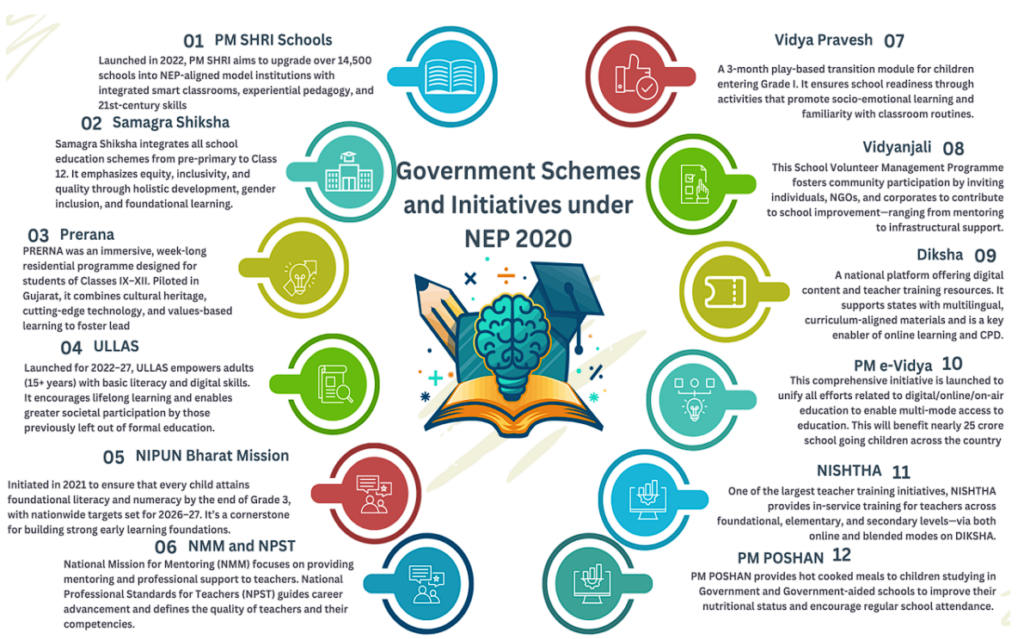

Overview of ULLAS Scheme
- Launched: 2022 by Union Education Ministry
- Target group: Non-literate persons aged 15+ years
Implementation Approach:
- Door-to-door identification of non-literates
- Basic literacy + numeracy up to Class 3 level
- Online/offline learning modules
- Mandatory test → certification
- These individuals must then take a test, and those who clear it are certified as literate
Expanded Definition of Literacy (2024):
- Reading, writing, numeracy
- Digital & financial literacy
- Life skills with comprehension
Benchmark:
- 95% literacy = 100% literacy for certification purposes
Progress Under ULLAS
- Declared Fully Literate (100%):
Himachal Pradesh, Mizoram, Goa, Tripura, Ladakh - Likely Soon: Two southern States + one UT
- Impact Measurement: Expected in upcoming Census
Bihar: The Major Challenge
1. Bihar’s Low Literacy Levels
PLFS 2023–24
- Overall: 74.3% (2nd lowest after Andhra Pradesh – 72.6%)
- Male literacy: 82.3%
- Female literacy: 66.1%
- Non-literates (15–59 age group): ~2 crore, incl. 1.32 crore women
- Historical: Census 2011 → literacy 61.8% (lowest in India)
2. Administrative & Financial Issues
Funds sanctioned (2023–24): ₹35 crore
- Centre: ₹21 cr
- State: ₹14 cr
Issues flagged by Centre:
- Funds not transferred to Single Nodal Agency (SNA)
- No annual plan submitted
- Zero utilisation of funds
- 7% interest penalty on delayed transfer
Union Education Minister wrote twice urging immediate action.
Bihar’s Argument – Akshar Anchal Scheme
- State-run adult literacy programme operational for 15 years
- Focus groups: Dalits, Mahadalits, minorities, EBCs, Women (15–45 years)
- Features:
- Basic literacy + numeracy
- Bi-annual literacy tests for women
- Claim:
- Higher financial outlay than ULLAS
- Existing system adequate
- ULLAS is redundant
Challenges in Achieving 100% Literacy
- Centre–State Coordination Deficit
Bihar’s non-participation slows progress towards national target. - Duplication vs. Convergence of Schemes
Need to integrate Akshar Anchal with ULLAS to avoid parallel systems. - Gender Gap in Literacy
Bihar’s low female literacy is a major barrier. - Underutilisation of Central Funds
Suggested: performance-based incentives. - Political & Administrative Inertia
Cooperative federalism needed in education governance. - Monitoring & Learning Gaps
Require: - Digital learning systems
- Community-based models
- Third-party evaluations
Way Forward
- Improve Centre–State collaboration, especially with low-literacy states.
- Align Akshar Anchal with ULLAS standards for national uniformity.
- Focus on female literacy as a key social multiplier.
- Mandatory utilisation and auditing of literacy funds.
- Strengthen monitoring through community volunteers, digital apps, and independent assessments.
Conclusion
Achieving 100% literacy by 2030 depends critically on mobilising states with high illiteracy, especially Bihar. ULLAS reflects NEP 2020’s vision of lifelong learning, but real success requires political will, fiscal accountability, and cooperative federalism.
Literacy must be treated not as a statistic but as a social transformation tool.
UPSC PYQ
Q. Which one of the following statements is NOT correct regarding the National Education Policy 2020 in India? (UPSC ESE 2021)
- It proposes sweeping changes in the education system from pre-primary to PhD and skill development
- It states that universities from among top 100 in the world will be able to set up campuses in India
- It expects that India will achieve 60% GER by 2030
- It suggests NAAC to be merged with UGC and AICTE
Answer: C
CARE MCQ
Under the ULLAS (Understanding Lifelong Learning for All in Society) scheme, achieving which literacy benchmark is treated as equivalent to 100% literacy?
(a) 90% literacy
(b) 92% literacy
(c) 95% literacy
(d) 98% literacy
Answer: (c)
Explanation:
- The Union Education Ministry (Aug 2024 guidelines) notified that 95% literacy shall be considered equivalent to 100% literacy for declaring a State/UT as “fully literate.”
- Literacy under ULLAS includes reading, writing, numeracy with comprehension, plus digital, financial, and life-skills literacy.
- States like Himachal Pradesh, Mizoram, Goa, Tripura, and Ladakh have already declared themselves fully literate following this benchmark.