How to Prepare Polity for APPSC Group 1 Exam 2026: Syllabus, Strategy, Important Topics and Best Course
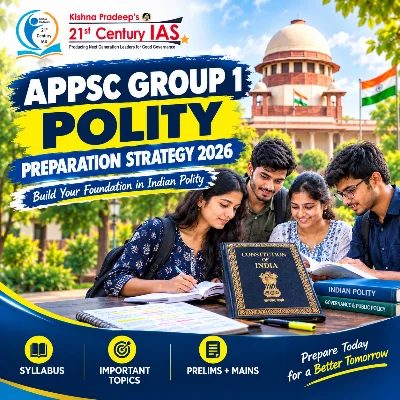
Wondering how to prepare Polity for APPSC Group 1? Indian Polity is one of the highest-scoring subjects in the APPSC Group 1 exam 2026, because the APPSC Group 1 Polity syllabus is fixed, the sources are stable and the same topics are tested in both Prelims and Mains. In this complete APPSC Group 1 Polity preparation strategy, you will get the official Prelims and Mains syllabus, a step-by-step study plan, the most important topics, Mains answer-writing tips and the best APPSC Group 1 Polity course to finish the subject with confidence.
1. Why Polity Matters in APPSC Group 1 Exam
Polity rewards systematic study more than almost any other subject in the APPSC Group 1 syllabus. Questions come straight from constitutional Articles, amendments and landmark judgments, so accurate facts turn directly into marks. You can read the full APPSC Group 1 Syllabus 2026 to see where Polity fits in the overall exam.
- Static and predictable: the core of the Indian Constitution changes slowly, so your Indian Polity for APPSC preparation does not go out of date.
- Useful in both stages: APPSC Group 1 Prelims tests facts and provisions; APPSC Group 1 Mains tests analysis of the same topics.
- Linked to current affairs: Governor disputes, Centre–State finance, local body elections and Supreme Court rulings make news every year.
- Helps other papers: governance, ethics and essay answers all draw on constitutional values.
2. APPSC Group 1 Prelims Polity Syllabus
In the APPSC Group 1 Prelims syllabus, Polity appears as Section B (Constitution, Polity) of General Studies. See the complete APPSC Group 1 Prelims Syllabus for all sections.
| No. | Topic | What it covers |
| 10 | Indian Constitution | Evolution, features, Preamble, Fundamental Rights, Fundamental Duties, Directive Principles of State Policy, Amendments, Significant Provisions and Basic Structure |
| 11 | Union and States, Parliament and State Legislatures | Structure, function, power and privileges; issues in the federal structure; devolution of power and finances up to local levels and challenges therein |
| 12 | Constitutional Authorities | Powers, functions and responsibilities |
| 13 | Panchayati Raj | Local self-government in rural areas |
3. APPSC Group 1 Mains Polity Syllabus
The APPSC Group 1 Mains Polity syllabus (Indian Polity and Constitution) has eight topics and expects analysis, not just recall. Check the full APPSC Group 1 Mains Syllabus and Exam Pattern for paper-wise details.
- Indian Constitution and its salient features.
- Functions and duties of the Indian Union asnd the State Governments.
- Issues and challenges pertaining to the Federal structure — Role of Governor in States.
- Distribution of powers between the Union and States (Union List, State List and Concurrent List) — Issues and challenges.
- Rural and Urban Local Governance under the 73rd and 74th Constitutional Amendments.
- Constitutional Authorities and their Role.
- Parliament and State Legislatures — structure, functioning, conduct of business, powers & privileges and issues arising out of these.
- Judiciary in India — Structure and functions, important provisions relating to emergency and constitutional amendments, judicial review, Public Interest Litigation.
4. APPSC Group 1 Polity: Prelims and Mains Overlap
Nearly every APPSC Group 1 Prelims Polity topic reappears in APPSC Group 1 Mains Polity, so one integrated preparation covers both stages.
| Theme | Prelims (topic no.) | Mains (topic no.) | Prelims asks | Mains asks |
| Constitution and its features | 10 | 1 | Articles, Preamble, FRs, DPSPs, Basic Structure | Salient features, critical analysis |
| Union and States | 11 | 2, 3, 4 | Structure, powers, lists | Federal issues, Governor’s role, Centre–State disputes |
| Parliament and State Legislatures | 11 | 7 | Structure, privileges, procedures | Conduct of business, issues, reforms |
| Constitutional Authorities | 12 | 6 | Appointment, removal, powers | Role and effectiveness |
| Local Governance | 11, 13 | 5 | Panchayati Raj provisions, devolution | 73rd and 74th Amendments, challenges |
| Judiciary | 10 (Amendments, Basic Structure) | 8 | Key judgments, writs | Judicial review, PIL, emergency provisions |
5. Step-by-Step APPSC Group 1 Polity Preparation Strategy
Follow these six steps in order; together they form a complete APPSC Group 1 preparation strategy for Polity.
- Read the syllabus closely. Keep the APPSC Group 1 Polity syllabus in front of you and map every chapter you study to a syllabus line.
- Build the base from one standard book. Use one comprehensive Indian Polity textbook and read it fully once before adding other sources.
- Read the Bare Constitution alongside. Check key Articles (Parts III, IV, IVA, V, VI, IX, IXA, XVIII and XX) in the original text to sharpen Prelims accuracy.
- Make short APPSC Group 1 Polity notes. One page per topic: Articles, amendments, key cases and current issues. These become your revision sheets.
- Link with current affairs. Track Governor–State disputes, Finance Commission reports, local body elections and Supreme Court rulings through Daily Current Affairs and APPSC CARE Articles.
- Practise and revise. Solve APPSC Group 1 Previous Year Question Papers and APPSC Topic-Wise Prelims Practice, write timed Mains answers, and revise your notes at least three times before the exam.
Preparing on your own? Follow our 150-Day Guide to APPSC Group 1 Preparation from Home for a full timetable across all subjects.
6. APPSC Group 1 Polity Important Topics
These APPSC Group 1 Polity important topics deserve priority in both Prelims and Mains.
Indian Constitution
- Making of the Constitution: Constituent Assembly, committees, sources.
- Preamble: key words and their meaning, the 42nd Amendment.
- Fundamental Rights (Articles 12–35), writs, and reasonable restrictions.
- DPSPs and their relationship with Fundamental Rights.
- Fundamental Duties (Article 51A).
- Amendment procedure (Article 368) and the Basic Structure doctrine from Kesavananda Bharati onwards.
Union, States and Federalism
- President, Vice-President, Prime Minister and Council of Ministers; Governor, Chief Minister and State Council of Ministers.
- Seventh Schedule: Union, State and Concurrent Lists; residuary powers.
- Centre–State legislative, administrative and financial relations; Finance Commission; GST Council.
- Role of the Governor: discretionary powers, assent to Bills, President’s Rule (Article 356), and the Sarkaria and Punchhi Commissions.
Parliament and State Legislatures
- Composition, sessions, Speaker and Chairman, types of Bills, Money Bill, joint sitting.
- Parliamentary committees, privileges, anti-defection law (Tenth Schedule).
- Legislative Councils and their creation or abolition.
Constitutional Authorities
- Election Commission, CAG, UPSC and State PSCs, Finance Commission, Attorney General and Advocate General, National Commissions for SCs, STs and BCs.
- For each: Article, appointment, tenure, removal, powers and current issues.
Local Governance (Panchayati Raj and Urban Local Bodies)
- 73rd Amendment: Part IX, Eleventh Schedule, Gram Sabha, reservation, State Election and Finance Commissions.
- 74th Amendment: Part IXA, Twelfth Schedule, municipalities and metropolitan planning.
- Challenges: funds, functions and functionaries; Andhra Pradesh’s local governance experience.
Judiciary
- Supreme Court and High Courts: appointment, collegium, jurisdiction.
- Judicial review, judicial activism, PIL and its misuse.
- Emergency provisions (Articles 352, 356, 360) and the 44th Amendment safeguards.
7. Best Books and Study Material for APPSC Group 1 Polity
Keep your APPSC Group 1 Polity study material short and focused: one standard source, revised many times, beats many sources read once.
- One standard Indian Polity textbook for concepts and Articles.
- The Bare Constitution of India for exact wording of key provisions.
- Current affairs: the AP Current Affairs Monthly Magazine for state and national developments.
- Practice: the APPSC Prelims Practice Magazine for MCQs.
- Structured notes: APPSC Group 1 Study Material from KP IAS Academy, written to the APPSC syllabus.
8. APPSC Group 1 Mains Polity Answer Writing Tips
In APPSC Group 1 Mains, structure and evidence earn marks more than length.
- Introduction: start with the relevant Article, a definition or a recent event.
- Body: use subheadings or points; cite Articles, amendments, Supreme Court cases and committee reports.
- Both sides: for “issues and challenges” questions, give the provision, the problem and the way forward.
- Conclusion: end with a balanced suggestion rooted in constitutional values.
- Add a diagram where it helps: a flowchart of the amendment process or a table of the three Lists saves words.
- Practise daily: write answers under time limits with Nitya Sadhana Mains Practice and get them evaluated.
- Learn from toppers: study presentation and structure in our Toppers’ Copies.
- Andhra Pradesh angle: add state examples such as local body devolution or Centre–State finance issues affecting AP.
9. Common Mistakes in APPSC Group 1 Polity Preparation
- Reading many books instead of revising one standard source several times.
- Memorising Article numbers without understanding what each provision does.
- Ignoring the Bare Constitution and current affairs.
- Preparing APPSC Group 1 Prelims and Mains Polity separately instead of together.
- Skipping answer-writing practice until after Prelims.
- Not taking a full-length APPSC Group 1 test series under exam conditions.
10. Best APPSC Group 1 Polity Course: KP IAS Academy
Looking for the best APPSC Group 1 Polity course or APPSC Group 1 online coaching? The APPSC Group 1 Polity Complete Course by KP IAS Academy covers the complete Prelims and Mains syllabus in one integrated programme.
One structured course takes you from the basics to exam-ready answers, so you spend your time studying, not searching for material. Learn why aspirants choose us in Best APPSC Group 1 Coaching and see our Results.
Enroll now in the APPSC Group 1 Polity Complete Course for ₹4,999
| What you get | Details |
| Classes | 120 hours covering Prelims + Mains |
| Study material | Complete Polity material mapped to the APPSC syllabus |
| Mains practice | 100 Mains answer-writing practice questions |
| Prelims test series | Full-length Prelims test series, free (worth ₹2,499) |
| Course fee | ₹4,999 only |
11. FAQs on APPSC Group 1 Polity Preparation
How to prepare Polity for APPSC Group 1?
Start with the official syllabus, study one standard Indian Polity book with the Bare Constitution, make topic-wise notes, link them with current affairs, and practise MCQs and Mains answers regularly.
How long does it take to complete APPSC Group 1 Polity?
With focused study, most aspirants complete the syllabus in 2–3 months, followed by regular revision and test practice.
Is one book enough for APPSC Group 1 Polity?
One standard Polity textbook, the Bare Constitution and current affairs notes cover most of the syllabus.
Should I prepare APPSC Group 1 Prelims and Mains Polity together?
Yes. The topics overlap heavily, so integrated preparation saves time and builds depth.
How important is current affairs for APPSC Group 1 Polity?
Very. Questions on the Governor’s role, Centre–State relations, local bodies and court judgments often come from recent events.
Which is the best course for APPSC Group 1 Polity?
The KP IAS Academy APPSC Group 1 Polity Complete Course offers 120 hours of classes, complete Polity material, 100 Mains answer practice questions and a free full-length Prelims test series worth ₹2,499, all for ₹4,999.
12. Conclusion
Polity can be your highest-scoring subject in the APPSC Group 1 exam 2026 if you follow the syllabus closely, study from a single strong source, connect topics with current affairs and practise consistently. Start early, revise often, and let the APPSC Group 1 Polity Complete Course from KP IAS Academy guide you to the final list. For more guidance, explore our APPSC exam resources or contact us.