Why in News?
India’s electric vehicle ecosystem is expanding rapidly, with EV sales rising nearly 46 times since 2016. According to the PIB report, EV sales increased from around 50,000 units in 2016 to about 23 lakh units in 2025, while EV exports rose from USD 1.2 million in 2020 to USD 84 million in 2024. This reflects India’s growing shift towards clean mobility, energy security and domestic EV manufacturing.
What is an Electric Vehicle?
An Electric Vehicle is a vehicle powered by an electric motor using energy stored in a battery. The battery can be recharged through an external power source.
EVs are important because they reduce dependence on fossil fuels, lower vehicular emissions and support India’s transition towards a cleaner transport system.
Types of Electric Vehicles
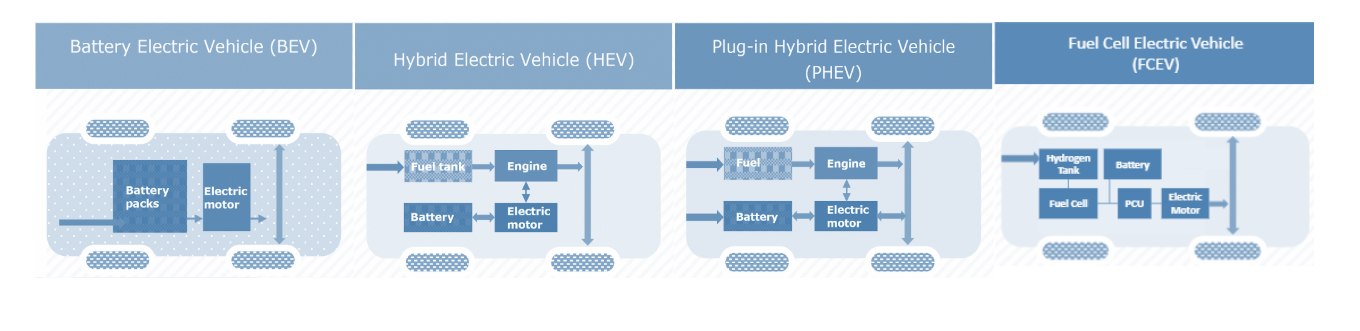
Type of EV | Meaning |
Battery Electric Vehicle | Fully electric vehicle powered only by battery |
Hybrid Electric Vehicle | Uses both internal combustion engine and electric motor |
Plug-in Hybrid Electric Vehicle | Hybrid vehicle with externally rechargeable battery |
Fuel Cell Electric Vehicle | Produces electricity from chemical energy, usually hydrogen |
India’s EV Growth in the Last Decade
India’s EV transition began gaining momentum after the launch of the National Electric Mobility Mission Plan and FAME India Scheme in 2015.
Key Growth Indicators
Indicator | Status |
EV sales in 2016 | Around 50,000 units |
EV sales in 2025 | Around 23 lakh units |
Growth since 2016 | Nearly 46 times |
EV adoption FY 2015–16 | 0.08% |
EV adoption FY 2025–26 | 8.26% |
EV exports in 2020 | USD 1.2 million |
EV exports in 2024 | USD 84 million |
This growth has been driven by policy incentives, improved vehicle availability, rising environmental awareness and increasing consumer confidence.
Why EVs are the Smart Choice
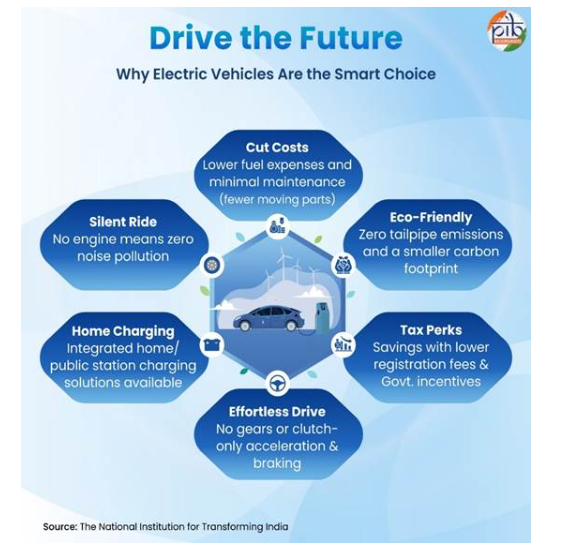
1. Lower Running Cost
EVs reduce fuel expenses and have fewer moving parts, resulting in lower maintenance costs.
2. Eco-Friendly Mobility
EVs have zero tailpipe emissions and a smaller carbon footprint compared to conventional vehicles.
3. Silent Ride
EVs reduce engine noise and help lower urban noise pollution.
4. Convenient Charging
Charging options are expanding through home charging and public charging stations.
5. Tax and Policy Benefits
Lower registration fees, tax incentives and government schemes make EVs financially attractive.
6. Easy Driving Experience
EVs do not require gear or clutch operation, making driving smoother and easier.
Policy Engine Behind India’s EV Growth
India’s EV growth has been supported by a combination of demand incentives, manufacturing incentives, battery localisation and charging infrastructure expansion.
Major Policy Interventions
- National Mission on Manufacturing, 2025
- PM E-DRIVE Scheme, 2024
- PM e-Bus Sewa Payment Security Mechanism Scheme, 2024
- Scheme for Promotion of Manufacturing of Electric Passenger Cars in India, 2024
- PLI Scheme for Automobile and Auto Components Industry, 2021
- PLI Scheme for Advanced Chemistry Cell Battery Storage, 2021
Major Government Schemes
1. National Electric Mobility Mission Plan
The NEMMP 2020 provided a roadmap for faster adoption and domestic manufacturing of EVs. It aimed to improve energy security and promote clean mobility.
2. FAME India Scheme
The FAME India Scheme was launched in 2015 under the NEMMP framework. It supported EV adoption through buyer incentives, charging infrastructure and manufacturing support.
3. PM E-DRIVE Scheme
The PM Electric Drive Revolution in Innovative Vehicle Enhancement Scheme was notified in 2024 by the Ministry of Heavy Industries.
Key Features
- Outlay of ₹10,900 crore
- Covers e-two-wheelers, e-three-wheelers, e-trucks, e-buses and e-ambulances
- Supports domestic manufacturing through the Phased Manufacturing Programme
- Provides incentives to reduce purchase cost
- Allocates ₹4,391 crore for e-buses
- Provides ₹2,000 crore for public charging stations
- Allocates ₹780 crore for modernisation of vehicle testing agencies
4. PM e-Bus Sewa Payment Security Mechanism Scheme
This scheme supports deployment of 10,000 electric buses through the Public Private Partnership model. It provides payment security coverage for buses for up to 12 years.
It aims to strengthen urban bus transport, reduce vehicular pollution and improve clean public mobility.
5. PLI Scheme for Automobile and Auto Components
The PLI-Auto Scheme, 2021 promotes domestic manufacturing of advanced automotive technology, including EVs.
It requires a minimum 50% domestic value addition and encourages investment across the automotive value chain.
6. PLI Scheme for Advanced Chemistry Cell Battery Storage
The PLI-ACC Battery Scheme, 2021 has an outlay of ₹18,100 crore and aims to establish 50 GWh of advanced battery manufacturing capacity.
Batteries account for nearly 35–40% of an EV’s total cost. Therefore, domestic battery manufacturing is critical for reducing EV prices and improving energy security.
7. Low GST on EVs
EVs attract a concessional 5% GST, making them more tax-friendly compared to conventional vehicles.
Manufacturing, Startups and Exports
- India is moving from an assembly-led EV market to a broader manufacturing ecosystem.
Domestic production now covers:
- battery packs
- motors
- drivetrains
- power electronics
- wiring systems
- charging equipment
- Major Indian manufacturers such as Tata Motors, Mahindra, TVS and Bajaj Auto are expanding EV capacity. Global players are also exploring manufacturing opportunities in India.
- India has around 400 EV startups, working in areas such as charging infrastructure, battery innovation, low-cost manufacturing and data-driven mobility solutions.
- EV exports have grown from USD 1.2 million in 2020 to USD 84 million in 2024, with destinations including Nepal, Indonesia and Japan.
EV Infrastructure and Charging Network
- Charging infrastructure is essential for wider EV adoption.As of July 2026, India had 52,718 public charging stations, of which 16,561 were equipped with fast charging facilities.
- Tools such as e-Amrit help users locate charging stations. Industry players are also expanding fast-charging networks across cities and highways.
India Electric Mobility Index
The India Electric Mobility Index was launched by NITI Aayog in August 2025.
It tracks the progress of States and Union Territories in electric mobility across three pillars:
- transport electrification
- charging infrastructure readiness
- EV research and innovation
Regions are classified as:
- Frontrunners
- Performers
- Aspirants
Delhi, Maharashtra and Chandigarh emerged as frontrunners due to their stronger EV ecosystems.
India’s EV and Climate Vision
India’s EV policy is linked with its wider climate commitments.
Key Climate Goals
Goal | Target |
EV penetration | 30% by 2030 |
Emission reduction | Cut 1 billion tonnes of projected carbon emissions by 2030 |
Carbon intensity | Reduce by 45% by 2030 |
Net-zero target | Achieve net-zero by 2070 |
Transport accounts for around 9% of India’s total emissions. Therefore, EVs are important for reducing oil dependence, improving air quality and supporting a low-carbon economy.
Challenges in India’s EV Transition
1. Charging Infrastructure Gap
Although charging stations are increasing, range anxiety remains a concern in many regions.
2. Battery Dependence
India still depends on imports for key battery minerals and components, especially lithium, cobalt and nickel.
3. High Upfront Cost
EVs have lower running costs, but initial purchase cost remains a barrier for many consumers.
4. Grid Readiness
Large-scale EV charging requires reliable electricity supply and smart grid management.
5. Recycling and Battery Waste
Battery recycling systems must be strengthened to manage end-of-life batteries sustainably.
6. Uneven State-Level Progress
Some States have mature EV ecosystems, while others need stronger policy support and infrastructure.
Way Forward
1. Expand Charging Infrastructure
India must build reliable public charging networks across cities, highways and rural growth centres.
2. Localise Battery Manufacturing
Domestic production of battery cells, components and critical minerals must be strengthened.
3. Strengthen Public Transport Electrification
E-buses, e-rickshaws and last-mile EVs can reduce pollution and improve urban mobility.
4. Improve Affordability
Financial incentives, low-interest loans and battery leasing models can make EVs more accessible.
5. Promote Battery Recycling
India should scale up recycling of lithium-ion batteries and adopt circular economy principles.
6. Support EV Startups
Startups working in charging, battery technology, software and mobility solutions should receive regulatory and financial support.
7. Improve State-Level Coordination
States should align EV policies with land, power, transport, urban planning and industrial policy.
Conclusion
India’s EV transition is no longer limited to environmental policy; it has become a major pillar of energy security, industrial transformation and climate action. Rising EV sales, expanding charging infrastructure, domestic manufacturing, startup innovation and policy support show that India is entering a decisive phase of clean mobility. However, the next stage will depend on battery localisation, mineral security, grid readiness, affordable financing and recycling systems. If implemented effectively, India can become not only a large EV market but also a global hub for electric mobility manufacturing, exports and green industrial growth.