Why in News?
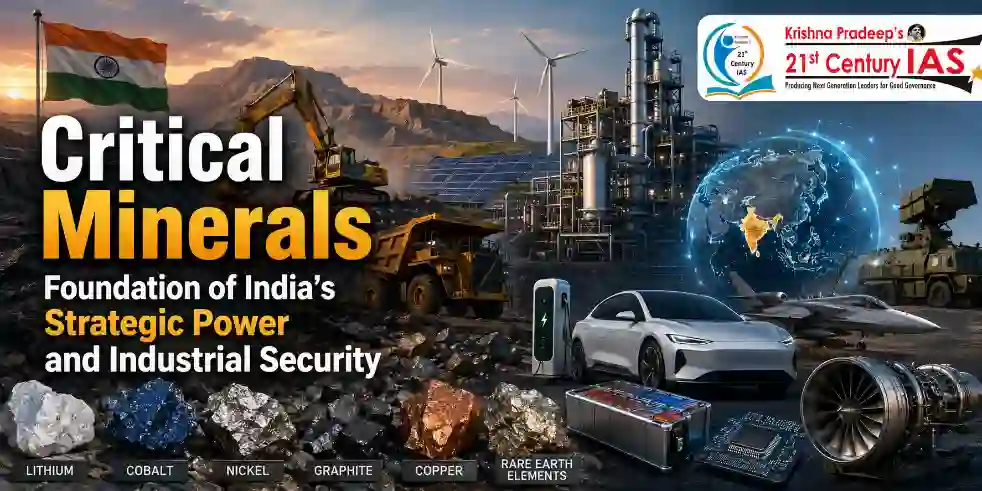
Critical minerals have moved from being a resource policy issue to becoming a major question of industrial strategy, energy security and national security. Minerals such as lithium, cobalt, nickel, graphite, copper and rare earth elements are essential for electric vehicles, battery storage, renewable energy, semiconductors, defence systems and advanced manufacturing.As decarbonisation and digitalisation expand, mineral security is becoming as important as oil security was in the 20th century. India is therefore strengthening its domestic exploration, overseas acquisition, processing capacity, recycling and international partnerships.
What are Critical Minerals?
Critical minerals are non-fuel metallic or non-metallic minerals that are essential for modern technologies but face high supply risks.
They are called critical because any disruption in their supply can affect:
- clean energy transition
- electric mobility
- semiconductor manufacturing
- defence production
- renewable energy storage
- artificial intelligence and advanced electronics
- industrial competitiveness
- national security
There is no single global definition of critical minerals. Each country identifies them based on its own economic needs, supply risks and strategic priorities.
India has identified 30 critical minerals, including lithium, cobalt, nickel, graphite, copper and rare earth elements.
Why Critical Minerals are Strategically Important?
1. Foundation of Clean Energy Transition
Critical minerals are central to India’s clean energy goals.
- Lithium, cobalt and nickel: used in lithium-ion batteries
- Copper: used in power systems, transmission and electric vehicles
- Graphite: used in battery anodes
- Rare earth elements: used in permanent magnets for wind turbines and electric motors
- Silicon, tellurium, indium and gallium: used in solar photovoltaic cells
As India expands solar power, wind energy, battery storage and electric mobility, demand for these minerals will rise sharply.
2. Essential for Advanced Manufacturing
Critical minerals are inputs for:
- semiconductors
- artificial intelligence hardware
- advanced electronics
- telecommunications
- aerospace systems
- precision manufacturing
Thus, critical mineral availability directly affects India’s ambitions in Make in India, semiconductor manufacturing and advanced industrialisation.
3. Defence and National Security Importance
Defence systems require high-purity minerals and rare earth magnets for:
- missiles
- jet engines
- radar systems
- drones
- satellites
- AI-enabled military hardware
Therefore, critical mineral dependence can create strategic vulnerability.
4. Link with Sustainable Development Goals
Critical minerals support:
- SDG 7: Affordable and Clean Energy
- SDG 9: Industry, Innovation and Infrastructure
- SDG 13: Climate Action
However, mineral extraction must be sustainable, as mining can affect water, biodiversity, labour rights and local communities.
Global Supply Chain Concentration
- The global supply of critical minerals is highly concentrated.
- For copper, lithium, nickel, cobalt, graphite and rare earth elements, the average market share of the top three refining countries increased from around 82% in 2020 to 86% in 2024.
- China dominates global processing. It is the leading refiner in 19 out of 20 strategic minerals, with an average market share of about 70%.
China’s Processing Dominance
Mineral / Product | China’s Approximate Processing Share |
Rare earths | Over 90% |
Graphite | Over 90% |
Cobalt | Nearly 75% |
Lithium chemicals | Around 70% |
This makes critical minerals not merely commercial commodities, but tools of geopolitical influence.
Geopolitical Risks in Critical Minerals
1. Export Controls and Supply Weaponisation
China’s rare earth export controls announced in 2025 created concerns across energy, automotive, defence, aerospace, artificial intelligence and semiconductor sectors.
This shows how mineral supply chains can be used as geopolitical instruments.
2. Future Supply Shortfalls
Global clean energy transitions will require minerals beyond current production levels.
- The copper project pipeline indicates a possible 30% supply shortfall by 2035.
- Lithium may remain better supplied in the near term, but rising demand could push it into deficit by the 2030s.
- Rare earth demand will rise with wind power, electronics and magnets.
3. Friendshoring and Strategic Alliances
Major economies are trying to reduce dependence on concentrated suppliers.
- The European Union Critical Raw Materials Act sets 2030 targets of:
- 10% domestic extraction
- 40% processing
- 25% recycling
- not more than 65% dependence on a single country
- The United States is building diversified supply chains through strategic partnerships.
- Countries are adopting China+1 and trusted-partner strategies.
India’s Critical Mineral Demand and Domestic Potential
- India’s clean energy and manufacturing ambitions are highly mineral intensive.
- Under a net zero scenario, India’s cumulative demand for critical energy transition minerals could reach around 169 million tonnes by 2070, about 51% higher than under a current policy pathway.
Domestic Potential
India has reserves or occurrences of several critical minerals.
Mineral | Domestic Potential / Occurrence |
Cobalt | Around 44.9 million tonnes |
Copper | Around 163.9 million tonnes |
Graphite | Around 211.6 million tonnes |
Nickel | Around 189 million tonnes |
Rare Earth Elements | Monazite deposits and rare earth oxides, especially in coastal and hard-rock regions |
Lithium | Discovered in parts of Karnataka and Jammu & Kashmir |
India also has rare earth potential in States such as Andhra Pradesh, Karnataka, Odisha and Kerala, while monazite sands in Kerala are rich in rare earth elements.
Why Reserves Alone Do Not Ensure Security
India has domestic mineral potential, but reserves have not yet translated into supply security.
Key Gaps
- India remains import dependent for lithium, cobalt and nickel.
- Graphite and rare earth processing remain vulnerable to China-dominated supply chains.
- India lacks adequate high-purity processing and refining capacity.
- Much of the value addition lies in the midstream stage: refining, separation, purification and chemical processing.
Thus, the major challenge is not only mining, but building a complete mine-to-market value chain.
India’s Major Policy Initiatives
1. National Critical Mineral Mission
The National Critical Mineral Mission aims to develop the full critical mineral value chain.
It focuses on:
- exploration
- mining
- processing
- recycling
- research and development
- human resource development
- strategic stockpiling
Major Targets
- 1,200 domestic exploration projects by 2030–31
- production of at least 15 critical minerals
- acquisition of 50 overseas mining assets by Indian companies
- creation of recycling capacity for critical minerals
- promotion of patents and Centres of Excellence
2. Identification of 30 Critical Minerals
India has identified 30 critical minerals to guide policy planning, investment and supply chain security.
3. MMDR Act Amendment, 2023
The Mines and Minerals (Development and Regulation) Act, 1957 was amended in 2023 to empower the Central Government to auction several identified critical minerals. This is expected to improve private participation and domestic production.
4. Overseas Mineral Acquisition through KABIL
Khanij Bidesh India Limited (KABIL) has secured 15,703 hectares in Argentina’s Catamarca province for lithium exploration.
This reflects India’s effort to secure overseas resources in lithium-rich regions.
5. Rare Earth Corridors
The 2026–27 Budget proposed rare earth corridors in:
- Odisha
- Kerala
- Andhra Pradesh
- Tamil Nadu
These corridors can support rare earth processing, value addition and industrial clustering.
6. India–U.S. Critical Minerals Framework
The India–U.S. critical minerals and rare earths framework signed in May 2026 provides a diplomatic lever for building resilient and diversified supply chains.
7. Quad and Trusted Supply Chains
India is also part of wider strategic conversations with partners such as the U.S., Australia and Japan to develop secure and diversified mineral supply chains.
8. PLI Schemes and Manufacturing Linkages
India’s PLI schemes for Advanced Chemistry Cell batteries, solar PV modules, electronics and semiconductors are linked to critical mineral security because these sectors depend heavily on mineral inputs.
Challenges to India’s Critical Mineral Security
1. Heavy Import Dependence
India is highly dependent on imports for lithium, cobalt and nickel. Rare earth magnets and high-purity processed products are also vulnerable to external supply disruptions.
2. Processing and Refining Gap
India’s biggest weakness lies in the midstream stage. It lacks adequate facilities for:
- battery-grade lithium chemicals
- high-purity graphite
- rare earth separation
- advanced smelting
- chemical refining
- high-purity mineral inputs
Without processing capability, domestic reserves alone cannot create strategic autonomy.
3. China’s Midstream Monopoly
China’s dominance in rare earths, graphite, cobalt and lithium processing exposes India to price shocks, export controls and supply disruption.
4. Shallow Exploration
India’s exploration is still relatively shallow. Critical minerals often require advanced methods such as:
- airborne geophysical surveys
- hyperspectral mapping
- geochemical surveys
- AI-based geological modelling
- deep-seated exploration
5. Regulatory and Clearance Delays
Mining projects often face delays due to environmental, forest and land-related approvals.
6. Weak Private Participation
Critical mineral exploration and refining require high-risk, long-term capital. India still lacks a strong ecosystem of junior mining companies and risk-sharing mechanisms.
7. Remote Region Project Economics
Many deposits are located in remote areas with weak logistics, power and water infrastructure, reducing commercial viability.
8. Weak Circular Economy
Recycling of e-waste, lithium-ion batteries, end-of-life vehicles, mine tailings, fly ash and red mud remains limited due to weak collection systems and technology gaps.
9. Absence of Strategic Stockpiles
Unlike strategic petroleum reserves, India does not yet have a comprehensive strategic reserve for critical minerals.
Global Approaches to Critical Mineral Security
Country / Bloc | Approach |
China | Dominates mining, refining, processing and exports; uses minerals as geoeconomic leverage |
United States | De-risks supply chains through alliances, friendshoring and overseas investments |
European Union | Builds strategic autonomy through domestic extraction, processing, recycling and reduced dependence |
Australia | Positions itself as a trusted supplier while expanding downstream processing |
Japan | Uses resource diplomacy, overseas assets, long-term contracts and stockpiles |
India | Moving towards a mine-to-market strategy using exploration, overseas acquisition, processing and partnerships |
Way Forward for India
1. Make Processing a National Priority
India must build refining, separation, purification and chemical processing capacity. Mineral processing parks and targeted incentives can help create value-added supply chains.
2. Strengthen Domestic Exploration
India should expand deep-seated exploration using AI, 3D geological modelling, airborne surveys and advanced geophysical methods.
3. Attract Private Capital
Private investment needs:
- reliable geological data
- predictable approvals
- risk-sharing mechanisms
- faster clearances
- supportive infrastructure
4. Diversify Overseas Supply
India should secure long-term supplies through KABIL and partnerships with countries such as Australia, Argentina, Chile, Namibia and African nations.
5. Create Strategic Mineral Stockpiles
India should establish strategic reserves for minerals essential to batteries, defence, semiconductors and renewable energy.
6. Scale Recycling and Urban Mining
Recycling should be integrated into supply planning. India must strengthen recovery from:
- e-waste
- lithium-ion batteries
- end-of-life vehicles
- mine tailings
- fly ash
- red mud
7. Build Research and Innovation Ecosystem
India needs applied R&D in metallurgy, mineral separation, battery chemistry, rare earth magnets and recycling technologies.
8. Adopt a National Critical Minerals Strategy
A comprehensive strategy should:
- define mineral-specific risk thresholds
- set measurable milestones
- coordinate ministries and industry
- integrate recycling and stockpiling
- monitor global supply risks
- align minerals with energy, defence and industrial policy
Conclusion
Critical minerals will define India’s energy transition, industrial competitiveness and strategic autonomy. India has mineral potential, policy momentum and growing international partnerships, but the real challenge lies in execution. Domestic exploration must be converted into production, and reserves must be converted into high-purity processing capability. India’s future strength will depend not only on owning minerals but on mastering the entire value chain — from mine to market, recycling to refining, and diplomacy to domestic manufacturing.