Why in News?
The Government highlighted India’s progress in improving the ease of living through secure housing, clean cooking fuel, drinking water, sanitation, electricity, financial inclusion, transport infrastructure and digital governance.
The initiatives reflect a shift towards citizen-centric, mission-led and technology-enabled governance, aimed at improving dignity, comfort, connectivity and access to opportunities.
Housing and Basic Amenities
Access to a secure pucca house is essential for dignity, safety and improved quality of life. To expand affordable housing, the government launched PMAY-Urban in 2015 and PMAY-Gramin in 2016. These schemes also promote convergence with toilets, drinking water and electricity.
Pradhan Mantri Awas Yojana–Urban
- Launched: 2015
- Objective: Provide pucca houses to eligible urban households
- Beneficiaries: EWS, LIG and MIG categories across urban India
PMAY-U 2.0
- Launched: 2024
- Provides assistance of up to ₹2.5 lakh
- Assistance is available under the Beneficiary-Led Construction component
- A female family member must be the owner or co-owner
- Promotes women’s property ownership and housing security
Pradhan Mantri Awas Yojana–Gramin
- Launched: 2016
- Objective: Provide pucca houses to eligible rural households
- Assistance in plain areas: ₹1.20 lakh per house
- Assistance in hilly and difficult areas: ₹1.30 lakh per house
Progress, 2016–2026
- Target registered: 3.98 crore houses
- Houses sanctioned: 3.91 crore
- Houses completed: 3.05 crore
- Around 75% of sanctioned houses are owned by women or jointly owned
Convergence with Basic Services
PMAY-G houses are linked with:
- Toilets
- Drinking water
- Electricity connections
This makes the scheme more than a housing programme by integrating it with essential household amenities.
Atal Mission for Rejuvenation and Urban Transformation
- Launched: 2015
- Objective: Address basic service gaps in urban centres
AMRUT Phase I
- Covered 500 cities
- Focus areas:
- Water supply, Sewerage, Green spaces, Urban transport
AMRUT 2.0
- Launched: October 2021
- Coverage expanded to all 4,800 statutory towns
- The allocation was nearly three times higher than the original mission
Universal Access to Essentials
Before 2014, many households lacked clean cooking fuel, safe drinking water and sanitation. Women in rural areas were especially affected by smoke from traditional fuels, the burden of fetching water and inadequate sanitation. PMUY, Jal Jeevan Mission and Swachh Bharat Mission were launched to address these gaps at scale.
Pradhan Mantri Ujjwala Yojana
- Launched: May 2016
- Objective: Provide clean LPG connections to eligible households
- Initial target of 8 crore connections achieved by September 2019
- Ujjwala 2.0, launched in August 2021, targeted one crore additional connections
- Further expansions added 60 lakh, 75 lakh and another 25 lakh approved connections
- Total clean cooking gas connections provided: Over 10.57 crore
LPG Access Expansion
- National LPG coverage increased from 55.9% in April 2014 to 107.2% in April 2026
- LPG consumers increased from 14.51 crore to 33.39 crore
- Rural access improved through expansion of distributorships and bottling infrastructure
- Clean cooking fuel reduced dependence on traditional biomass and improved household dignity
Jal Jeevan Mission
- Launched: 2019
- Goal: Har Ghar Jal through functional rural household tap connections
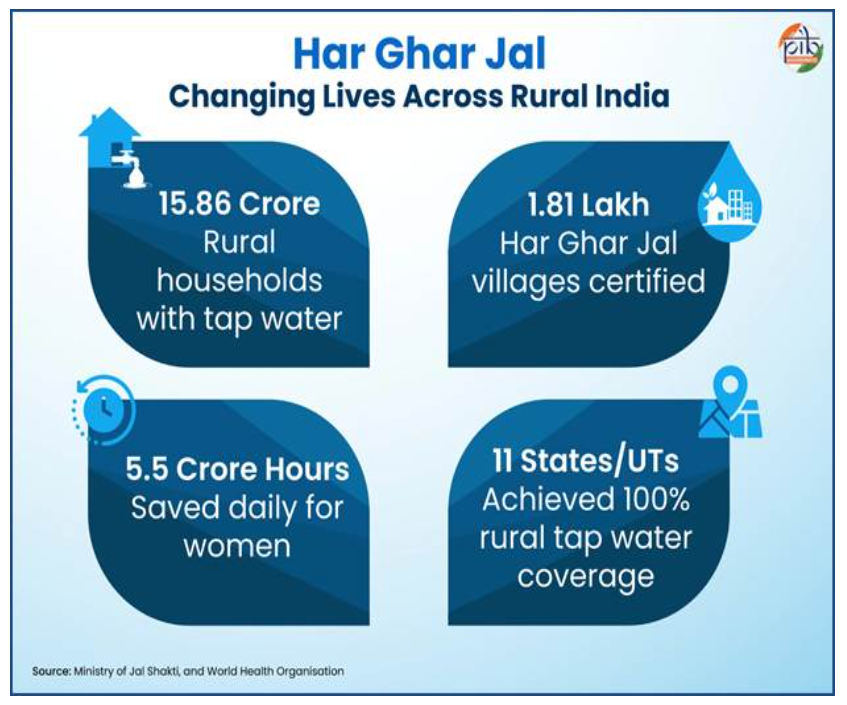
- Rural households with tap water at launch: 3.23 crore, or 16.72%
- Coverage by June 2026: 15.86 crore households, or 81.94%
- New connections added: Around 12 crore
- Investment: ₹2.08 lakh crore
Social Impact
- More than 9 crore women were freed from the burden of fetching water
- Around 1.81 lakh villages were certified as Har Ghar Jal by Gram Sabhas
- 11 States and Union Territories achieved complete rural household coverage
- The mission improved access, health, convenience and water security
JJM 2.0
- Mission extended in March 2026 until December 2028
Swachh Bharat Mission–Gramin
- Launched: 2014
- Objective: Universal rural sanitation and elimination of open defecation
- Rural sanitation coverage increased from 39% in 2014 to 100% in 2019
Progress by June 2026
- More than 12.14 crore household toilets completed
- Around 2.76 lakh community sanitary complexes created
- More than 5.69 lakh villages declared ODF Plus
- 5.34 lakh villages developed solid-waste management arrangements
- 5.55 lakh villages developed liquid-waste management arrangements
Swachh Bharat Mission–Urban
- Launched: 2014
- Objective: Improve urban sanitation, toilet access and waste management
Progress, 2014–2026
- More than 63 lakh household toilets constructed
- Around six lakh community toilets built
- Urban waste processing increased from 16% to 82%
- Door-to-door waste collection increased from 43% to 98%
- Urban Local Bodies in all 35 States and Union Territories declared themselves ODF in October 2019
Power for All: Reliable, Affordable and Clean Energy
Reliable electricity supports household comfort, education, industry and economic activity. Between 2014 and 2026, India expanded power generation, transmission and last-mile electricity access while increasing the share of renewable energy.
Expansion of Installed Power Capacity
- Total installed power capacity increased from 248 GW in FY 2014 to over 532 GW by March 2026
- Renewable sources account for more than half of installed capacity
- India has the third-largest clean-energy capacity in the world
Growth of Energy Sources
| Energy Source | 2014 Capacity | March 2026 Capacity |
| Renewable energy | 76.38 GW | 274.69 GW |
| Solar power | 2.82 GW | 150.26 GW |
| Wind power | 21.04 GW | 56.09 GW |
| Nuclear power | 4.78 GW | 8.78 GW |
| Hydro power | — | 51.4 GW |
| Biomass and other sources | — | 11.74 GW |
- Wind capacity increased 2.66 times
- Nuclear capacity grew by around 84%
- Rapid solar expansion drove the growth of clean-energy capacity
Improved Electricity Availability
- Average rural supply increased from 12.5 hours per day in 2014 to 22.6 hours in 2026
- Urban areas receive up to 23.4 hours of electricity daily
- National energy shortage declined from 4.2% in 2013–14 to 0.03% in 2025–26
- Per capita electricity consumption increased from 957 kWh in 2013–14 to 1,460 kWh in 2024–25
SAUBHAGYA
The Pradhan Mantri Sahaj Bijli Har Ghar Yojana was launched in 2017 to provide free last-mile electricity connections to unelectrified rural and urban households.
Achievements
- Around 2.86 crore households received electricity connections
- Scheme targets were achieved by March 2022
- The programme was closed after completing its intended household-electrification targets
PM Surya Ghar Muft Bijli Yojana
- Launched: February 2024
- Objective: Promote residential rooftop solar installations
- Eligible households can receive up to 300 free electricity units per month
- Central subsidy of up to ₹78,000 is transferred directly to beneficiaries
- More than 40 lakh households installed rooftop solar systems by May 2026
Benefits
- Reduces household electricity bills
- Enables families to generate their own clean electricity
- Allows households to earn by selling surplus power
- Promotes decentralised renewable-energy generation
UJALA
The Unnat Jyoti by Affordable LEDs for All programme promotes affordable and energy-efficient lighting.
Achievements
- Around 37 crore LED bulbs distributed
- Estimated annual household savings: ₹19,153 crore
- Reduced electricity consumption and household power expenses
- Supported energy efficiency and lower peak-power demand
Financial Inclusion and Empowerment
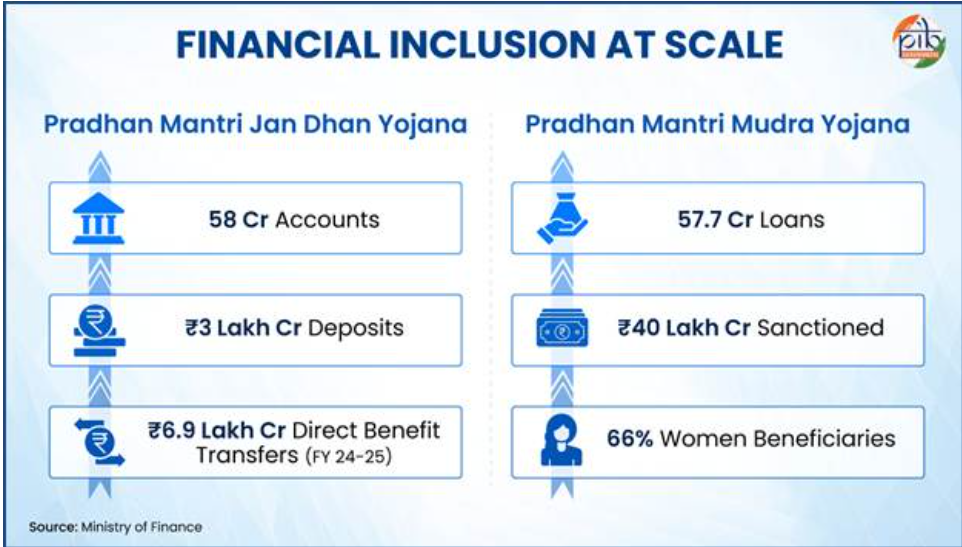
Since 2014, India has developed an interconnected financial ecosystem covering savings, credit, insurance, pensions and welfare delivery. The focus has been on bringing excluded citizens into the formal financial system, reducing dependence on informal lenders and improving economic security.
Pradhan Mantri Jan Dhan Yojana
PMJDY, launched in 2014, expanded universal access to banking and became the foundation of the JAM Trinity—Jan Dhan, Aadhaar and Mobile.
Key Features
- Zero-balance bank accounts
- Direct Benefit Transfer of welfare payments
- RuPay debit cards with accident-insurance cover
- Access to savings, payments and other financial services
- Transparent and leakage-free delivery of government benefits
Significance
PMJDY strengthened financial inclusion, digital payments, welfare efficiency and household financial security. It brought crores of previously unbanked citizens into the formal banking system.
Pradhan Mantri Mudra Yojana
PMMY, launched in 2015, provides collateral-free institutional credit to micro and small enterprises that earlier depended heavily on informal lenders.
Key Features
- Loans for starting and expanding micro-enterprises
- Strong participation of women entrepreneurs
- Significant coverage of SC, ST and OBC beneficiaries
- Tarun Plus supports successful borrowers seeking higher-value loans
- Encourages enterprise growth, self-employment and job creation
Transport and Connectivity
Between 2014 and 2026, India’s transport infrastructure expanded rapidly across highways, rural roads, tunnels, bridges and expressways. The focus shifted towards faster mobility, reduced travel time, regional integration, logistics efficiency and improved access to markets and public services.
Roads and National Highways
- India’s road network reached 63.73 lakh km, becoming the second-largest in the world
- National highways expanded by nearly 61%
- Four-lane and wider highways increased substantially
- 3,644 km of access-controlled high-speed corridors and expressways became operational
- Around 22,590 km of roads were completed under Bharatmala
- Budgetary support for roads and highways increased almost tenfold
Landmark Connectivity Projects
- Z-Morh/Sonamarg Tunnel: Improved access to Ladakh and supported tourism
- Sudarshan Setu: Connected Okha with Beyt Dwarka
- Maitri Setu: Linked Tripura with Bangladesh
- Atal Tunnel: Provided all-weather connectivity between Manali and Lahaul–Spiti
- Dr. Syama Prasad Mukherjee Tunnel: Reduced Jammu–Srinagar travel time
- Dhola–Sadiya Bridge: Strengthened connectivity between Assam and Arunachal Pradesh
- Delhi–Dehradun Economic Corridor: Reduced travel time and included an elevated wildlife corridor
- Ahmedabad–Dholera Expressway: Improved logistics and regional connectivity
- Dwarka Expressway and Urban Extension Road-II: Reduced congestion and improved freight movement in Delhi-NCR
- NH-31 Ganga Bridge: Shortened routes for heavy vehicles in Bihar
Pradhan Mantri Gram Sadak Yojana
PMGSY provides durable, all-weather rural road connectivity and links villages with markets, schools, hospitals and economic opportunities.
Progress
- 99.6% of eligible habitations connected
- Rural roads completed during 2014–26 exceeded the length completed during 2000–14
Significance
- Reduced rural isolation
- Improved access to healthcare and education
- Strengthened agricultural marketing
- Supported rural livelihoods and mobility
- Promoted balanced regional development
Railways: Speed, Safety and Modernisation
Since 2014, Indian Railways has focused on electrification, safety, speed, comfort and capacity expansion.
Electrification and Safety
- Electrification increased from 20% to 99.6%, covering 69,873 route km
- Kavach, India’s indigenous Automatic Train Protection system, helps prevent collisions
- Train accidents declined from 135 in 2014–15 to 16 in 2025–26
- Railway budgetary allocation rose nearly ninefold
Vande Bharat
- Indigenous semi-high-speed train launched in 2019
- 162 services operational by March 2026
- Vande Bharat Sleeper introduced on the Howrah–Guwahati route
Amrit Bharat Trains
- Affordable, non-AC, high-capacity long-distance trains
Amrit Bharat Station Scheme
- Launched in 2023
- Focus on lifts, escalators, waiting halls, toilets and passenger information systems
High-Speed Rail
- Mumbai–Ahmedabad Bullet Train corridor under construction
- Length: 508 km
- Designed speed: 320 kmph
- Seven additional high-speed corridors proposed
High-Speed rail. These routes include:
- Mumbai–Pune
- Pune–Hyderabad
- Hyderabad–Bengaluru
- Hyderabad–Chennai
- Chennai–Bengaluru
- Delhi–Varanasi
- Varanasi–Siliguri
These announcements highlight the strategic role of high‑speed rail in India’s growth, integration, and sustainable development.
Governance Reforms
Governance reforms have focused on reducing compliance burdens, strengthening accountability, improving transparency and making public services faster and citizen-friendly.
Jan Vishwas Acts
The Jan Vishwas (Amendment of Provisions) Act, 2023 decriminalised minor procedural defaults across several Central laws by replacing imprisonment with civil penalties.
The Jan Vishwas Act, 2026 expanded this reform by:
- Covering 784 provisions across 79 Central Acts
- Decriminalising 717 provisions
- Amending 67 citizen-facing provisions
- Replacing imprisonment with warnings or monetary penalties
- Providing advisory notices for first-time violations
- Rationalising penalties according to the seriousness of offences
- Providing for Adjudicating Officers and Appellate Authorities
- Allowing periodic revision of fines and penalties
These reforms promote trust-based regulation, voluntary compliance, proportional penalties and ease of doing business.
CPGRAMS
The Centralised Public Grievance Redress and Monitoring System provides a common platform for citizens to submit and monitor grievances relating to Ministries, Departments, States and Union Territories.
- Around six lakh grievances were resolved between January 2025 and February 2026
- Nearly 69.8% of evaluated resolutions were rated satisfactory
- Strengthens accountability, monitoring and citizen satisfaction
MyGov
- Launched: 2014
- Promotes citizen participation in policymaking and governance
- Has more than 60 million registered users
- State-level platforms operate in 28 States and Union Territories
- Supports public consultations, policy outreach and dissemination of scheme information
MyGov acts as a bridge between citizens and government, strengthening participatory and interactive governance.
PM GatiShakti National Master Plan
- Launched: 2021
- Brings together 58 Ministries and Departments
- Uses a GIS-based platform containing 3,204 data layers
- Enables integrated and coordinated infrastructure planning
- Covers transport, logistics, education, healthcare and other social sectors
- Open to public and private entities for wider participation
PM GatiShakti reduces duplication, improves coordination and supports multimodal, data-driven infrastructure planning.