Table of Contents
Relevance: UPSC GS Paper III: Cybersecurity, internal security, digital economy and cybercrime
Prelims: NCRB | Cybercrime | Financial Fraud | Social Engineering | Data Theft | Device Hacking | Cyberbullying | Online Sexual Harassment | Digital Footprint | Lokniti-CSDS | Common Cause
Mains: Digital Vulnerability | Cybersecurity Awareness | Trust-based Manipulation | Digital Inclusion | Institutional Impersonation | Under-reporting | Victim Protection | Cyber Resilience | Digital Privacy
Why in News?
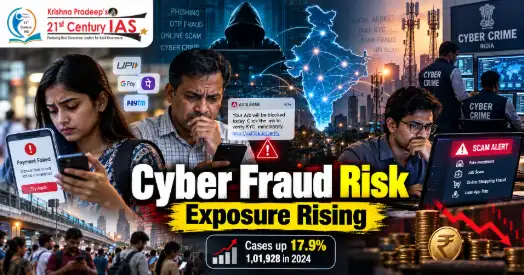
- NCRB data show that cybercrime cases increased by 17.9%, from 86,420 in 2023 to 1,01,928 in 2024.Cybercrime increased even as overall registered crime declined by 6% during the same period.A Lokniti-CSDS and Common Cause study of 8,306 citizens across 16 States found that greater internet usage was associated with higher scam exposure.
What Does the Data Reveal?
Cybercrime Moving Against the National Trend
- Rapid Increase: Registered cybercrime cases rose by 17.9% nationally in 2024.
- Overall Crime Decline: Total registered crime declined by 6% during the same period.
- Distinct Crime Pattern: Cybercrime is increasing despite the broader decline in recorded crime.
Recorded Cases Do Not Show the Complete Picture
- Under-reporting: Many victims do not formally report cyber fraud because of embarrassment, limited awareness, small financial losses or uncertainty about the complaint process.
- Invisible Layer: Official crime statistics capture only registered cases and may not reflect the true scale of attempted fraud.
- Survey Evidence: The Lokniti-CSDS and Common Cause study examined both scam exposure and actual victimisation.
Study Coverage
The study surveyed:
- 8,306 citizens;
- across 16 States;
- and examined citizens’ exposure to scam calls and messages, actual victimisation and the social profile of those affected.
The analysis formed part of the Status of Policing in India Report 2026.
What is the Scale of Scam Exposure?
Fraudsters approach citizens through messages and calls based on common digital activities, personal relationships and fear of institutions.
Common Types of Scam Calls
- Fake Delivery Calls: 33% frequently received calls about deliveries they had never ordered.
- Investment Scams: 31% frequently encountered calls promising high investment returns.
- Bank Impersonation: 27% frequently received calls from persons claiming to be bank officials and seeking account details.
- Illegal-Activity Claims: 23% received calls claiming that their phones were linked to illegal activities.
- Friend-in-Distress Scams: 23% received calls from unknown numbers claiming to be friends urgently requiring money.
- Police or Authority Impersonation: About one-fifth frequently received calls claiming that a friend or relative was in danger or involved in a crime.
However, the survey also found that roughly half to six in ten respondents had never received such calls. Scam exposure is therefore widespread but not uniform.
How Does Internet Usage Affect Vulnerability?
High Internet Usage
Among respondents with high online usage:
- 18% fell in the high scam-exposure category;
- 28% fell in the moderate-exposure category;
- together, more than 46% reported moderate or high scam exposure.
Non-Internet Users
Among respondents who did not use the internet:
- only 5% reported high exposure;
- 14% reported moderate exposure.
Main Inference
- Greater Digital Footprint: People spending more time online create more digital interactions, accounts and transaction records.
- Higher Visibility: Greater online activity provides fraudsters with more opportunities to identify and contact potential victims.
- Connectivity-related Risk: Digital participation creates benefits but also increases the number of points through which fraudsters can approach individuals.
Thus, scam exposure is closely connected with the extent of an individual’s participation in the digital ecosystem.
How Do Fraudsters Exploit Digital Footprints?
Modern cyber fraud does not depend only on sophisticated hacking. Fraudsters increasingly use social engineering, which involves manipulating human emotions and trust.
Aspiration
- Investment Scams: Promises of unusually high returns exploit the desire for quick wealth.
- Victims may be pressured to act quickly before verifying the investment.
Familiarity
- Delivery Scams: Fraudsters use the widespread practice of online shopping to make fake delivery calls appear genuine.
- Frequent e-commerce users may consider such calls routine.
Institutional Trust
- Bank Impersonation: Fraudsters pretend to be bank officials to obtain personal and account information.
- The credibility of the banking institution is used to make the demand appear legitimate.
Fear of Authority
- Fake Police Calls: Victims may be told that their phone, bank account or family member is connected with a crime.
- Fear and urgency reduce the victim’s ability to independently verify the claim.
Personal Relationships
- Friend or Relative Scams: Fraudsters pretend to be known persons requiring emergency financial assistance.
- Emotional concern is used to bypass normal caution.
Deception Through Familiar Situations
The effectiveness of such fraud lies in making an unfamiliar criminal demand appear connected to a familiar:
Person | Institution | Transaction | Emergency | Social relationship
How Many Scam Encounters Cause Actual Harm?
The study found that 13% of respondents had been direct victims of cybercrime during the previous two to three years.
Nature of Cybercrime Experienced
Among cybercrime victims:
- Financial Fraud: 54%
- Device Hacking: 13%
- Personal Data Theft: 11%
- Cyberbullying or Social-Media Abuse: 7%
- Online Sexual Harassment: 4%
Dominance of Financial Fraud
Financial fraud formed the largest category of cyber victimisation. This reflects the growing use of digital platforms for:
- banking;
- payments;
- investment;
- online shopping;
- and person-to-person transfers.
However, cybercrime also extends beyond financial loss to privacy violations, social abuse and sexual harassment.
Who is Most Vulnerable to Financial Fraud?
Vulnerability to financial fraud is not restricted to individuals with low education or limited digital awareness.
Economic Status
Among surveyed cybercrime victims:
- Wealthiest Respondents: 57% experienced financial fraud.
- Economically Disadvantaged Respondents: 47% experienced financial fraud.
Educational Status
- Respondents Without Formal Education: 40% experienced financial fraud.
- College Graduates: 59% experienced financial fraud.
Why Are Wealthier and Educated Users More Exposed?
- Greater Digital Participation: They may use online banking, investment, shopping and payment applications more frequently.
- Higher Transaction Value: Fraudsters may target individuals believed to possess greater financial resources.
- Larger Digital Footprint: Multiple accounts and platforms create additional opportunities for contact and deception.
- Reporting Differences: Better-educated respondents may also be more likely to recognise and report fraud.
Vulnerability is Multidimensional
The data do not suggest that economically disadvantaged or less-educated citizens are safe.
Instead:
- high online users face greater scam exposure;
- wealthier and educated users may be targeted for larger financial gains;
- disadvantaged victims may suffer greater hardship even from smaller losses;
- and different groups may be vulnerable to different forms of cybercrime.
Cyber fraud has therefore become less a consequence of individual carelessness and more a risk associated with deep digital connectivity.
What is the Extent of Financial Loss?
More than eight in ten cybercrime victims reported some financial loss.
Distribution of Losses
- Up to ₹1,000: 8%
- ₹1,001–₹5,000: 25%
- ₹5,000–₹20,000: About 29%
- Above ₹20,000: 23%
Impact of Losses
- High-value Losses: Nearly one-fourth of victims lost more than ₹20,000.
- Household Impact: Even smaller losses can significantly affect low-income households.
- Cumulative Harm: Repeated fraud, recovery delays and emotional distress can increase the actual cost beyond the amount stolen.
Significance
- Digital-Economy Risk: Increasing cyber fraud can weaken public trust in digital banking, e-commerce and online public services.
- Social-Engineering Threat: The data show that fraud prevention cannot depend only on technical cybersecurity.
- Targeted Criminality: Fraudsters select victims based on online activity, social position and perceived financial resources.
- Inclusive Cybersecurity: Awareness programmes must cover digitally active, educated and wealthy users as well as disadvantaged groups.
- Data-Protection Concern: Hacking and personal-data theft can enable repeated fraud and identity misuse.
- Governance Challenge: The increase in cybercrime despite declining overall crime requires specialised prevention, investigation and victim-support systems.
Challenges
- Under-reporting: Official statistics may underestimate the true scale of cyber fraud.
- Rapidly Changing Methods: Fraudsters regularly modify calls, messages and impersonation techniques.
- Social Engineering: Fear, trust, urgency and aspiration are difficult to address through technical measures alone.
- Expanding Digital Footprint: Greater online participation creates more opportunities for profiling and targeting.
- Institutional Impersonation: Fraudsters misuse the credibility of banks, police and delivery companies.
- Unequal Impact: The same financial loss may have more serious consequences for low-income households.
- Low Awareness: Citizens may not verify unsolicited calls or understand how personal information can be misused.
- Data Vulnerability: Personal-data theft can support identity fraud and repeated targeting.
- Psychological Harm: Cyberbullying, abuse and sexual harassment can cause lasting emotional damage.
- Victim Blaming: Treating fraud as mere carelessness may discourage victims from reporting incidents.
Way Forward
- Targeted Awareness: Cybersecurity campaigns should address frequent internet users, investors, online shoppers, senior citizens and low-income households.
- Recognise Social Engineering: Training should explain how fraudsters exploit fear, urgency, trust and personal relationships.
- Verification Culture: Citizens should independently verify delivery, bank, police and emergency claims through official channels.
- Digital Hygiene: Users should avoid sharing account details, passwords, PINs and verification codes through unsolicited calls or messages.
- Strengthen Reporting: Complaint systems should be simple, accessible and sensitive to victims.
- Rapid Financial Response: Banks and digital-payment providers should strengthen real-time fraud detection, transaction alerts and quick account-freezing mechanisms.
- Platform Accountability: Digital platforms should detect fraudulent advertisements, fake profiles and impersonation attempts.
- Data Minimisation: Institutions should collect and retain only necessary personal data and strengthen protection against breaches.
- Specialised Capacity: Investigators require training in digital evidence, financial trails, social-media abuse and device forensics.
- Victim-Centred Approach: Cybercrime responses should provide financial guidance, privacy protection and psychological support.
- Evidence-Based Policy: NCRB data and large-scale citizen surveys should be used together to understand both reported and unreported cybercrime.
Conclusion
India’s expanding digital ecosystem has improved access to finance, commerce and public services, but it has also created new opportunities for fraud. The evidence shows that vulnerability is shaped by the level of online participation, socio-economic position and the ability of fraudsters to manipulate trust and fear. Building cyber resilience therefore requires technical safeguards, citizen awareness, responsible data practices, rapid victim support and stronger institutional coordination.
CARE MCQ
Q. Consider the following statements regarding cyber-fraud vulnerability in India:
- Respondents with higher online usage reported greater scam exposure than non-internet users.
- Financial fraud was the largest category among surveyed cybercrime victims.
- The study found that financial fraud was confined mainly to respondents without formal education.
- Cyber fraudsters frequently use institutional credibility and personal relationships to make deception appear genuine.
Which of the statements given above are correct?
(a) 1 and 2 only
(b) 1, 2 and 4 only
(c) 2, 3 and 4 only
(d) 1, 2, 3 and 4
Answer: (b) 1, 2 and 4 only
Explanation
- Statement 1 is correct: More than 46% of high-internet users reported moderate or high scam exposure, compared with 19% of non-internet users.
- Statement 2 is correct: Financial fraud accounted for 54% of cybercrime victimisation in the survey.
- Statement 3 is incorrect: College graduates reported higher financial-fraud victimisation than respondents without formal education.
- Statement 4 is correct: Fraudsters impersonate banks, police, friends and delivery services to exploit trust, fear and urgency.
FAQs
Q.1) How much did cybercrime increase in 2024?
Registered cases rose by 17.9%, from 86,420 in 2023 to 1,01,928 in 2024.
Q.2) Who faces greater scam exposure?
Respondents with high levels of internet usage face greater exposure than non-internet users.
Q.3) What was the most common cybercrime among surveyed victims?
Financial fraud was the largest category, affecting 54% of victims.
Q.4) Why are educated and wealthier users targeted?
Their greater digital participation and financial resources create more opportunities for fraudsters.
Q.5) What is social engineering?
It is the manipulation of trust, fear, urgency or relationships to deceive people into sharing information or transferring money.