Why in News?
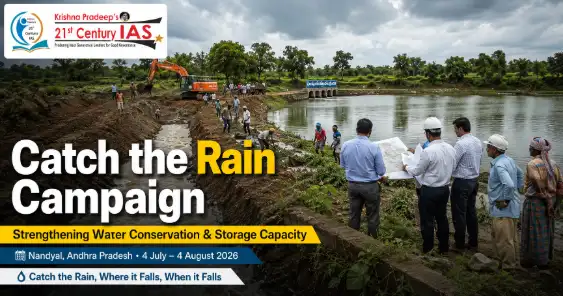
The Catch the Rain Campaign is being implemented across Nandyal district of Andhra Pradesh from 4 July to 4 August 2026. The campaign aims to conserve every drop of rainwater through the restoration of traditional water bodies, desilting of feeder channels, revival of tank systems and creation of additional water storage capacity.
The campaign follows the principle: “Catch the Rain, Where it Falls, When it Falls.”
About the Catch the Rain Campaign in Nandyal
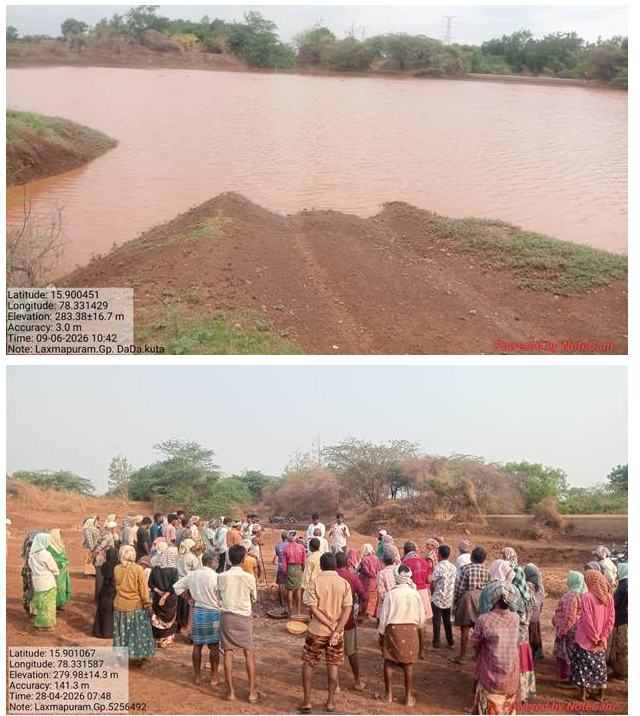
- The campaign in Nandyal focuses on strengthening the district’s ability to capture, store and recharge rainwater during the monsoon season.
- It is being implemented through convergence among different departments and with the participation of local communities. The major objective is to ensure that rainwater is not wasted as surface runoff, but is directed into tanks, ponds, check dams and other storage structures.
The campaign gives importance to three core ideas:
1. Conservation of Rainwater
Every possible drop of rainfall is to be captured and stored locally.
2. Revival of Traditional Water Systems
Traditional tanks, feeder channels and local water bodies are restored to improve water availability.
3. Groundwater Recharge
Farm ponds, check dams and percolation tanks are strengthened to recharge groundwater.
Scientific Planning and Community Participation
A major feature of the campaign is the combination of scientific planning and participatory implementation.
1. Planning Across Gram Panchayats
Scientific planning is being carried out across all 489 Gram Panchayats in Nandyal district.
2. Field Surveys and Mapping
Field surveys are conducted to identify:
- priority water bodies
- feeder channels
- watershed areas
- tank systems
- water conservation needs
3. Technical Assessment
Concerned departments conduct technical assessments before sanctioning works. This ensures that interventions are planned according to local geography and water-flow patterns.
4. Use of Local Knowledge
Consultations are held with local communities and village elders. This helps combine technical planning with traditional knowledge.
5. Gram Sabha Approval
Proposed works are placed before the Gram Sabha to ensure transparency, accountability and community participation.
This model shows how water conservation can be improved when planning is both scientific and democratic.
Major Water Conservation Interventions
- Based on the planning process, Nandyal district has identified, sanctioned and grounded 2,103 water conservation works, achieving 100% grounding.
1. Desilting of Feeder and Supply Channels
Under the campaign, 2,691 km of feeder and supply channels are desilted and restored.
This improves the flow of rainwater into:
- tanks
- reservoirs
- local water bodies
Desilting is important because silted channels reduce water flow and prevent tanks from receiving adequate rainwater.
2. Restoration of Minor Irrigation Tanks
Restoration works are undertaken in 251 Minor Irrigation Tanks.
Out of these, 225 works have been completed, while the remaining works are under progress.
Minor irrigation tanks are crucial in rural areas because they support:
- local irrigation
- groundwater recharge
- livestock needs
- village-level water security
3. Strengthening Rainwater Harvesting Structures
The district has strengthened its network of:
- 22,221 Farm Ponds
- 2,221 Check Dams
- 202 Percolation Tanks
These structures increase water storage, reduce runoff and improve groundwater recharge.
Additional Water Storage Capacity Created
The district has assessed additional water storage capacity through technical estimates prepared by engineering departments.
1. Storage Restored through Feeder Channels and Water Structures
Restoration of feeder channels and water conservation structures is estimated to restore 3.27 TMC of tank storage capacity.
2. Storage from New Structures
Newly created water conservation structures contribute an additional 0.03 TMC of storage.
Together, these interventions improve the district’s capacity to capture monsoon runoff and retain water for agriculture, livelihoods and local communities.
Conclusion
The Catch the Rain Campaign in Nandyal district demonstrates how scientific planning, community participation and departmental convergence can strengthen water conservation infrastructure. By restoring feeder channels, reviving tanks and expanding rainwater harvesting structures, the district is improving its capacity to capture and store monsoon runoff. This approach advances the vision of “Catch the Rain, Where it Falls, When it Falls” and contributes to long-term water security and climate resilience.