Bureau of Port Security (BoPS): Strengthening India’s Coastal and Port Security Architecture
Table of Contents
Source: The Hindu
Relevance:
GS Paper III: Internal security, coastal security, maritime security, infrastructure security, cybersecurity of critical infrastructure
Important Key Concepts for Prelims and Mains:
For Prelims:
- Bureau of Port Security (BoPS), Merchant Shipping Act 2025, ISPS Code, Coastal Security, CISF, Maritime Terrorism, Cybersecurity of Ports, Indian Ports Act 2025, Maritime India Vision 2030
For Mains:
- Coastal Security Architecture, Maritime Governance, Regulatory Oversight, Centre–State Relations, Maritime Federalism, Port-led Development, Cybersecurity in Critical Infrastructure, Ease of Doing Business vs Security
Why in News?
The Union Government has constituted the Bureau of Port Security (BoPS) as a statutory body under Section 13 of the Merchant Shipping Act, 2025. The BoPS has been created to provide a unified regulatory and oversight framework for the security of ships and port facilities across India, at a time when maritime trade, port capacity, and coastal vulnerabilities are rapidly expanding.
What is the Bureau of Port Security (BoPS)?
About
The Bureau of Port Security is a central statutory regulatory authority responsible for overseeing security arrangements at ports and port facilities in India. It is modelled on the Bureau of Civil Aviation Security (BCAS) and functions under the Ministry of Ports, Shipping and Waterways.
Legal Basis
- Constituted under Merchant Shipping Act, 2025
- Empowered to enforce international maritime security obligations, including the International Ship and Port Facility Security (ISPS) Code
Institutional Design
- Acts as the nodal agency for port security regulation
- Coordinates with operational security forces rather than replacing them
Why was BoPS Created?
India’s coastal security framework has traditionally been fragmented, involving multiple agencies:
- Indian Navy
- Indian Coast Guard
- Central Industrial Security Force (CISF)
- State Maritime Police
This multi-agency arrangement, while operationally robust, often resulted in:
- Overlapping jurisdictions
- Coordination gaps
- Delayed intelligence sharing
- Uneven security standards across ports
The BoPS addresses these issues by providing single-point statutory oversight, standardisation, and coordination.
Role and Functions of BoPS
1. Regulatory Oversight
- Enforcement of ISPS Code across all major and non-major ports
- Ensuring uniform security protocols for ships and port facilities
2. Standardisation of Security Measures
- Designation of CISF as a Recognised Security Organisation
- Preparation of:
- Standard Security Plans
- Port Facility Security Assessments
- Training modules for public and private security agencies
3. Coordination & Intelligence Sharing
- Acts as a coordination hub among:
- Central agencies
- State maritime authorities
- Port operators
- Facilitates real-time information exchange on maritime threats
4. Addressing Emerging Maritime Threats
BoPS is mandated to monitor, deter, and counter:
- Maritime terrorism
- Arms and narcotics smuggling
- Human trafficking and illegal migration
- Piracy and poaching
- Cyber threats to port IT and logistics systems
5. Cybersecurity of Ports
- Dedicated division for protecting:
- Port IT infrastructure
- Digital logistics platforms
- Automated cargo-handling systems
- Coordination with national cybersecurity agencies for threat mitigation
India’s Maritime Growth and Security Imperatives
India’s maritime sector has witnessed a decade of rapid expansion:
- Cargo handled increased from 974 MMT (2014) to 1,594 MMT (2025)
- Port capacity expanded by 57%
- Ship turnaround time reduced to 48 hours
- Coastal shipping rose by 118%
- Inland waterway cargo increased eightfold
- Nine Indian ports featured in the World Bank’s Container Port Performance Index
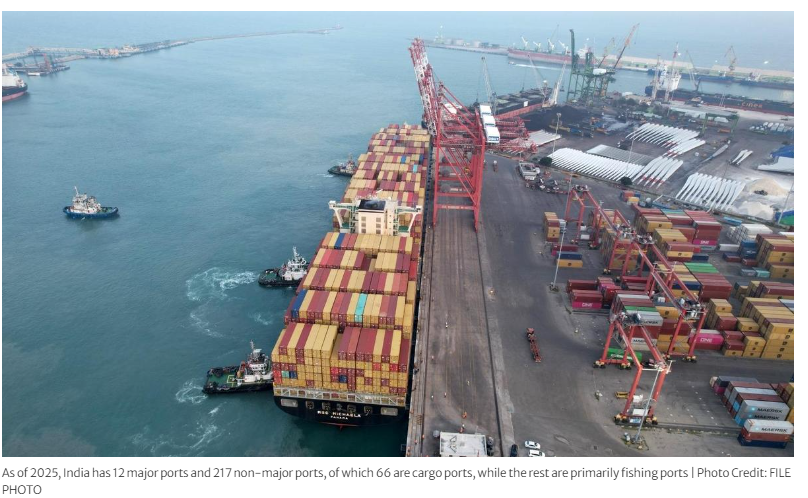
Port Landscape (2025)
- 12 major ports (Union List; handle ~53% cargo)
- 217 non-major ports, including:
- 66 cargo ports
- Predominantly fishing ports
- Private ports like Mundra and Sikka handle nearly 19% of cargo traffic
This scale of growth necessitates robust and modern security governance, making BoPS a strategic requirement rather than an administrative addition.
Modernisation of Port Laws in India
To align maritime growth with security and efficiency, India has undertaken comprehensive legal reforms:
- Indian Ports Act, 2025 (replacing the 1908 Act)
- Merchant Shipping Act, 2025
- Coastal Shipping Act, 2025
- Establishment of BoPS
Objectives of New Framework
- Risk-based security approach
- Simplification of licensing and compliance
- Encouragement of Indian shipping ownership
- Promotion of eco-friendly and cost-efficient transport
- Strengthening ease of doing business without compromising security
These reforms align with Maritime India Vision 2030, which prioritises best-in-class port infrastructure and secure maritime logistics.
Key Challenges in Coastal and Port Security
- Expanding Coastline Exposure: Over 7,500 km of coastline with diverse port profiles
- Dual-use Ports: Fishing ports being exploited for illegal trafficking
- Cyber Vulnerabilities: Digitisation increases exposure to cyberattacks
- Asymmetric Threats: Terrorism and smuggling using low-cost maritime routes
- Centre–State Coordination: Security oversight across Union and State jurisdictions
BoPS seeks to address these through centralised regulation with decentralised execution.
Criticisms and Federal Concerns
Maritime Federalism
- Coastal States have criticised increased Union control over non-major (State-owned) ports
- Described as a potential “silent cost to federalism”
Powers of Port Authorities
- Indian Ports Act, 2025 grants wide inspection and entry powers to port officials
- Concerns raised over:
- Lack of explicit judicial safeguards
- Possible overreach affecting civil liberties
These criticisms are primarily directed at the legislative framework, though they influence the operational environment of BoPS.
Conclusion
The Bureau of Port Security represents a structural shift in India’s maritime security governance, aligning regulatory oversight with the scale and complexity of modern port-led growth. While concerns regarding federal balance and procedural safeguards merit attention, BoPS has the potential to significantly enhance India’s ability to secure its coastline, ports, and maritime trade routes. Effective implementation, transparency, and cooperative federalism will be key to realising its strategic promise.
UPSC PYQ
Q. Consider the following pairs:
| Port | Well known as |
| 1. Kamarajar Port | First major port in India registered as a company |
| 2. Mundra Port | Largest privately owned port in India |
| 3. Visakhapatnam Port | Largest container port in India |
Which of the pairs given above are correctly matched?
(a) Only one pair
(b) Only two pairs
(c) All three pairs
(d) None of the pairs
Answer: (b) Only two pairs
Explanation:
Pair 1: Kamarajar Port – First major port in India registered as a company
Correct
Kamarajar Port (formerly Ennore Port), located on the Coromandel Coast near Chennai, is the only corporatised major port in India. It is registered as a company under the Companies Act and follows the landlord port model, making it the first major port in India with this status.
Pair 2: Mundra Port – Largest privately owned port in India
Correct
Mundra Port, situated on the Gulf of Kutch in Gujarat, is India’s largest private port. Operated by Adani Ports and SEZ Limited (APSEZ), it is a major hub for container, bulk, and multipurpose cargo.
Pair 3: Visakhapatnam Port – Largest container port in India
Incorrect
The largest container port in India is Jawaharlal Nehru Port Trust (JNPT / Nhava Sheva) on the west coast. Visakhapatnam Port is a major port but not the largest container port.
CARE MCQ
Q.With reference to the Bureau of Port Security (BoPS), consider the following statements:
- It is a statutory body established under the Merchant Shipping Act, 2025.
- It functions under the Ministry of Home Affairs.
- It is responsible for enforcing the ISPS Code in Indian ports.
Which of the statements given above are correct?
(a) 1 and 2 only
(b) 1 and 3 only
(c) 2 and 3 only
(d) 1, 2 and 3
Correct Answer: (b) 1 and 3 only
Explanation:
- Statement 1 is correct: BoPS is a statutory body under the Merchant Shipping Act, 2025.
- Statement 2 is incorrect: It functions under the Ministry of Ports, Shipping and Waterways.
- Statement 3 is correct: Enforcement of the ISPS Code is a core mandate of BoPS.