
APPSC Current Affairs 1 September 2026 covering Andhra Pradesh tribal development, NM-ICPS and Nepal flash floods

Relevance: GS Paper II – Tribal Welfare, Health and Education | GS Paper III – Inclusive Growth

Important Keywords for Prelims and Mains

Prelims: Sanjeevani Programme | Adivathalli Bata | ASR District | Talli Bidda Express | Jan Aushadhi Kendras
Mains: Tribal Development | Local Employment | Last-Mile Healthcare | Digital Inclusion | Sustainable Livelihoods

Why in News?

Andhra Pradesh Chief Minister N. Chandrababu Naidu launched the Sanjeevani programme at Ganneli in Araku Valley, Alluri Sitarama Raju district. The programme aims to deliver quality healthcare to remote tribal families as part of the government’s goal of eliminating tribal poverty.

Five-Pronged Strategy

The State’s tribal development policy is based on:

  • infrastructure;
  • healthcare;
  • education;
  • employment; and
  • welfare.

It recognises tribal poverty as multidimensional and seeks to combine public services with sustainable livelihoods.

Major Initiatives

Infrastructure and Connectivity

  • 900 km of roads constructed under the Adivathalli Bata project at a cost of ₹1,000 crore.
  • Tap water and rooftop solar systems planned for 1.60 lakh houses.
  • Cell towers being installed to improve digital connectivity.

Healthcare

  • Sanjeevani programme: Quality medical care for remote tribal families.
  • Emergency network: 150 vehicles deployed in ASR district.
  • Tribal Health Infrastructure Mission: ₹250 crore allocated.
  • 104 ambulances: Mobile services offering 42 diagnostic tests.
  • Talli Bidda Express: Transport assistance for pregnant women.
  • Drone services: Blood samples transported from remote health centres to major hospitals.
  • Medical support: ₹10,000 monthly pension for patients with sickle cell disease and thalassemia.
  • Jan Aushadhi Kendras: Proposed in all mandals for affordable medicines.

Education and Skills

  • Agreement with IIT Madras to improve tribal education and provide coaching for examinations such as IIT and NEET.
  • Target to train one lakh tribal youth in three years for jobs in emerging industries.

Local Employment

  • The government will propose a legally acceptable alternative to G.O. 3, which had reserved jobs in tribal areas for local candidates but was annulled by the Supreme Court.

Sustainable Livelihoods

  • Coffee cultivation to be expanded by one lakh acres.
  • Coffee and pepper promoted as alternative crops.
  • Tribal products to be developed as recognised brands.
  • Homestays encouraged to provide income from Araku tourism.

Welfare Convergence

  • Beneficiary families were covered under schemes such as Talliki Vandanam, Annadata Sukhibhava, Stree Shakti and Auto Driver Service.

Conclusion

Andhra Pradesh’s strategy addresses tribal poverty through healthcare, education, infrastructure, employment and livelihoods. Its success will depend on effective implementation, community participation and protection of tribal rights.

CARE MCQ

Q. Consider the following statements:

  1. The Sanjeevani programme seeks to improve healthcare in remote tribal areas.
  2. Adivathalli Bata is related to road connectivity.
  3. Coffee cultivation is proposed to be expanded by one lakh acres.

Which of the statements given above are correct?

(a) 1 and 2 only
(b) 2 and 3 only
(c) 1 and 3 only
(d) 1, 2 and 3

Answer: (d) 1, 2 and 3

Explanation: Sanjeevani focuses on tribal healthcare, Adivathalli Bata improves road connectivity, and coffee cultivation is planned to be extended by one lakh acres.

FAQs

1. What is the Sanjeevani programme?

It is an initiative to provide quality healthcare to families living in remote tribal areas of ASR district.

2. What is Adivathalli Bata?

It is a tribal road-connectivity project under which about 900 km of roads have been constructed.

3. What is the skill-development target?

The government plans to train one lakh tribal youth over three years.

4. How are drones being used?

Drones transport blood samples from remote health centres to major hospitals for faster diagnosis.

5. What livelihoods are being promoted?

Coffee, pepper, branded tribal products and community-based homestays are being encouraged.

Relevance: GS Paper III – Science and Technology | Artificial Intelligence | Cybersecurity | Indigenisation of Technology

Important Keywords for Prelims and Mains

For Prelims: Cyber-Physical Systems | NM-ICPS | Technology Innovation Hubs | TTRPs | CHANAKYA Fellowship | BharatGen | Digital Twin
For Mains: Technology Sovereignty | Translational Research | Industry–Academia Collaboration | Critical Infrastructure | Indigenous Innovation | Viksit Bharat

Why in News?

India is expanding its indigenous Cyber-Physical Systems ecosystem through the National Mission on Interdisciplinary Cyber-Physical Systems (NM-ICPS). Its Technology Innovation Hubs and Technology Translation Research Parks are converting research into practical applications across healthcare, agriculture, mining, communications, cybersecurity and mobility.

What are Cyber-Physical Systems?

Cyber-Physical System (CPS) integrates computing and communication technologies with physical machines and processes.

It enables a machine or system to:

  • sense its surroundings;
  • collect real-time data;
  • analyse the information;
  • take decisions; and
  • respond automatically to changing conditions.

Thus, CPS connects the digital world with the physical world.

Examples

  • Driverless vehicles navigating roads
  • Smart factories adjusting production automatically
  • Medical devices monitoring patients continuously
  • Smart buildings regulating lighting and temperature
  • Cleaning robots and fitness trackers

Core Components of CPS

ComponentFunction
SensorsCollect data from the physical environment
Computing systemProcesses and analyses the data
Communication networkTransfers data between connected devices
Software and AISupports decision-making
ActuatorsCarry out the required physical response

CPS differs from ordinary automation because it continuously observes, analyses and responds to real-world conditions.

National Mission on Interdisciplinary Cyber-Physical Systems

The Department of Science and Technology (DST) implements NM-ICPS.

Key Facts

  • Approved: 2018
  • Duration: Nine years
  • Financial outlay: ₹3,660 crore
  • Technology Innovation Hubs: 25
  • Implementing department: Department of Science and Technology

The Mission connects academia, industry, government and international organisations. It covers the entire innovation process—from research and development to product creation, commercialisation and start-up incubation.

Major Objectives

  • Build indigenous CPS capabilities.
  • Develop technologies of national importance.
  • Create specialised human resources.
  • Establish interdisciplinary Centres of Excellence.
  • Translate research into commercially useful products.
  • Promote entrepreneurship and start-ups.
  • Address critical national challenges through technology.

Technology Innovation Hubs

NM-ICPS has established 25 Technology Innovation Hubs (TIHs) at leading academic institutions. These hubs operate as Section 8 companies.

Their work covers four major areas:

  • technology development;
  • human-resource and skill development;
  • entrepreneurship and start-up incubation; and
  • international collaboration.

The hubs also work with government ministries to identify national problems and develop practical technological solutions.

Technology Translation Research Parks

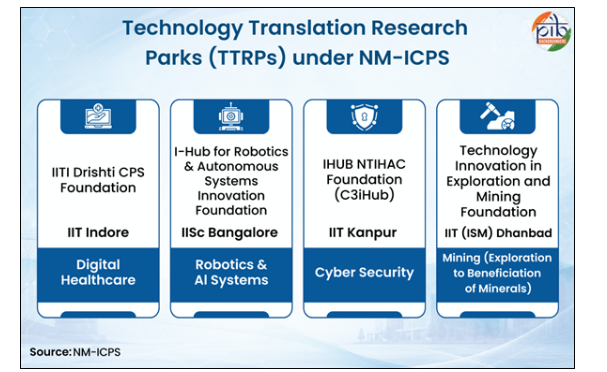
In 2025, four high-performing TIHs were upgraded and supported as Technology Translation Research Parks (TTRPs).

Their purpose is to accelerate the validation, deployment and commercialisation of promising technologies.

InstitutionSpecialised domain
IIT KanpurCybersecurity
IISc BengaluruRobotics and AI systems
IIT (ISM) DhanbadMining technologies
IIT IndoreDigital healthcare

Achievements of NM-ICPS

As of August 2026, the Mission had:

  • enabled 1,146 technologies;
  • contributed to 1,329 technology products;
  • awarded 5,824 CHANAKYA fellowships;
  • trained more than 2.46 lakh professionals;
  • incubated 1,136 start-ups and spin-offs;
  • contributed to over 24,000 jobs; and
  • established 200 international collaborations.

Its technologies cover agriculture, healthcare, mining, cybersecurity, communication and positioning.
CHANAKYA Fellowship Programme

CHANAKYA stands for Comprehensive and Holistic Advancement of National Knowledge Yield and Analytics.

The programme supports:

  • undergraduate students;
  • postgraduate students;
  • doctoral researchers; and
  • postdoctoral researchers.

It funds research projects addressing real-world CPS challenges through specialised Technology Innovation Hubs.

BharatGen: Indigenous AI for CPS

  • BharatGen, supported under NM-ICPS, is developing sovereign artificial-intelligence capabilities suited to Indian languages and contexts.
  • It is led by IIT Bombay through a consortium of academic institutions and covers text, speech and vision-language technologies.

Major Models

ModelPurpose
Param-2Foundation model with 17 billion parameters; supports all 22 Scheduled Indian languages
ShrutamSpeech-to-text model supporting 12 Indian languages
SooktamText-to-speech model supporting 12 Indian languages
PatramMultilingual access to complex Indian documents under the DocBodh framework
Ayur ParamAI model for Ayurveda
Agri ParamAI model for agriculture
Legal ParamAI model for the Indian legal domain

BharatGen can improve human-machine interaction and enable locally relevant decision-making in healthcare, agriculture and governance.

Major Applications of CPS

Healthcare

The Drishti CPS Foundation at IIT Indore has developed CharakDT, a digital twin of the human body. It simulates organs such as the lungs, eyes and heart to study disease progression and test treatments virtually.

digital twin is a virtual copy of a physical object, process or system. It uses real-time sensor data to represent and analyse how the physical system behaves.

Agriculture

IIT Bombay has developed an Agri-IoT Farm Management System that monitors:

  • soil conditions;
  • weather; and
  • farm-level microclimate.

It supports the efficient use of water and fertilisers while improving agricultural productivity.

Mining

The TEXMiN hub at IIT (ISM) Dhanbad has developed drones capable of transmitting data up to 50 kilometres. They allow real-time monitoring while reducing workers’ exposure to hazardous mining locations.

Advanced Communication

IIIT Bengaluru has developed an indigenous 5G-Advanced ORAN Massive MIMO Radio Unit (32TR RU).

It can support reliable, high-speed and cost-effective 5G connectivity, particularly in underserved and remote regions.

Cybersecurity

The IHUB NTIHAC Foundation at IIT Kanpur is developing technologies to secure CPS and critical infrastructure.

Its major initiatives include:

  • an IT-OT Security Operations Centre for continuous monitoring; and
  • crypto-forensic tools to assist law-enforcement agencies in investigating cryptocurrency-related crimes.

Mobility and Autonomous Systems

  • The TiHAN Foundation at IIT Hyderabad has established India’s first dedicated proving ground for autonomous navigation. It tests aerial and ground-based autonomous vehicles before deployment.
  • The IISc Bengaluru-based robotics hub has developed the iRASTE application, which identifies accident-prone locations and provides real-time alerts to drivers. It is being piloted in Nagpur.

Significance for India

  • Technological self-reliance: Reduces dependence on imported critical technologies.
  • Research commercialisation: Connects laboratories with industry and markets.
  • Improved public services: Supports smarter healthcare, agriculture, transport and infrastructure.
  • Industrial modernisation: Enables intelligent factories, mining and communication systems.
  • Start-up growth: Converts research ideas into products and enterprises.
  • Skilled employment: Creates specialised capabilities in AI, robotics and cybersecurity.
  • National security: Strengthens protection of connected critical infrastructure.
  • Linguistic inclusion: BharatGen makes intelligent systems accessible in Indian languages.

Challenges

  • High research, testing and deployment costs
  • Shortage of specialised interdisciplinary skills
  • Cyberattacks against connected critical infrastructure
  • Privacy risks arising from continuous data collection
  • Lack of common technical and safety standards
  • Limited transfer of research from laboratories to markets
  • Dependence on imported sensors, chips and advanced components
  • Digital connectivity gaps in remote areas
  • Difficulty in assigning liability when autonomous systems fail

Way Forward

  • Develop common standards for safety, interoperability and accountability.
  • Adopt security-by-design for all critical CPS infrastructure.
  • Strengthen domestic production of sensors, chips and communication equipment.
  • Expand testing facilities and regulatory sandboxes.
  • Improve coordination among research institutions, industry and government.
  • Support start-ups through patient capital and public procurement.
  • Develop interdisciplinary courses combining engineering, AI and cybersecurity.
  • Establish strong data-protection and ethical-governance mechanisms.
  • Expand CPS applications in agriculture, healthcare and disaster management.
  • Promote multilingual and locally relevant solutions through BharatGen.

Conclusion

Cyber-Physical Systems are transforming machines into intelligent and responsive networks. Through NM-ICPS, TIHs, TTRPs and BharatGen, India is building an indigenous ecosystem that connects research, talent, enterprise and public needs. Secure and inclusive deployment of CPS can support a technology-driven and self-reliant Viksit Bharat.
CARE MCQ

Q1. Consider the following statements regarding NM-ICPS:

  1. It is implemented by the Department of Science and Technology.
  2. Technology Innovation Hubs under the Mission operate as Section 8 companies.
  3. The Mission deals exclusively with cybersecurity.

Which of the statements given above are correct?

(a) 1 only
(b) 1 and 2 only
(c) 2 and 3 only
(d) 1, 2 and 3

Answer: (b) 1 and 2 only

Explanation: Statements 1 and 2 are correct. Statement 3 is incorrect because the Mission covers healthcare, agriculture, mining, communication, robotics, mobility and cybersecurity.

Q2. Match the following institutions with their Technology Translation Research Park domains:

  1. IIT Kanpur — Cybersecurity
  2. IISc Bengaluru — Robotics and AI
  3. IIT Indore — Digital healthcare
  4. IIT (ISM) Dhanbad — Mining technologies

How many of the pairs given above are correctly matched?

(a) Only one
(b) Only two
(c) Only three
(d) All four

Answer: (d) All four

Explanation: Each of the four institutions specialises in the correctly matched CPS domain.

FAQs

1. What is a Cyber-Physical System?

It is a system that integrates computing, communication and physical processes to sense, analyse and respond in real time.

2. Which department implements NM-ICPS?

The Department of Science and Technology implements the Mission.

3. What are Technology Innovation Hubs?

They are specialised Section 8 companies hosted by academic institutions to promote technology, skills, start-ups and collaboration.

4. What is a Technology Translation Research Park?

It helps convert promising research into tested, deployable and commercially useful technologies.

5. What is BharatGen?

It is an indigenous AI initiative developing multilingual and multimodal models suited to Indian languages and sectors.

6. What is a digital twin?

It is a live virtual representation of a physical object, process or system created using real-time data.

Relevance: GS Paper I – Physical Geography and Natural Disasters | GS Paper II – India and its Neighbourhood | GS Paper III – Disaster Management

Important Keywords for Prelims and Mains

For Prelims: Rock–Ice Avalanche | Debris Flood | GLOF | Moraine | Cryosphere | Bhote Koshi | Gandak | NGRMP
For Mains: Cascading Hazards | Transboundary Rivers | Regional Early-Warning System | Himalayan Vulnerability | Disaster Diplomacy | Climate Resilience

Why in News?

A massive rock–ice collapse near the Nepal–China border on August 26, 2026 generated a debris-laden flash flood that devastated parts of Nepal, Tibet and downstream areas.Preliminary estimates indicated 579 deaths in Nepal, nearly 2,000 missing persons and more than 93,000 people requiring assistance. Indian nationals, including Kailash Mansarovar pilgrims, were also reported missing.The disaster highlights the need for India, Nepal and China to cooperate on Himalayan hazard monitoring, early warnings and emergency response.

What Triggered the Disaster?

The event initially appeared to be a 4.4-magnitude earthquake. However, the United States Geological Survey later concluded that the recorded seismic activity was caused by the collapse itself rather than a tectonic earthquake.

The disaster unfolded through a cascading process:

  1. A massive slab of glacier and underlying rock became detached.
  2. The material plunged about one kilometre into the valley.
  3. Ice, rock, mud and water mixed into a high-energy debris flow.
  4. The flood travelled downstream, destroying settlements and infrastructure.

The collapse was later registered as producing seismic energy equivalent to an earthquake of about magnitude 5.2.

Was It a GLOF?

The event should not automatically be classified as a conventional Glacial Lake Outburst Flood (GLOF).

A GLOF is the sudden release of water from a glacial lake after the failure or overtopping of its natural dam, which may be made of ice, moraine or bedrock.

Conventional GLOFNepal disaster
Begins with failure of a glacial-lake barrierBegan with a massive rock–ice collapse
Stored lake water is releasedIce and rock transformed into a debris flood
Water is the main moving mediumWater, rock, ice, mud and debris moved together
May be triggered by rain, avalanche or earthquakePrecise trigger remains under investigation

The event is more accurately described as a rock–ice collapse-triggered debris flood. It shows that Himalayan disaster planning must cover several connected cryospheric hazards rather than focusing only on glacial lakes.

Regional Impact

Nepal

  • Villages and towns were swept away.
  • Bridges, roads, communication networks and hydropower stations were destroyed.
  • Around 475 MW of electricity-generating capacity was lost.
  • Rescue efforts were complicated by damaged transport and communication links.

China

  • The disaster severely damaged Gyirong Port, a major gateway between Nepal and China in the Tibet Autonomous Region.
  • The port, upgraded as an international-standard land gateway at a cost of $175.8 million, was buried under sediment and debris. Roads, electricity and communication links on the Chinese side were also disrupted.

India

The floodwaters entered river systems connected with the Gandak, Kosi and Ganga, placing Bihar and Uttar Pradesh on alert.

  • Communities near vulnerable embankments were evacuated.
  • Surveillance was strengthened at the Valmikinagar Barrage.
  • Maharajganj and Kushinagar districts increased preparedness.
  • NDRF teams were deployed along the Bihar–Uttar Pradesh border.
  • India activated humanitarian assistance and dispatched more than 47.5 tonnes of relief material, including medicines, food and tents, to Nepal.

Why Is the Himalayan Region Highly Vulnerable?

Geological Factors

The Himalayas are young fold mountains created by the continuing collision of the Indian and Eurasian plates. Their fractured rocks, steep slopes and active faults make them prone to earthquakes and landslides.

Climatic Factors

Intense monsoon rainfall, cloudbursts and rapid snowmelt can saturate slopes, increase river discharge and produce flash floods.

Cryospheric Changes

Rising temperatures accelerate:

  • glacier retreat;
  • glacial-lake formation;
  • permafrost thaw;
  • snow and ice melt; and
  • instability of high-altitude rock slopes.

When permafrost thaws, ice that binds rock and soil weakens, increasing the risk of rockfalls and ice–rock avalanches.

High Sediment Load

Himalayan rivers carry large quantities of sediment. This can raise riverbeds, block channels and create temporary dams whose sudden failure produces destructive floods.

Human Activities

Unscientific road cutting, hydropower construction, blasting, debris dumping, unplanned urbanisation and tourism beyond carrying capacity increase the natural fragility of mountain slopes.

Cascading Hazards

Himalayan disasters often occur as connected events:

  • earthquake → landslide → river blockage → flash flood;
  • extreme rainfall → slope failure → debris flow;
  • avalanche → glacial-lake overtopping → GLOF.

India’s Measures Against Himalayan Hazards

National GLOF Risk Mitigation Programme

The National Glacial Lake Outburst Flood Risk Mitigation Programme covers Arunachal Pradesh, Himachal Pradesh, Sikkim and Uttarakhand.

With an outlay of ₹150 crore, it supports:

  • hazard assessment;
  • lake monitoring;
  • early-warning systems;
  • community preparedness; and
  • structural mitigation.

Satellite Monitoring

The Central Water Commission, supported by NRSC-ISRO, monitors Himalayan glacial lakes and water bodies through remote sensing. Monitoring was expanded from 2025 to 2,843 water bodies, including 2,485 glacial lakes.

Warning Infrastructure

Automatic weather stations, lake-level sensors, discharge gauges, cameras, sirens and satellite communication systems are being developed for vulnerable areas.

NDMA Guidelines

The NDMA Guidelines on Management of GLOFs, 2020 cover hazard zonation, lake monitoring, controlled drainage, warning dissemination, evacuation and recovery.

Hydropower and Dam Safety

GLOF studies are required for new dams located in catchments containing glacial lakes. Dam-break analysis, emergency action plans and the Dam Safety Act, 2021 seek to prevent cascading infrastructure failures.

Community Preparedness

Aapda Mitra, Yuva Aapda Mitra, SDRF and NDRF programmes train volunteers in warnings, evacuation, first aid and search-and-rescue operations.

Landslide Mitigation

₹1,000-crore National Landslide Risk Mitigation Project supports slope stabilisation, drainage improvement, retaining structures and hazard mapping in 15 landslide-prone States.

Why Is Regional Cooperation Necessary?

Transboundary Nature of Rivers

A flood originating in Tibet or Nepal can enter India within hours. National borders cannot contain the movement of water, debris or sediment.

Real-Time Data Sharing

Downstream regions require timely information on:

  • rainfall;
  • river discharge;
  • glacial-lake levels;
  • seismic activity;
  • landslide blockages; and
  • emergency dam releases.

Joint Monitoring

Many high-risk glaciers and lakes are located in remote border regions. Joint satellite observation, field surveys and automatic sensors can improve hazard detection.

Common Early-Warning Systems

Warnings generated upstream must reach downstream authorities and communities without delay. National systems should therefore be interoperable.

Coordinated Disaster Response

Major Himalayan disasters can overwhelm a single country’s rescue, medical and logistical capacity. Joint exercises and pre-arranged humanitarian corridors can speed up relief.

Confidence Building

Transparent hydrological data can reduce suspicion that floods were caused by deliberate dam releases or the withholding of upstream information.

Challenges

  • Geopolitical mistrust among India, Nepal and China
  • Absence of a permanent trilateral disaster-management mechanism
  • Limited access to remote high-altitude regions
  • Gaps in last-mile warning communication
  • Different technical standards and data formats
  • Inadequate cumulative assessment of roads and hydropower projects
  • Weak enforcement of land-use regulations
  • Difficulty in forecasting compound and cascading hazards

Way Forward

  • Establish an India–Nepal–China Himalayan Disaster Cooperation Mechanism.
  • Create a real-time transboundary data-sharing protocol.
  • Develop a shared inventory of glaciers, glacial lakes and unstable slopes.
  • Install solar-powered sensors on lakes, glaciers and rock faces.
  • Use AI to combine satellite, weather, seismic and river-flow data.
  • Develop digital twins of vulnerable Himalayan river basins.
  • Conduct joint emergency simulations and rescue exercises.
  • Establish drone corridors for relief delivery when roads collapse.
  • Introduce geofenced alerts and digital tracking for pilgrims and tourists.
  • Apply basin-wide environmental assessment to roads, dams and tunnels.
  • Strengthen community-based warning, evacuation and resilient construction.

Conclusion

The Nepal disaster demonstrates that Himalayan hazards are interconnected and transboundary. India, Nepal and China cannot manage them through isolated national responses. Political differences must be separated from disaster cooperation so that scientific information, early warnings and emergency assistance can move freely across borders.

CARE MCQ

Q1. Consider the following statements:

  1. Every debris flood originating in a glaciated region is necessarily a GLOF.
  2. Rock–ice collapses can generate seismic signals even without a tectonic earthquake.
  3. Himalayan disasters may involve cascading interactions among landslides, river blockages and flash floods.

Which of the statements given above are correct?

(a) 1 and 2 only
(b) 2 and 3 only
(c) 1 and 3 only
(d) 1, 2 and 3

Answer: (b) 2 and 3 only

Explanation: Statement 1 is incorrect because a debris flood may originate from a rock–ice collapse without the failure of a glacial lake. Statements 2 and 3 are correct.

FAQs

1. What caused the Nepal flash flood?

A massive rock–ice collapse near the Nepal–China border generated a high-energy, debris-laden flood.

2. Was it a conventional GLOF?

No. Available evidence indicates that it began with a rock–ice collapse rather than the direct failure of a pre-existing glacial lake.

3. Why was seismic activity recorded?

The impact and movement of the collapsing mass generated seismic waves resembling those of an earthquake.

4. How did the disaster affect India?

Floodwater entered rivers connected with the Gandak, Kosi and Ganga, placing parts of Bihar and Uttar Pradesh on alert.

5. Why is cross-border cooperation essential?

Upstream hazards can affect downstream countries within hours, making real-time data sharing and coordinated warnings necessary.

Enroll Now for Unlimited UPSC Utsav

Start Date

22/03/2026

Timings

08 AM – 4 PM

    Courses

    Scroll to Top