Why in News?
Andhra Pradesh secured proposed investments worth up to ₹4,100 crore through two Memoranda of Understanding signed during Bharat Tex 2026 at Bharat Mandapam in New Delhi.The agreements were signed under the leadership of K. Rekha Rani, Commissioner of Andhra Pradesh Handlooms and Textiles, as part of the State’s efforts to attract investments into the textile sector.
Major Investment Agreements
| Project | Investment | Major Outcome |
| Sustainable textile recycling facility in Visakhapatnam | Up to ₹4,000 crore | Establishment of a major textile recycling facility |
| Garment manufacturing unit | ₹100 crore | Around 3,000 direct and indirect jobs |
| Total | Up to ₹4,100 crore | Expansion of the State’s textile sector |
Textile Recycling Facility
- A sustainable textile recycling facility is proposed to be established in Visakhapatnam with an investment of up to ₹4,000 crore.
Garment Manufacturing Unit
- A garment manufacturing unit will be set up with an investment of ₹100 crore. It is expected to generate around 3,000 direct and indirect employment opportunities.
Bharat Tex 2026
- Bharat Tex 2026 is being organised by the Union Ministry of Textiles at Bharat Mandapam, New Delhi.
Andhra Pradesh participated to showcase its:
- Handloom heritage
- Handicrafts
- Textile and apparel capabilities
- Garment products
- Investment potential
- Export opportunities
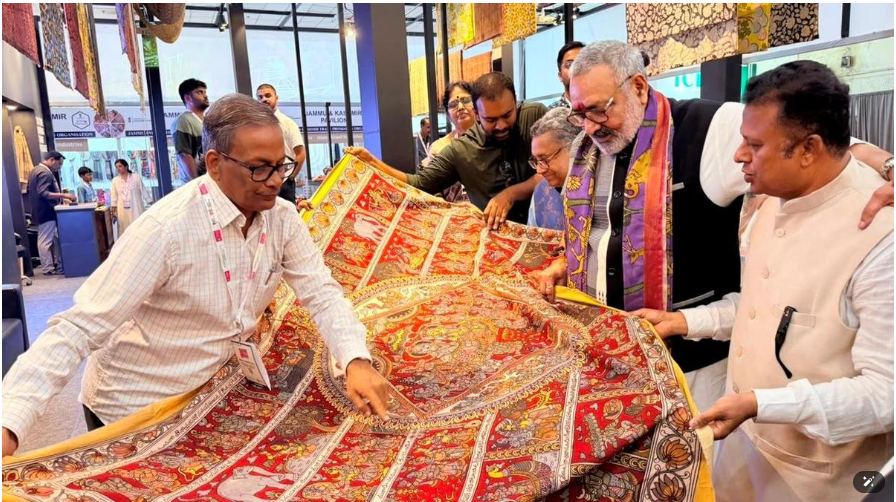
Andhra Pradesh Pavilion
The Andhra Pradesh Pavilion was established in Hall Number 9 and inaugurated by Commissioner K. Rekha Rani.
It displayed:
- Handloom products
- Textiles
- Apparel and garments
- GI-tagged products
- One District One Product items
The pavilion included products and representatives from:
- Guntur Textile Park
- Tarakeswara Textile Park
- Harish Fashions
- APCO
- Magic Weaves
It presented Andhra Pradesh’s traditional handloom legacy along with its modern textile and apparel industry.
Lepakshi Handicrafts Stall
The Lepakshi handicrafts stall was inaugurated by Union Minister for Textiles Giriraj Singh.
The stall highlighted Andhra Pradesh’s:
- Handloom heritage
- Handicrafts
- Textile capabilities
- Traditional products
- Investment potential
Global Potential of Andhra Pradesh Handlooms
Rajya Sabha member V. Vijayendra Prasad visited the Andhra Pradesh Pavilion and observed that the State’s handloom sector had considerable potential in international markets.
He highlighted growing demand for:
- Authentic handmade products
- Culturally rooted products
- Traditional handloom products
Such demand is particularly visible among the Indian diaspora and overseas consumers, especially in the United States.
He stated that Andhra Pradesh was well-positioned to emerge as a leading global sourcing centre for handloom and textile products.
Collaboration with AEPC
Representatives of the Apparel Export Promotion Council, or AEPC, expressed interest in collaborating with the Andhra Pradesh Department of Handlooms and Textiles.
The proposed collaboration will focus on:
- Export awareness programmes
- Capacity-building programmes
- Support for textile MSMEs
- Strengthening export competitiveness
Andhra Pradesh’s Textile Profile
Andhra Pradesh is one of India’s leading textile-producing States.
| Indicator | Andhra Pradesh’s Position |
| Silk production | 2nd |
| Cotton production | 6th |
| Jute production | 7th |
| Textile MSMEs | More than 15,000 |
| Large textile units | More than 140 |
| Power looms | Around 35,000 |
| Textile exports | Approximately USD 444 million |
These figures reflect the scale of the State’s textile production and manufacturing ecosystem.
Conclusion
Andhra Pradesh secured a major textile investment commitment through two MoUs worth up to ₹4,100 crore at Bharat Tex 2026.The proposals include a ₹4,000-crore sustainable textile recycling facility in Visakhapatnam and a ₹100-crore garment manufacturing unit expected to create around 3,000 jobs. The event also provided a platform to showcase the State’s handlooms, handicrafts, GI-tagged products, ODOP items, textile parks and modern apparel industry.With more than 15,000 textile MSMEs, over 140 large textile units, around 35,000 power looms and exports worth approximately USD 444 million, Andhra Pradesh seeks to attract investments, improve export competitiveness and expand access to international markets.
Why in News?
- India’s tourism and hospitality sector contributes about 7% of GDP and accounts for over 9% of total employment.Tourism demand is increasingly expanding beyond metropolitan centres to Tier-II and Tier-III cities.Improved airports, highways, economic corridors and digital infrastructure are opening new tourism destinations. The sector requires coordinated reforms in investment, taxation, visas, infrastructure, destination management and environmental sustainability to realise its full potential.

Tourism as a Strategic Economic Asset
- India possesses a diverse range of natural, cultural, historical and spiritual attractions. These assets make tourism an important instrument of economic development rather than merely a leisure activity.
The tourism and hospitality sector contributes to the economy through:
- Direct and indirect employment
- Entrepreneurship and local enterprise development
- Infrastructure creation
- Foreign-exchange earnings
- Regional and rural development
- Promotion of Indian culture and heritage
- Strengthening of India’s global soft power
- The employment impact of tourism extends far beyond hotels and travel companies. A direct job in tourism creates demand for several indirect services, including transport, food supply, handicrafts, construction, entertainment and local retail.
- India’s tourism wealth is therefore a strategic asset capable of creating broad-based and decentralised economic growth.
India’s Tourism Potential
- India’s tourism potential is supported by a combination of domestic and international travel.
- International tourist arrivals reached 20.57 million in 2024, compared with 17.91 million in 2019, representing an increase of 14.82% over the pre-pandemic level.
- Domestic tourism also recorded substantial expansion. Domestic tourist visits increased to 18.6 billion during 2014–2024, compared with 6.8 billion during 2004–2013.
- Under its Vision@2047 roadmap, India aims to attract 100 million international visitors by 2047. The World Travel and Tourism Council has projected that India’s travel and tourism contribution could reach USD 523 billion by 2034, making it the world’s fourth-largest tourism economy.
Current Growth of the Hospitality Sector
India’s hospitality sector has moved beyond the post-pandemic recovery phase.
Major trends include:
- Strong occupancy levels across major markets
- Average room rates exceeding pre-pandemic levels
- Sustained demand for hotel accommodation
- Expansion of domestic and international hotel brands
- Increased interest from institutional investors
- Growth of business, leisure and spiritual travel
The recovery has improved investor confidence and strengthened the ability of hospitality companies to invest in:
- New accommodation capacity
- Technology and innovation
- Improved guest experiences
- Expansion into emerging destinations
- Modernisation of existing properties
Investment participation now includes institutional funds, family offices, listed hotel companies and real-estate developers.
However, institutional investment in Indian hospitality remains below the levels found in mature tourism markets. This gap represents a major opportunity for future expansion.
Emergence of Distributed Tourism Demand
A defining feature of India’s present tourism cycle is the geographical diversification of demand.
Earlier, tourism and hotel activity was concentrated mainly in:
- Metropolitan cities
- Established business centres
- Major heritage destinations
- Traditional tourist circuits
Growth is now increasingly being driven by Tier-II and Tier-III cities.
This transformation is creating a more diverse and resilient tourism ecosystem. It is also enabling smaller cities and regional destinations to benefit from:
- Hotel investment
- Business travel
- Conferences and exhibitions
- Religious tourism
- Local employment
- Improved transport connectivity
- Urban infrastructure development
Major hotel brands are expanding into emerging destinations such as Ayodhya, Varanasi and Siliguri. Premium hotel occupancy across India was expected to reach 72–74% in 2025–26. India also emerged as the second-largest hotel investment market in the Asia-Pacific region, attracting approximately USD 340 million in hotel transactions.
Infrastructure–Tourism Interdependence
Tourism development and infrastructure expansion increasingly reinforce each other.
The development of the following can transform tourism flows:
- Regional airports, National and State highway, Railway connections, Economic and industrial corridors,Convention centres, Urban transport, Digital connectivity,Wayside amenities
Every new airport, highway or transport link can make a previously inaccessible destination commercially viable.
Similarly, growing tourism demand can justify further investment in:
- Roads
- Public transport
- Sanitation
- Water supply
- Accommodation
- Digital services
- Public spaces
Airport-Centric Tourism Development
Airport-centric development is emerging as an important driver of hotel growth.
Airports create demand through:
- Business travel
- Transit stays
- Airline crews
- Meetings
- Incentive travel
- Conferences
- Exhibitions
This segment is commonly associated with MICE tourism—Meetings, Incentives, Conferences and Exhibitions.
The expansion of regional air connectivity can therefore stimulate both tourism and business-related hospitality activity.
Government-Led Infrastructure Development
- Under the Swadesh Darshan Scheme, the government sanctioned 76 thematic tourism projects with an approved cost of approximately ₹5,290 crore, of which 75 were physically completed.
- The Special Assistance to States for Capital Investment—Development of Iconic Tourist Centres to Global Scale sanctioned 40 projects across 23 States.
- The Union Budget 2026–27 also proposed the deployment of 4,000 electric buses to improve green connectivity in the Purvodaya States.
Major Growth Segments
Spiritual and Heritage Tourism
Spiritual tourism continues to account for a major share of domestic travel.
Destinations such as:
- Ayodhya
- Puri
- Kedarnath
- Varanasi
- Ujjain
have generated increased demand for accommodation, transport, food services, local guides and handicrafts.
Projects such as the Kashi Vishwanath Corridor and Mahakal Lok Corridor have increased visitor footfall and supported local hospitality economies.
Tourism development around religious and heritage centres can create employment for:
- Local artisans
- Transport operators
- Street vendors
- Guides
- Homestay owners
- Small restaurants
However, destination development must be accompanied by crowd management, sanitation and environmental protection.
Medical and Wellness Tourism
India has emerged as a destination for cost-effective medical treatment and wellness services.
The country attracts patients for:
- Specialised surgeries
- Advanced medical procedures
- Ayurveda
- Yoga
- Rehabilitation
- Preventive healthcare
India’s medical tourism market was valued at approximately USD 8.7 billion in 2025 and is projected to reach nearly USD 16 billion by 2030.
The government has also proposed support for the establishment of five regional medical hubs to promote medical-value travel.
Sustainable and Eco-Tourism
Demand for low-impact and environmentally responsible travel is increasing.
Community-based tourism, rural homestays and nature tourism can:
- Generate local livelihoods
- Reduce excessive concentration at major destinations
- Promote conservation
- Encourage community participation
- Preserve local culture
The sustainable tourism market in India was valued at approximately USD 44.3 million in 2025. With an estimated annual growth rate of 19.3%, it is projected to reach USD 258 million by 2035.
Digital Tourism
India’s Digital Public Infrastructure is improving the travel experience.
Important digital enablers include:
- Unified Payments Interface for cashless transactions
- DigiYatra for biometric airport entry
- Online booking platforms
- Digital maps and navigation
- e-Visa facilities
- AI-based travel planning
Online bookings account for around 60% of tourism booking-channel revenue.
Further expansion of unified multimodal booking systems, digital visitor information and AI-based itinerary planning can improve convenience for both domestic and international travellers.
Investment Potential
Tourism investment must extend beyond hotels to include the entire destination ecosystem.
Investment is required in:
- Hospitality development should be incorporated into wider economic and infrastructure planning. Airports and transport networks
- Hotels and homestays
- Convention facilities
- Visitor-information centres
- Sanitation and waste management
- Digital infrastructure
- Restaurants and retail spaces
- Heritage conservation
- Adventure and recreational facilities
For example, investments in airports and highways must be supported by:
- Adequate accommodation
- Destination readiness
- Local transport
- Trained personnel
- Safety systems
- Quality visitor experiences
The editorial identifies policy coordination as essential for unlocking a potential USD 3-trillion travel and tourism opportunity.
Role of FAITH
- The Federation of Associations in Indian Tourism and Hospitality, or FAITH, is the apex body representing India’s tourism and hospitality sector.
- FAITH has called for a time-bound action programme to establish India as a major global tourism destination.
Its major priorities include:
Industry Status
Tourism should receive uniform industry status across all States.
This can enable hospitality enterprises to obtain:
- Lower-cost institutional finance
- Long-term loans
- Industrial electricity tariffs
- Infrastructure-related incentives
- Easier access to investment
The absence of uniform industry status increases financing costs and restricts expansion.
Development of 50 Destinations
The government should fast-track the development of 50 tourism destinations on mission mode.
These destinations require:
- Clear implementation timelines
- Adequate accommodation
- Last-mile connectivity
- Visitor facilities
- Destination branding
- Sustainable management
Brand Bharat
India requires a dedicated international tourism-promotion campaign under a strong Brand Bharat initiative.
Such a campaign should:
- Receive sustained financial support
- Promote India’s cultural and natural diversity
- Target major international tourism markets
- Build a consistent global image
- Complement the existing Incredible India identity
Liberal Visa Regime
A more liberal visa system can strengthen inbound tourism.
Required measures include:
- Expansion of e-Visa access
- Simplified entry procedures
- Faster processing
- Long-duration and multiple-entry visas
- Improved access for major source markets
Rationalised Taxation
- India’s tourism services face relatively high and complex taxation.
- Premium hotel rooms priced above ₹7,500 per night attract 18% GST. State taxes on tourist transport and taxes affecting aviation also increase travel costs.
- Tax rationalisation aligned with international benchmarks can improve India’s competitiveness.
Single-Window Clearance
Tourism and hospitality projects require multiple approvals from local, State and Union authorities.
A single-window clearance system can:
- Reduce compliance costs
- Shorten project timelines
- Improve ease of doing business
- Encourage private investment
- Reduce administrative uncertainty
Challenges
- Regulatory fragmentation: Multiple licences and non-uniform State policies increase costs and delay investments.
- Poor connectivity: Weak roads, transport, sanitation, signage, digital access and wayside amenities restrict tourism beyond major cities.
- Safety concerns: Harassment, overcharging, language barriers and unregulated services damage India’s tourism image.
- Skill shortage: India lacks trained guides, hotel staff, transport operators and homestay managers. Over 5.54 lakh persons were trained, but only 59,210 were placed.
- Visa barriers: Costly and complex visa procedures reduce India’s competitiveness.
- Environmental stress: Overcrowding, waste, water scarcity and unplanned construction threaten fragile destinations.
- High taxation: Taxes on hotels, transport and aviation make travel in India expensive.
Way Forward
- Grant uniform industry status to tourism.
- Introduce single-window clearances.
- Improve roads, sanitation, public transport and digital connectivity.
- Integrate tourism with airport, highway and urban planning.
- Regulate visitors according to ecological carrying capacity.
- Promote renewable energy, water conservation and waste management.
- Expand training in languages, hospitality, safety and digital skills.
- Strengthen tourist police, multilingual help centres and grievance systems.
Significance
- Generates direct and indirect employment.
- Promotes growth in Tier-II, Tier-III and rural areas.
- Supports homestays, handicrafts, transport and food enterprises.
- Attracts infrastructure investment and foreign exchange.
- Strengthens India’s culture, heritage and global soft power.
- Creates multiplier effects across agriculture, construction, retail and transport.
Conclusion
Tourism can become a major driver of inclusive growth, employment and regional development. Better infrastructure, simpler regulation, skilled manpower and sustainable destination management can transform India into a globally competitive tourism economy and support Viksit Bharat 2047.
Why in News?
US President Donald Trump withdrew his proposal to impose a 20% reimbursement fee on commercial cargo transiting the Strait of Hormuz, just one day after announcing it. The proposed fee was replaced with prospective trade and investment deals with Gulf countries after concerns emerged over its legality, calculation, enforcement and impact on global shipping and energy-importing countries such as India.
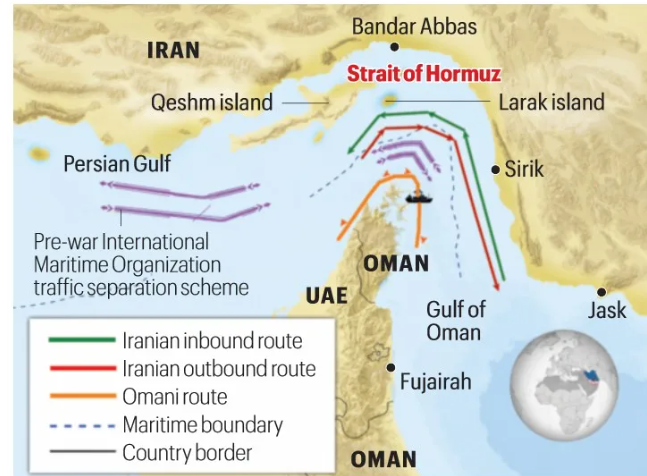
What was the Proposed Transit Fee?
- The US President had announced that the United States would become the “Guardian of the Hormuz Strait” and provide security to commercial vessels.
- In return, the US proposed a 20% reimbursement fee on all cargo shipped through the Strait.
- The stated purpose was to recover the cost incurred by American forces in securing navigation through the strategically important waterway.
However, the announcement did not explain:
- The basis for calculating the fee
- The authority responsible for collecting it
- The vessels or cargo to which it would apply
- The method of enforcement
- The security guarantee offered in return
- The President later announced that the proposed fee would be replaced with trade and investment commitments from Gulf countries.
Why was the Proposal Unworkable?
Calculation Ambiguity
The announcement did not clarify whether the 20% fee would be calculated on:
- The total value of cargo
- The cost incurred by the US military
- Freight and insurance charges
- Some other formula
If imposed on the total cargo value, the fee would have been far higher than normal shipping costs and would have sharply raised the landed price of energy and other commodities.
Lack of Enforcement Mechanism
- The proposal did not explain how the US would collect the levy from vessels belonging to different countries.
- Imposing such a charge would have required control over vessel movements, shipping routes, ports, insurers and payment systems.
Doubtful Security Guarantee
- The US justified the levy as payment for providing safe passage. However, its response to Iranian attacks on vessels had mainly been retaliatory.
- The absence of pre-emptive protection raised doubts over whether Washington could guarantee uninterrupted and secure commercial navigation.
Impact on Global Energy Markets
Before the conflict, the Strait of Hormuz carried nearly one-fifth of global oil and LNG flows.
A 20% levy could have raised:
- Crude oil prices
- LNG and LPG costs
- Shipping charges
- War-risk insurance premiums
- Fertiliser and industrial-input prices
It could therefore have affected global inflation and trade.
International Legal Position
- The International Maritime Organization opposed the proposed fee.
- It maintained that there was no legal basis for imposing mandatory tolls merely for transiting a strait used for international navigation.
Position under UNCLOS
- The United Nations Convention on the Law of the Sea recognises transit passage through international straits.
- Natural waterways such as the Strait of Hormuz generally do not carry a mandatory transit fee, unlike artificial waterways such as:
- Suez Canal
- Panama Canal
- Charges may be imposed for specific services supplied to vessels, but not merely for passage through an international strait.
- Neither the US nor Iran has ratified UNCLOS. However, several of its navigational principles are widely accepted as customary international law.
Contradiction with the US Position
- The US has traditionally supported freedom of navigation and opposed Iranian attempts to regulate or charge vessels passing through Hormuz.
- The proposed American levy contradicted this long-standing position and could have strengthened Iran’s argument that it too had the right to impose tolls.
US–Iran Contest over the Strait
The fee controversy reflects a deeper struggle between the US and Iran over control of the Strait of Hormuz.
Interim US–Iran Pact
An interim agreement signed on June 17, 2026, aimed to reopen the Strait.
Following the agreement:
- Vessel movements increased
- Transits crossed 90 on June 24
- Average daily movements remained around 40–50 on several days
However, this remained below the pre-war level of up to 140 daily vessel transits.
Renewed tensions later caused movements to fall to their lowest level in nearly a month.
Iran’s Position
Iran claimed that it had always been the guardian of the Strait and argued that whoever provided secure passage could seek compensation.
However, Iran’s Foreign Minister described the proposed 20% rate as excessive.
Since the conflict began in February 2026, Iran has:
- Asserted sovereignty over parts of the Strait
- Directed vessels to use Tehran-authorised routes
- Targeted vessels using unauthorised lanes
- Proposed a service fee for transit
- Temporarily closed the Strait to commercial shipping
US Position
- The US rejected Iran’s control over maritime traffic and encouraged vessels to use routes closer to Oman’s coastline.
- It also conducted strikes against Iranian military targets in response to attacks on commercial vessels.
- The conflicting interpretation of the June agreement became a major source of renewed tension.
Strategic Importance of the Strait of Hormuz
- The Strait of Hormuz is a narrow maritime passage between Iran and Oman connecting the Persian Gulf with the Gulf of Oman and the Arabian Sea.
- It is one of the world’s most important energy chokepoints because major West Asian oil and gas exporters depend on it.
Disruption affects:
- Global crude oil supply
- LNG and LPG shipments
- Shipping and insurance costs
- Energy-importing economies
- Inflation and industrial production
The imposition of competing US and Iranian fees could also have forced shipping companies to choose one side, increasing the risk of retaliatory targeting.
Why the Proposal Mattered for India
India is highly dependent on imported energy transported through the Strait of Hormuz.
Dependence on West Asian Supplies
Approximately:
- 40% of India’s crude oil imports
- 60% of its LNG imports
- 90% of its LPG imports
come from West Asia through the Strait.
India’s overall import dependence is more than:
- 88% for crude oil
- 60% for LPG
- About 50% for natural gas
This makes India particularly vulnerable to disruption or additional transit costs.
Possible Rise in Crude Oil Costs
- If crude oil were priced at USD 75 per barrel, a 20% fee would add USD 15, pushing the landed cost to more than USD 90 per barrel after freight and insurance.
- India imports approximately 1.8–2 billion barrels of crude oil annually.
- Every USD 1 increase per barrel can raise India’s annual oil import bill by up to USD 2 billion.
Estimated Additional Burden
Assuming that 30% of India’s oil imports continued to pass through Hormuz, the fee could have added approximately USD 9 billion annually to India’s crude oil import bill.
This estimate excludes the additional burden on:
- LNG
- LPG
- Fertilisers
- Petrochemicals
- Industrial inputs
The actual economic cost could therefore have been considerably higher.
India’s Response to the Crisis
- India has consistently maintained that international waterways such as the Strait of Hormuz should remain free and accessible to all vessels.
Diversification of Crude Oil Sources
Diversified sourcing helped India maintain adequate crude oil supplies during the crisis.
However, diversification could not fully insulate India from:
- Higher international prices
- Increased freight costs
- War-risk insurance premiums
- LNG and LPG supply constraints
Gas Rationing
The government rationed gas supplies to certain industries and commercial consumers to ensure availability for:
- Households
- Priority sectors
- Essential services
Some restrictions were relaxed after the June agreement improved vessel movements.
Measures against Panic Buying
- Emergency measures were introduced to discourage panic buying and maintain public confidence in domestic fuel availability.
Supply Security over Price
- India prioritised energy availability over cost.
- Its oil imports during March–May 2026 increased by 47% year-on-year to USD 48.88 billion, according to provisional data from the Ministry of Petroleum and Natural Gas.
Wider Economic Consequences for India
Higher energy prices affect the wider economy through several channels.
Trade Balance
Oil, gas and other energy products constitute a major part of India’s imports. Higher costs widen the merchandise trade deficit.
Current Account Deficit
A larger energy import bill can increase the current account deficit unless compensated by stronger exports or capital inflows.
Inflation
Higher crude prices raise the cost of:
- Petrol and diesel
- Transportation
- Fertilisers
- Electricity
- Industrial production
- Food distribution
This can produce wider inflationary pressures.
Rupee Exchange Rate
Higher demand for dollars to pay for energy imports may weaken the rupee.
Currency depreciation can further increase the domestic cost of imported energy.
Fiscal Pressure
If the government or oil-marketing companies absorb part of the price increase, it may create pressure on subsidies, taxation and public finances.
Way Forward
Protect Freedom of Navigation
- India should continue to support unrestricted and non-discriminatory passage through international waterways in accordance with international law.
Diversify Energy Sources
India should expand sourcing from:
- Russia, United States,Africa,Latin America,Other non-Hormuz suppliers
Long-term contracts and flexible supply arrangements can reduce concentration risks.
Strengthen Strategic Reserves
Larger strategic petroleum reserves can provide temporary protection during major supply disruptions.
Expand Alternative Energy
Reducing dependence on imported hydrocarbons requires faster expansion of:
- Renewable energy
- Green hydrogen
- Biofuels
- Electric mobility
- Domestic natural-gas production
Improve Maritime Risk Preparedness
India should strengthen coordination among:
- Navy
- Shipping companies
- Energy importers
- Insurers
- Ports
- Diplomatic missions
This can support vessel tracking, risk assessment and emergency rerouting.
Build Supply-Chain Resilience
Long-term resilience requires diversified transport routes, storage capacity and agreements with multiple suppliers.
Diplomatic Engagement
India should maintain dialogue with the US, Iran, Oman and Gulf countries to promote de-escalation and uninterrupted commercial navigation.
Conclusion
The reversal of the proposed 20% Hormuz fee exposed the legal, diplomatic and economic limits of unilaterally taxing an international maritime strait. For India, the episode demonstrates the vulnerability created by heavy dependence on West Asian energy supplies. Continued support for freedom of navigation, diversified sourcing, strategic reserves and faster energy transition are essential to protect India’s economy from geopolitical disruptions and strengthen long-term energy security.