News at a Glance |
| Andhra Pradesh: A.P. DSP Harshitha Manikanta scales Mount Elbrus |
| Balakrishna finds place in World Book of Records, Naidu terms it historic milestone |
| Science and Tehcnology: ISRO Successfully Conducts Integrated Air Drop Test (IADT-1) for Gaganyaan Mission |
| The Mystery of Cellular Complexity: Insights from Asgard Archaea Research |
| Polity and Governance: Presidential Reference and Judicial Review |
| A Decade After the Land Boundary Agreement: Citizenship Challenges of Enclave Residents |
| Defence: India–France Collaboration on 120 kN Engine for AMCA |
| DRDO Successfully Tests Multi-Layered Air Defence System |
| Andhra Pradesh: A.P. DSP Harshitha Manikanta scales Mount Elbrus |
A.P. DSP Harshitha Manikanta scales Mount Elbrus
Source: The Hindu
APPSC Syllabus Relevance: Sports
Context: Mount Elbrus and Seven summits
Why in News
DSP Harshitha Manikanta of Andhra Pradesh Police scaled Mount Elbrus, the highest peak in Europe.
Introduction
- Deputy Superintendent of Police (DSP) Harshitha Manikanta, attached to the Railways wing of the Andhra Pradesh Police, has achieved a remarkable feat by successfully scaling Mount Elbrus, the highest peak in Europe.
- Standing at 5,642 metres in the Caucasus mountain range, along the Russia–Georgia border, Mount Elbrus is one of the most challenging summits in the world.
Key Highlights of the Achievement
- Mount Elbrus: The tallest peak in Europe, part of the prestigious Seven Summits challenge.
- Conditions faced: Extreme freezing temperatures, steep and icy slopes, unpredictable weather conditions.
- Training: Harshitha balanced rigorous mountaineering preparation with her professional duties as a police officer.
- Recognition: Andhra Pradesh Home Minister V. Anita congratulated her, calling the feat a reflection of the discipline and perseverance of the State police force.
- Personal front: She is married to Chittoor Superintendent of Police Manikantha Chandolu, underlining the support and motivation within the police fraternity.

(Image Source: The Hindu)
About Mount Elbrus
- Height: 5,642 metres (18,510 feet).
- Location: Caucasus Range, straddling the border of Russia and Georgia.
- Significance: Known as the highest peak in Europe and part of the Seven Summits challenge – climbing the highest peak in each continent.
- Mountaineering Challenges: Harsh weather, crevasses, glaciers, and thin oxygen levels.
Broader Significance
1. Women Empowerment in Uniformed Services
- Demonstrates the growing presence of women officers in challenging fields beyond their official duties.
- Inspires young women to pursue careers in the police and armed services while excelling in extra-professional arenas.
2. Discipline and Perseverance
- Upholds the values of the police force – endurance, courage, and dedication – on an international platform.
- Highlights the ability to balance professional responsibilities with personal passions.
3. International Geography and Cultural Linkages
- Draws attention to the Caucasus region, a geopolitically significant area between Europe and Asia.
- Mountaineering feats like these build global awareness and people-to-people connections.
4. The Seven Summits Challenge
- Scaling Mount Elbrus is a step toward completing the Seven Summits challenge, pursued by elite mountaineers worldwide.
- This places Indian officers and adventurers on the global adventure sports map.
Seven Summits
- Asia – Mount Everest (8,848 m)
- South America – Aconcagua (6,961 m)
- North America – Denali (6,190 m)
- Africa – Kilimanjaro (5,895 m)
- Europe – Elbrus (5,642 m)
- Antarctica – Vinson Massif (4,892 m)
- Australia/Oceania – Puncak Jaya (Carstensz Pyramid, 4,884 m) or Mount Kosciuszko (2,228 m, alternative)
CARE MCQ |
Q1. Which of the following statements about DSP Harshitha Manikanta’s feat of scaling Mount Elbrus are correct?
Select the correct answer using the code given below: A) 1 and 2 only B) 2 and 3 only C) 1 and 3 only D) All of the above |
Answer 1- A
|
Balakrishna finds place in World Book of Records
Source: The Hindu
APPSC Syllabus Relevance: Awards
Context: World Book of Records
Why in News
Nandamuri Balakrishna has been recognised by the World Book of Records, U.K., for completing 50 years as a lead hero in Indian cinema and for his social contributions through healthcare.
Introduction
- Nandamuri Balakrishna, veteran Telugu actor and politician, has been recognised by the World Book of Records, U.K., for completing an extraordinary journey of 50 years as a lead hero in Indian cinema.
- This recognition was included in the Gold Edition of World Book of Records, acknowledging not just his contribution to the film industry but also his service to society through healthcare initiatives.
Key Highlights of the Recognition
- Recognition by World Book of Records, U.K.
- Balakrishna’s achievement of completing 50 years as a lead hero in Indian cinema was formally recognised.
- Included in the Gold Edition for his long-standing contribution to cinema.
- Official Acknowledgements
- Chief Minister N. Chandrababu Naidu congratulated him, calling the journey a “golden chapter in Indian film history”.
- HRD Minister Nara Lokesh stated that it was a proud moment for the family and admirers of Telugu cinema.
- World Book of Records CEO Santosh Shukla highlighted his dual contribution—cinema and social service through healthcare.

(Image Source: The Hindu)
About Nandamuri Balakrishna
- Film Career
- Debuted as a child artist in 1974 in Tatamma Kala.
- Emerged as one of the leading actors in Telugu cinema with iconic performances in mythological, historical, and action films.
- Known for roles in Mangammagari Manavadu, Muddula Mavayya, Narasimha Naidu, Legend, and Gautamiputra Satakarni.
- Has acted in over 100 films, maintaining a distinct presence in the industry.
- Political Career
- Member of the Telugu Desam Party (TDP).
- Currently represents Hindupur constituency in the Andhra Pradesh Legislative Assembly.
- Social Contribution
- Serves as Chairman of the Basavatarakam Indo American Cancer Hospital & Research Institute for 15 years, providing affordable cancer care.
- Actively involved in philanthropic work in healthcare.
Significance of the Recognition
-
For Indian Cinema
- Acknowledges the longevity and consistency of an actor who has sustained a career as a lead hero for five decades.
- Reflects the cultural importance of Telugu cinema within the larger Indian film industry.
-
For Andhra Pradesh and Telugu Pride
- The recognition reinforces Telugu cinema’s global presence and strengthens regional identity in Indian cultural heritage.
- Enhances pride among Telugu-speaking communities and admirers of Balakrishna’s legacy.
-
For Social Service and Leadership
- The award also recognises contributions beyond cinema, particularly in the field of healthcare and public service.
- Highlights how film personalities in India often extend their influence into politics and social welfare.
CARE MCQ |
Q2. Consider the following statements regarding Nandamuri Balakrishna’s recognition by the World Book of Records:
Which of the statements given above is/are correct? (A) 1 only |
Answer 2- B
|
ISRO Successfully Conducts Integrated Air Drop Test (IADT-1) for Gaganyaan Mission
Source: The Hindu
UPSC Relevance: GS 3 Science and Technology
Context: Integrated Air Drop Test (IADT-1)
Why in News
ISRO successfully conducted its first Integrated Air Drop Test (IADT-1) to validate the parachute-based deceleration system for the Gaganyaan human spaceflight mission.
Introduction
- Recently, the Indian Space Research Organisation (ISRO) successfully carried out its first Integrated Air Drop Test (IADT-1) — a critical milestone in the country’s maiden human spaceflight programme, Gaganyaan.
- The test was aimed at validating the parachute-based deceleration system, a vital safety mechanism to ensure the safe return of astronauts during re-entry and landing.
- This achievement marks a significant step towards human-rating India’s launch and recovery systems and brings India closer to joining the select league of nations capable of independent human spaceflight.
What is the Integrated Air Drop Test (IADT)?
- The IADT is a specialised test to ensure that the parachute deployment system of the Gaganyaan crew module performs reliably under real-world conditions.
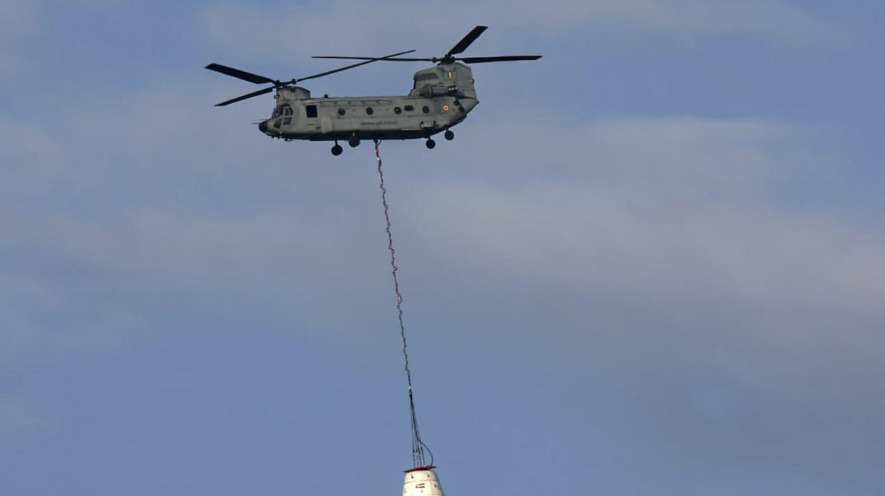
- A dummy crew capsule weighing around 5 tonnes was airlifted by an IAF Chinook helicopter and dropped from altitude.
- As the capsule descended through a few kilometres, the main parachutes deployed in a specific sequence to decelerate it to a safe splashdown speed.
- In actual missions, parachutes will deploy after atmospheric re-entry, slowing the module further after initial deceleration by heat shields and drogue parachutes.
- Thus, the IADT validates end-to-end functioning of the parachute recovery system, a life-critical component for astronauts.
(Image Source: The Hindu)
Importance of the Test
- Crew Safety – Ensures astronauts can return safely during splashdown phase.
- Risk Mitigation – The ascent, descent, and splashdown are the most hazardous mission phases; parachute systems reduce risks.
- Validation of Systems – Confirms integration of capsule design, parachute sequencing, and recovery mechanisms.
- Inter-Agency Cooperation – Involved multiple agencies like the Indian Air Force, Navy, DRDO, and Coast Guard in recovery operations.
- Step Towards Human-Rating – Establishes confidence in systems required for human spaceflight clearance.
Preparatory Work for Gaganyaan (as per Govt. updates)
- Union Minister of State for Science & Technology, Jitendra Singh, informed Parliament about major progress:
- Propulsion Systems: Crew module and service module propulsion systems developed and tested.
- Environmental Control & Life Support System (ECLSS): Engineering model realised.
- Crew Escape System (CES): Five types of motors developed and statically tested.
- Infrastructure:
- Orbital Module Preparation Facility
- Gaganyaan Control Centre & Facility
- Crew Training Facility
- Second Launch Pad modifications
- Precursors Missions: TV-D1 completed earlier; further missions like TV-D2 and G1 planned.
- Hardware Realisation:
- C32-G stage and CES motors developed
- HS200 Motors tested
- Crew Module and Service Module structures realised and phase-1 checks completed.
Roadmap for India’s Human Spaceflight Programme
- Gaganyaan First Uncrewed Flight (G1) → To validate systems without crew.
- Crewed Flight → Targeted in Q1 2027.
- Beyond Gaganyaan:
- Bharatiya Antariksh Station (BAS) by 2035.
- Indian Moon Landing by 2040.
- Long-term objective: independent sustained presence in Low Earth Orbit (LEO).
Significance of Gaganyaan
- Strategic Milestone – Places India in an elite group (USA, Russia, China).
- Atmanirbhar Bharat – Boosts self-reliance in critical space technologies.
- Technological Spin-offs – Advances in robotics, materials science, life sciences, avionics, and communication systems.
- Inter-agency Coordination – Strengthens synergy between ISRO, DRDO, IAF, Navy, and industry partners.
- Global Standing – Enhances India’s stature as a major spacefaring nation.
Challenges Ahead
- Human-rating launch vehicles and systems to international safety standards.
- Reliability of Crew Escape System (CES) under real emergency conditions.
- Life support systems for extended human survival in space.
- Astronaut training & psychological preparedness for mission stresses.
- Coordination of recovery operations in high seas.
Conclusion
- The successful Integrated Air Drop Test (IADT-1) marks a major milestone in India’s march towards its first human spaceflight under the Gaganyaan Mission. With continued progress in precursor tests, propulsion validation, life support development, and inter-agency coordination, India is on track to achieve its first crewed mission in 2027.
CARE MCQ |
UPSC PYQ |
Q1. Consider the following statements regarding the Integrated Air Drop Test (IADT-1) conducted by ISRO:
Which of the statements given above is/are correct? A. 1 and 2 only B. 2 and 3 only C. 1 and 3 only D. 1, 2 and 3 |
Q. Consider the following statements: (2016)
The Mangalyaan launched by ISRO
Which of the statements given above is/are correct? (a) 1 only (b) 2 and 3 only (c) 1 and 3 only (d) 1, 2 and 3 Ans: (c) |
| Answer 1- A
Explanation
|
The Mystery of Cellular Complexity: Insights from Asgard Archaea Research
Source: The Hindu
UPSC Relevance: GS3 Science and Technology
Context: Prokaryotic cells (bacteria and archaea)
Why in News
Indian Institute of Science (IISc) researchers discovered that Odinarchaeota (Asgard archaea) possesses two distinct FtsZ genes and a tubulin-like gene.
Introduction
One of the grand questions in biology is how simple prokaryotic cells (bacteria and archaea) evolved into complex eukaryotic cells found in animals, plants, fungi, and protists.
- Prokaryotic cells → Small, simple, lack internal compartments.
- Eukaryotic cells → Possess nuclei, organelles, and complex cytoskeletons that allow them to change shape, divide efficiently, and perform specialized functions.
The transition from prokaryotes to eukaryotes marks a major evolutionary leap, sometimes called the “eukaryogenesis problem”.
- A recent study by researchers at the Indian Institute of Science (IISc), Bengaluru, published in The EMBO Journal, has shed light on this transition using Asgard archaea, a group of microbes believed to be the closest living relatives of eukaryotes.
Why Asgard Archaea Are Important
- Named after the Norse gods, Asgard archaea (including Odinarchaeota, Lokiarchaeota, Thorarchaeota) were discovered in deep-sea sediments.
- They are considered the “missing link” between simple archaea and complex eukaryotes.
- Their genomes contain eukaryotic signature proteins (ESPs), including cytoskeletal proteins, suggesting evolutionary experimentation with cell structure and division.

(Image Source: The Hindu)
The Role of the Cytoskeleton in Evolution
- Cytoskeleton = Protein network giving cells shape, strength, and machinery for division and intracellular transport.
- In bacteria: Cell division is carried out by FtsZ protein, a tubulin-like protein that forms a “Z-ring” during binary fission.
- In eukaryotes: More advanced proteins like tubulin, actin, intermediate filaments support not only cell division but also organelle positioning and intracellular movement.
Thus, understanding how the cytoskeleton evolved helps us understand how complexity in life first arose.
Key Findings of the IISc Study
The team studied Odinarchaeota, an Asgard archaea, and discovered:
- Two FtsZ genes instead of one (unusual for prokaryotes).
- Named OdinFtsZ1 and OdinFtsZ2.
- Presence of a tubulin-like gene alongside them.
Experimental Insights
- Phylogenetic analysis: Showed the evolutionary position of these proteins.
- Biochemical tests + Cryo-electron microscopy: Helped visualize structures formed by proteins.
Behaviour of the Two FtsZ Proteins
- OdinFtsZ1:
- Formed straight protofilaments (similar to bacterial FtsZ).
- Could directly anchor to membranes → shows bacterial-like division.
- OdinFtsZ2:
- Formed spiral, ring-like structures (more complex).
- Needed adaptor proteins to attach to membranes.
- Together: They interacted, suggesting a division of labour.
Evolutionary Significance
- The co-existence of two FtsZ paralogs shows that even in archaea, proteins were beginning to specialize in different roles.
- The presence of tubulin-like protein along with FtsZ hints that Asgard archaea were experimenting with structural innovations.
- This may represent an intermediate stage in cytoskeletal evolution, foreshadowing the diverse systems in eukaryotes.
In other words, these microbes preserve a “snapshot of evolution in action”, where life was transitioning from simplicity to complexity.
Broader Implications
- Evolutionary Biology: Supports the theory that eukaryotes emerged from archaeal lineages, not from bacteria.
- Molecular Cell Biology: Offers insights into how proteins evolved new functions (protein paralogy → division of labour).
- Origin of Life Research: Adds to understanding of how complexity arises in living systems.
- Future Research: IISc team plans to grow live Asgard archaea in labs → could reveal real-time protein behaviour in living cells.
Conclusion
- The IISc study on Odinarchaeota cytoskeletal proteins provides rare evidence of how early life forms experimented with cell division machinery, eventually giving rise to the sophisticated cytoskeletal systems of eukaryotes.
- It highlights India’s contribution to fundamental questions of life’s origins and demonstrates how studies of microbes can illuminate evolutionary history.
CARE MCQ |
UPSC PYQ |
Q2. With reference to Asgard archaea, recently in news, consider the following statements:
Which of the statements given above is/are correct? (A) 1 and 2 only (B) 2 and 3 only (C) 1 and 3 only (D) 1, 2 and 3 |
Q. What is Cas9 protein that is often mentioned in news? (2019)
(a) A molecular scissors used in targeted gene editing (b) A biosensor used in the accurate detection of pathogens in patients (c) A gene that makes plants pest-resistant (d) A herbicidal substance synthesized in genetically modified crops Ans: (a) |
| Answer 2- C
Explanation
|
Presidential Reference and Judicial Review
Source: The Hindu
UPSC Syllabus Relevance: GS2 Polity and Governance
Context: Article 143 -the Supreme Court
Why in News
President Droupadi Murmu has referred questions under Article 143 to the Supreme Court, seeking clarity on whether the President and Governors can be judicially compelled to act within timelines on Bills.
Introduction
- A Constitution Bench led by Chief Justice of India B. R. Gavai is hearing a Presidential Reference under Article 143.
- President Droupadi Murmu has sought clarity on whether the President and Governors can be judicially compelled to act within prescribed timelines while granting assent to Bills passed by State legislatures.
- The Reference follows the Supreme Court’s April 8, 2025 judgment, where the Court held that the Governor’s inaction in granting assent to Bills was illegal, and it imposed judicially enforceable timelines on Governors and the President for the first time.
Background of the Case
- The Tamil Nadu Government approached the Supreme Court against Governor R.N. Ravi’s delay in assenting to 10 Bills, which were re-passed by the legislature.
- Instead of acting promptly, the Governor reserved them for Presidential consideration after prolonged inaction.
- On April 8, 2025, a Bench of Justices J.B. Pardiwala and R. Mahadevan:
- Declared the Governor’s delay unconstitutional and illegal.
- Held that both Governor and President must act within a “reasonable time” on Bills.
- Introduced judicially enforceable timelines — a landmark step in defining accountability of constitutional heads.

(Image Source: The Hindu)
Key Constitutional Provision – Article 143
- Article 143 (1): The President may refer a question of law or fact of public importance to the Supreme Court for its advisory opinion.
- Article 143 (2): The President may refer matters concerning pre-Constitution treaties, agreements, etc.
- The Supreme Court’s opinion under Article 143 is advisory and not binding. However, it carries great persuasive value and is usually followed.
The Core Questions Before the Court
- Can the Supreme Court, while answering a Presidential Reference, revisit and possibly overrule its own prior judgment?
- Do Governors and the President enjoy discretion in delaying assent, or are they bound by judicially enforceable timelines?
- What is the scope of judicial review over constitutional heads in legislative processes?
Can SC Overrule Its Own Verdict in a Presidential Reference?
- Ordinary Rule: The Supreme Court can review or overrule its previous judgments only in a judicial proceeding (review, curative petition, or larger bench reconsideration).
- In a Presidential Reference (Article 143):
- The Court cannot directly overturn its binding precedent, since the advisory jurisdiction is not adjudicatory.
- However, the Court can clarify, distinguish, or refine its earlier ruling in the course of answering the President’s questions.
- If the Court feels its earlier judgment is flawed, it can recommend that the matter be reconsidered by a larger bench in judicial proceedings.
Why This Reference is Important
- Separation of Powers: Defines the limits of judicial oversight over the President and Governors.
- Federalism: Protects State legislatures from arbitrary delays by Governors.
- Judicial Precedent: Raises the question of whether the Court can indirectly revisit a fresh ruling via Article 143.
- Checks and Balances: Reinforces accountability of nominated constitutional heads (Governor, President) to the democratic process.
Conclusion
- The Supreme Court’s April 2025 judgment sought to curb constitutional inaction by Governors and the President.
- The current Presidential Reference tests whether the Court’s advisory jurisdiction allows it to revisit or refine binding judicial precedents.
- While the Court may not directly overrule its own decision through Article 143, it can interpret and clarify the law, potentially paving the way for a larger bench to re-examine the April ruling.
CARE MCQ |
UPSC PYQ |
Q3. With reference to the Presidential Reference made to the Supreme Court in 2025 regarding Governors and the President’s role in granting assent to Bills, consider the following statements:
Which of the above statements is/are correct? (A) 1, 2 and 3 only (B) 1, 3 and 4 only (C) 2 and 4 only (D) 1, 2, 3 and 4 |
Q. Consider the following statements: (2010)
The Supreme Court of India tenders advice to the President of India on matters of law or fact
Which of the statements given above is/are correct? (a) 1 only (b) 2 only (c) 3 only (d) 1 and 2 Ans: (b) |
| Answer 3- B
Explanation
|
A Decade After the Land Boundary Agreement: Citizenship Challenges of Enclave Residents
Source: The Hindu
UPSC Syllabus Relevance: GS2 International Relations
Context: India–Bangladesh Land Boundary Agreement (LBA)
Why in News?
The 2015 India–Bangladesh Land Boundary Agreement (LBA) resolved the decades-old enclave problem, granting Indian citizenship to over 14,800 residents of Bangladeshi enclaves in Cooch Behar, West Bengal.
Background: The Enclave Problem
- Enclaves (Chitmahals): Territories of one country located inside another. India and Bangladesh inherited over 160 such enclaves after Partition in 1947.
- Land Boundary Agreement (LBA) 2015:
- 111 Indian enclaves in Bangladesh were transferred to Bangladesh.
- 51 Bangladeshi enclaves inside India (Cooch Behar, West Bengal) were integrated into India.
- 14,854 residents of Bangladeshi enclaves in India became Indian citizens (no one opted to move to Bangladesh).
- 922 residents of Indian enclaves in Bangladesh chose to migrate to India.
The agreement resolved a long-standing humanitarian and boundary issue, but the lived experience of “new citizens” highlights the gap between formal citizenship and socio-economic inclusion.

(Image Source: The Hindu)
Case Narratives: Struggles of New Citizens
1. Identity and Dignity
- Asma Bibi recalls being denied hospital admission in 2010 because she was an enclave resident.
- Naming her son “Jehad” was symbolic of the struggle for identity and citizenship.
- Today, she can vote, access hospitals, and hold Aadhaar and ration cards — yet daily life remains precarious.
2. Land and Property Rights
- Many enclave residents cannot register purchased land, leaving them vulnerable.
- Farmers cannot buy/sell land or claim benefits like PM-Kisan.
- Those who donated land for anganwadis and health centres feel betrayed when employment promises were not fulfilled, leading to closure of such centres.
3. Development Deficit
- Lack of schools, anganwadis, and functioning health centres.
- Inadequate housing support — State scheme Banglar Awas Yojana provides ₹1.3 lakh, insufficient for construction.
- No comprehensive skill training or livelihood programmes targeted at enclave youth.
4. Migration and Precarity
- Large-scale outmigration for work — 2-3 members per family working outside.
- Many face harassment/detention as “Bangladeshi suspects” despite Indian documents.
- Youth unemployment is high: some drop out of college, others prepare for low-level govt exams or migrate as casual labour.
5. Incomplete Documentation
- Many residents carry fraudulent parental names in school certificates (earlier needed for admission), creating lifelong identity complications.
- Residents of resettlement flats built for Indian returnees (922 migrants) still lack ownership papers, despite living there for years.
6. Eroding Enthusiasm
- July 31, the enclave exchange day, was once celebrated as an “Independence Day”.
- Now, enthusiasm has faded — youth feel political neglect, as their demands for education, land rights, and healthcare find little resonance.
Structural Issues and Policy Gaps
-
Legal-Citizenship vs. Substantive-Citizenship
- Formal inclusion as Indian citizens hasn’t translated into land tenure security, social welfare parity, or dignity of belonging.
-
Administrative Challenges
- Absence of pre-2015 records makes land regularisation and identity verification difficult.
- Bureaucratic delays in updating records, providing title deeds, and integrating enclave residents into welfare schemes.
-
Social and Psychological Dimensions
- Persistent suspicion and detention of enclave migrants reflect incomplete acceptance.
- Feelings of exclusion compared to neighbouring villages with uninterrupted citizenship since 1947.
-
Developmental Neglect
- Lack of affirmative development measures for enclaves despite their historical marginalisation.
- Closure of anganwadis and health centres due to unresolved land-job barter disputes.
- Youth unemployment leading to large-scale migration, replicating cycles of poverty.
Broader Significance
- Human Rights Perspective: Citizenship is not just legal recognition, but access to entitlements and freedom from discrimination.
- Federal Dimension: Centre–State tensions over schemes (e.g., stoppage of PM Awas Yojana funds) deepen developmental gaps.
- Security & Identity Politics: In the context of NRC and debates on illegal immigrants, enclave residents face double vulnerability — suspicion of being “outsiders” despite legal citizenship.
- Integration Challenge: The enclave issue shows that territorial integration does not automatically ensure social integration.
Way Forward
- Land Titling Reforms – Fast-track land surveys, property registration, and legal recognition of ownership.
- Targeted Development Package – Special funds for enclave areas covering housing, health, education, and livelihood.
- Skill Development & Employment – Vocational training, local entrepreneurship support, and job-linked schemes to reduce distress migration.
- Documentation Drive – Correcting fraudulent identity records from pre-2015 to ensure clean educational and social entitlements.
- Community Participation – Consult enclave residents in planning schemes (housing, anganwadis, health centres) to build trust.
- Awareness & Sensitisation – Police and officials need training to prevent wrongful detention of enclave residents as “foreigners”.
CARE MCQ |
UPSC PYQ |
Q4. Consider the following statements regarding the India–Bangladesh Land Boundary Agreement (2015):
Which of the statements given above is/are correct? (A) 1 and 2 only (B) 2 and 3 only (C) 1 and 3 only (D) 1, 2 and 3 |
Q. With reference to river Teesta, consider the following statements: (2017)
Which of the statements given above is/are correct? (a) 1 and 3 only (b) 2 only (c) 2 and 3 only (d) 1, 2 and 3 Ans: (b) |
| Answer – 4 – B
Explanation –
|
India–France Collaboration on 120 kN Engine for AMCA
Source: The Print
UPSC Syllabus Relevance: GS 3 Defence
Context: Advanced Medium Combat Aircraft (AMCA)
Why in News?
India has partnered with France’s Safran under a government-to-government deal to co-develop a 120 kN jet engine for the Advanced Medium Combat Aircraft (AMCA).
Introduction
- India has taken a decisive step in its quest for self-reliance in advanced defence technologies by partnering with France to jointly design and manufacture a 120 kN jet engine for the Advanced Medium Combat Aircraft (AMCA), India’s upcoming 5th generation fighter jet targeted for induction by 2035.
- The project will be executed under a Government-to-Government (G2G) agreement with the French engine manufacturer Safran, marking a major milestone in the Horizon 2047 roadmap of India–France strategic partnership.
Background: India’s Fighter Jet Programme
- AMCA (Advanced Medium Combat Aircraft):
- Indigenous 5th generation fighter under development by the Aeronautical Development Agency (ADA).
- Designed with stealth, super-cruise, advanced avionics, and multi-role capabilities.
- Planned in two phases:
- AMCA Mk-1 (Tranche 1): Powered by GE-414 engines.
- AMCA Mk-2 (Tranche 2): To be powered by the new 120 kN engine jointly developed with Safran.

(Image Source: The Hindu)
- Need for Indigenous Jet Engines:
- India’s experience with the Kaveri engine project highlighted the challenges of developing high-thrust jet engines domestically.
- Dependence on foreign suppliers has strategic and operational limitations.
- Developing a local ecosystem for jet engine manufacturing is vital for Atmanirbhar Bharat (self-reliant India) in defence.
Key Features of the India–France Engine Collaboration
- Partners:
- Government of India and Government of France.
- Industrial partner: Safran (France).
- Engine Specification:
- Thrust: 120 kN (kilonewtons).
- To be developed within 10 years, with production starting thereafter.
- Application:
- Will power AMCA Mk-2 (Tranche 2).
- AMCA Mk-1 will initially use GE-414 engines from the USA.
- Competing Bidders:
- Rolls Royce (UK).
- General Electric (USA).
- Safran (France) – selected due to wider ecosystem offer.
- Strategic Ecosystem Creation:
- Safran has pitched for creating a comprehensive engine manufacturing ecosystem in India.
- Includes potential for multiple engine types (fighter, transport, UAVs).
- Additional Cooperation:
- Safran is also establishing a Maintenance, Repair, and Overhaul (MRO) facility in Hyderabad for the Rafale’s M88 engine.
- This will be the first M88 servicing hub outside France, enhancing India’s aerospace servicing capabilities.
Significance of the Deal
1. Strategic Significance
- Reduces India’s dependence on US engines (GE) and diversifies supply sources.
- Enhances India–France defence partnership under Horizon 2047, commemorating 100 years of diplomatic ties.
- Strengthens India’s goal of fifth-generation fighter jet capability by 2035.
2. Technological Significance
- Transfer of advanced jet engine technology, which very few countries possess.
- Opportunity to develop indigenous R&D and manufacturing ecosystem for aero-engines.
- Lessons from the Kaveri project can be utilized with Safran’s expertise.
3. Economic and Industrial Significance
- Boosts Make in India and aerospace sector jobs.
- Development of local suppliers for high-tech aerospace components.
- Potential for India to emerge as an export hub for aircraft engines in the long run.
4. Defence Preparedness
- AMCA with indigenous engines will enhance strategic autonomy.
- Reduced vulnerability to sanctions or denial regimes (like CAATSA).
- Ability to integrate and modify engines without external constraints.
Challenges Ahead
- Timeframe: 10 years for development is ambitious, considering India’s past delays in aerospace projects.
- Technology Transfer Issues: Full transfer of cutting-edge technology (materials, turbine blades, thermal resistance) may face hurdles.
- Cost: Development of high-thrust jet engines involves multi-billion-dollar investments.
- Integration Risks: Smooth transition from GE-414 powered AMCA Mk-1 to Safran-powered Mk-2 requires careful planning.
India–France Defence Cooperation: A Broader Context
- Rafale Fighter Jets: India procured 36 Rafale fighters from France.
- Scorpene Submarines: India builds Scorpene-class submarines under technology transfer from France.
- Space Cooperation: Joint work between ISRO and CNES in satellite and space exploration.
- Horizon 2047 Roadmap: Sets long-term goals in defence, space, nuclear, digital innovation, and climate.
- 2026 – Year of Innovation: India and France to celebrate with joint R&D initiatives.
Conclusion
The India–France collaboration on the 120 kN AMCA engine represents a historic step towards strategic autonomy in aerospace technology. If executed successfully, it will:
- Power India’s 5th generation fighter jets.
- Establish India as a global aerospace hub.
- Deepen India–France ties under Horizon 2047.
However, success will depend on timely execution, effective technology transfer, and creation of a robust local supply chain. This project is not only about an engine—it is about building long-term indigenous capacity in one of the most complex defence technologies.
CARE MCQ |
UPSC PYQ |
Q5. With reference to India’s Advanced Medium Combat Aircraft (AMCA) programme, consider the following statements:
Which of the above statements are correct? (B) 1, 2 and 3 only (C) 2, 3 and 4 only (D) 1, 2, 3 and 4 |
Q. What is “Terminal High Altitude Area Defence (THAAD)”, sometimes seen in the news? (2018)
(a) An Israeli radar system (b) India’s indigenous anti-missile programme (c) An American anti-missile system (d) A defence collaboration between Japan and South Korea. Ans: (c) |
| Answer – 5 – B
Explanation –
|
DRDO Successfully Tests Multi-Layered Air Defence System
Source: The Hindu
UPSC Syllabus Relevance: GS3 Defence
Context: Multi-Layered Air Defence System
Why in News?
DRDO successfully conducted maiden flight tests of the Integrated Air Defence Weapon System (IADWS), a multi-layered indigenous air defence system.
Introduction
- On August 23, 2025, the Defence Research and Development Organisation (DRDO) successfully conducted the maiden flight tests of the Integrated Air Defence Weapon System (IADWS) off the coast of Odisha.
- This marks a significant leap in India’s indigenous air defence capability, as it integrates Quick Reaction Surface to Air Missiles (QRSAMs), Advanced Very Short Range Air Defence Systems (VSHORADS), and Directed Energy Weapons (DEW) into a single, coordinated defensive network.
Key Features of IADWS
-
Multi-layered Defence
- Designed to neutralise aerial threats at different ranges and altitudes.
- Provides a comprehensive protective shield against UAVs, drones, helicopters, and high-speed aircraft.

(Image Source: The Hindu)
-
Indigenous Systems
- QRSAM: Capable of intercepting aerial targets at short to medium ranges.
- VSHORADS: Portable, shoulder-fired missile system for close-range air defence.
- Directed Energy Weapon (DEW): A high-power laser-based system, designed to disable or destroy drones and low-flying aerial threats with precision.
-
Command and Control Integration
- Managed through a Centralised Command and Control Centre developed by the Defence Research and Development Laboratory (DRDL).
- Real-time integration of missile systems, detection radars, and laser systems ensures rapid response to simultaneous threats.
-
Testing Success
- Three aerial targets (two high-speed fixed-wing UAVs and one multi-copter drone) were simultaneously tracked, engaged, and destroyed by QRSAM, VSHORADS, and DEW.
- Performance validated by Range instruments at Chandipur Integrated Test Range (ITR).
Strategic Importance
-
Enhanced National Security
- Protects critical infrastructure, command centres, and strategic assets from enemy air attacks.
- Establishes a multi-layered defence bubble for Indian armed forces.
-
Indigenisation and Atmanirbhar Bharat
- Developed entirely by DRDO laboratories (DRDL, Research Centre Imarat, and Centre for High Energy Systems and Sciences).
- Reduces dependence on foreign air defence systems.
-
Technological Leap
- Integration of Directed Energy Weapons represents India’s entry into next-generation air defence technology, alongside traditional missile systems.
- Demonstrates capability in counter-drone warfare, crucial in modern conflicts.
-
Force Multiplier for Armed Forces
- Provides layered protection to troops and facilities.
- Complements long-range missile systems like Akash, Barak-8, and S-400 Triumf (Russian system in Indian service).
Broader Context – India’s Air Defence Architecture
India’s air defence ecosystem now spans across multiple layers:
- Long Range: Agni series (ballistic missile deterrence), Barak-8, S-400.
- Medium Range: Akash Missile System, MR-SAM.
- Short Range: QRSAM, Spyder.
- Very Short Range / Tactical: VSHORADS, MANPADS.
- Emerging Tech: Directed Energy Weapons, drone defence systems.
The IADWS fills a critical gap by providing an indigenous, multi-layered solution for simultaneous aerial threats.
Recent Developments in Indian Missile & Defence Systems
- Agni-5 Ballistic Missile test-fired successfully (2025).
- Gaganyaan Programme advanced with IADT-1 parachute test (Aug 2025).
- Expansion of Directed Energy Weapon research for counter-UAV and anti-missile roles.
Conclusion
- The successful testing of the Integrated Air Defence Weapon System (IADWS) represents a milestone in India’s journey towards self-reliant defence technology.
- It integrates missiles and laser-based weapons into a unified shield, offering multi-layered protection against evolving aerial threats.
- As Defence Minister Rajnath Singh highlighted, this strengthens India’s capability to defend vital assets and ensures technological parity with global powers in next-generation warfare.
CARE MCQ |
UPSC PYQ |
Q6. Consider the following statements about the Integrated Air Defence Weapon System (IADWS):
Which of the above statements are correct? (A) 1, 2 and 3 only (B) 1 and 4 only (C) 2 and 3 only (D) 1, 2, 3 and 4 |
Q. In the context of the Indian defence, what is ‘Dhruv’? (2008)
(a) Aircraft-carrying warship (b) Missile-carrying submarine (c) Advanced light helicopter (d) Intercontinental ballistic missile Ans: (c) |
| Answer – 6 – A
Explanation –
|