Table of Contents
Relevance: APPSC – Andhra Pradesh Specific (Economy, Industrial Policy, Governance Reforms, Ease of Doing Business)
For Prelims:
Deregulation Phase-2, Industrial Clearances, Ordinance Route, CFMS, AWARE 2.0, Data Lakes, WhatsApp Governance, Single-Window System
For Mains:
Deregulation Phase-2, Industrial Clearances, Ordinance Route, CFMS, AWARE 2.0, Data Lakes, WhatsApp Governance, Single-Window System
Why in News?
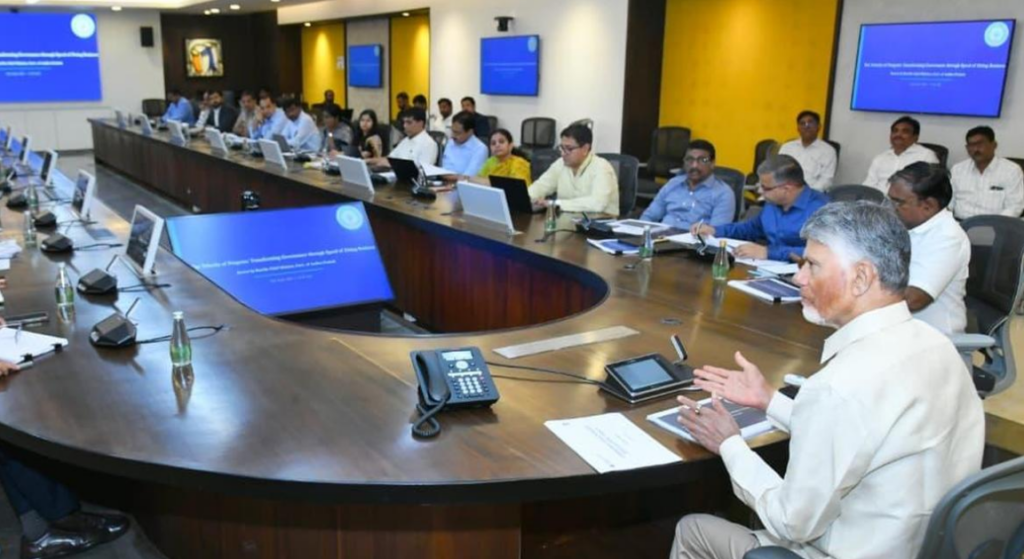
- Chandrababu Naidu has directed officials to implement Deregulation Phase-2 reforms to simplify industrial approvals and improve ease of doing business in Andhra Pradesh.
Background
- Andhra Pradesh has been focusing on improving its industrial ecosystem to attract investment and promote economic development.
- Complex regulatory procedures, multiple approvals, and outdated laws have been identified as key obstacles for industries.
- In this context, the State government has initiated a phased deregulation strategy to simplify procedures and enhance investor confidence.
Key Decisions and Announcements
- The Chief Minister emphasised the need to reduce complexity in industrial approvals and ensure a transparent, time-bound process.
- He proposed reducing more than 800 existing regulations to fewer than 100, thereby simplifying compliance requirements.
- Permissions and licences are to be limited to single-digit numbers, reducing procedural burden on industries.
- A lifetime validity for business registrations has been suggested to avoid repeated renewals.
- The government aims to reduce the time taken for industrial clearances by at least 40%.
- It has also been proposed to implement reforms through the Ordinance route for faster execution.
Deregulation Measures
The reform strategy includes several structural changes:
- Removal of outdated laws, including those from the colonial period
- Shift from permission-based system → self-declaration and intimation-based system
- Merging of approvals within departments to avoid duplication
- Elimination of double licensing systems
- Introduction of third-party inspections to reduce bureaucratic delays
Digital Governance Tools Used in Andhra Pradesh
The State is leveraging advanced digital systems to support these reforms:
- CFMS (Comprehensive Financial Management System) → financial monitoring
- AWARE 2.0 → real-time governance and data integration
- Data Lakes → centralised data storage and analytics
- Real-time data platforms → monitoring administrative processes
- WhatsApp Governance → citizen-service interface
These tools aim to make the approval process fully online and transparent.
Administrative Reform Model
The reform reflects a transition from a control-based regulatory system to a facilitation-based governance model.
The focus is on:
- Reducing administrative burden
- Increasing efficiency
- Enhancing investor experience
At the same time, the government has clarified that public safety and environmental standards will not be compromised.
Significance
- The reforms directly strengthen Andhra Pradesh’s position in Ease of Doing Business rankings.
- They aim to attract domestic and foreign investment by creating a simplified regulatory environment.
- The use of digital tools highlights the State’s emphasis on technology-driven governance.
- The shift towards self-declaration reflects a move towards trust-based governance, reducing bureaucratic intervention.
Challenges
- Ensuring compliance under a self-declaration system may require strong monitoring mechanisms.
- There is a need to balance deregulation with environmental and safety safeguards.
- Effective coordination across departments is necessary for successful implementation.
- Adoption of digital systems requires capacity building and technical infrastructure.
Way Forward
- The government should ensure proper monitoring and auditing mechanisms to prevent misuse of deregulation.
- Capacity building of officials and industries is essential for smooth implementation.
- Further phases of deregulation should focus on AI-based governance tools and deeper digital integration.
- A balanced approach combining ease of doing business with regulatory safeguards will be crucial.
CARE MCQ
Q.With reference to deregulation reforms in Andhra Pradesh, consider the following statements:
- The reforms aim to reduce the number of regulations from more than 800 to fewer than 100.
- The system shifts from permission-based approvals to self-declaration mechanisms.
- The reforms eliminate all regulatory checks including environmental safeguards.
Which of the above statements are correct?
A. 1 and 2 only
B. 2 and 3 only
C. 1 and 3 only
D. 1, 2 and 3
Answer: (a)
Explanation:
Statement 1 is correct: The number of regulations is proposed to be reduced significantly.
Statement 2 is correct: The system shifts towards self-declaration.
Statement 3 is incorrect: Environmental and safety safeguards will continue.
Q.Andhra Pradesh ranks among the leading states in India in which of the following sectors?
(a) Inland aquaculture production
(b) Petroleum refining capacity
(c) Tea plantation output
(d) Wool production
Ans: (a)
Explanation: Andhra Pradesh is the leading state in inland aquaculture, especially shrimp and fish farming, supported by extensive canal irrigation and coastal conditions, making fisheries a major contributor to the state economy.
Q.Which port is the largest in Andhra Pradesh in terms of cargo handling?
(a) Kakinada Port
(b) Krishnapatnam Port
(c) Visakhapatnam Port
(d) Gangavaram Port
Ans: (c)
Explanation: Visakhapatnam Port is one of the major ports of India and the largest in Andhra Pradesh, handling diverse cargo including coal, iron ore, and petroleum products, making it a key trade gateway.
Q.The Polavaram Project is primarily associated with which objective?
(a) Thermal power generation
(b) Irrigation and inter-basin water transfer
(c) Coastal erosion control
(d) Urban drinking water supply only
Ans: (b)
Explanation: The Polavaram Project is a multi-purpose irrigation project aimed at irrigation, inter-basin water transfer, flood control, and hydroelectric generation, significantly contributing to agricultural and regional development.
MAINS QUESTION
Q. Examine the role of deregulation and digital governance in improving ease of doing business in Andhra Pradesh.
Word Limit: 250 words
FAQs
Q1. What is deregulation?
Deregulation refers to reducing government rules and restrictions to simplify processes and promote economic activity.
Q2. What is the objective of Deregulation Phase-2 in Andhra Pradesh?
To simplify industrial approvals, reduce delays, and improve ease of doing business.
Q3. What is meant by self-declaration system?
Industries can start operations based on their own declaration of compliance, instead of waiting for prior approvals.
Q4. What is CFMS?
Comprehensive Financial Management System used for financial monitoring in Andhra Pradesh.