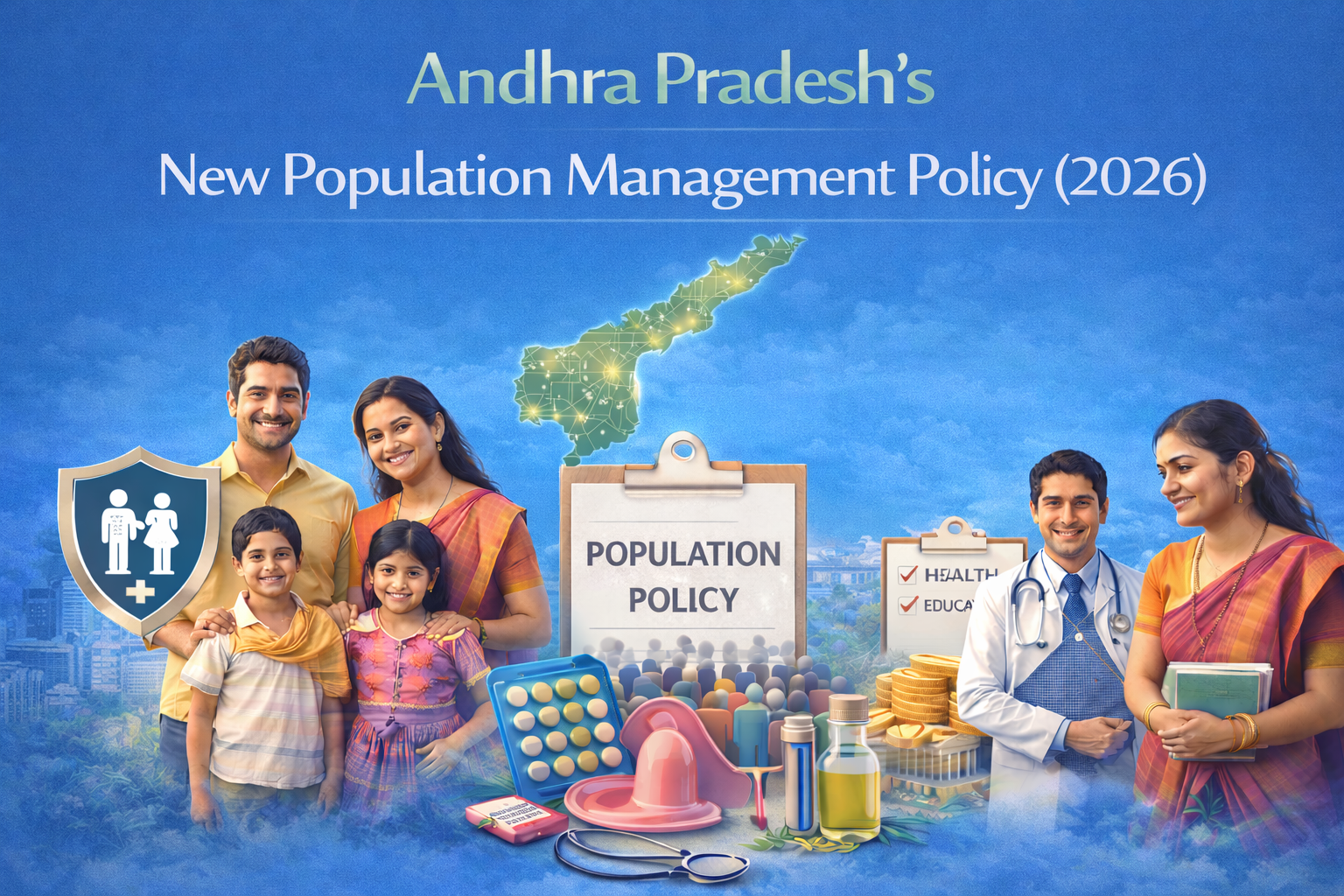
Andhra Pradesh’s New Population Management Policy (2026)
Table of Contents
Relevance: Governance
For Prelims:
- Population Management Policy (2026), Total Fertility Rate (TFR), Replacement Level Fertility (2.1), Ageing Population, Delimitation of Lok Sabha Seats, Two-Child Norm (Local Elections), ₹25,000 Birth Incentive, Poshana–Shiksha–Suraksha Package
For Mains:
- Declining Fertility Rate, Ageing Society, Shrinking Workforce, Demographic Dividend, Human Capital Development, Women’s Labour Force Participation, Political Representation and Delimitation, Fiscal Burden on State Finances, Childcare and Social Support Infrastructure
Why in News?
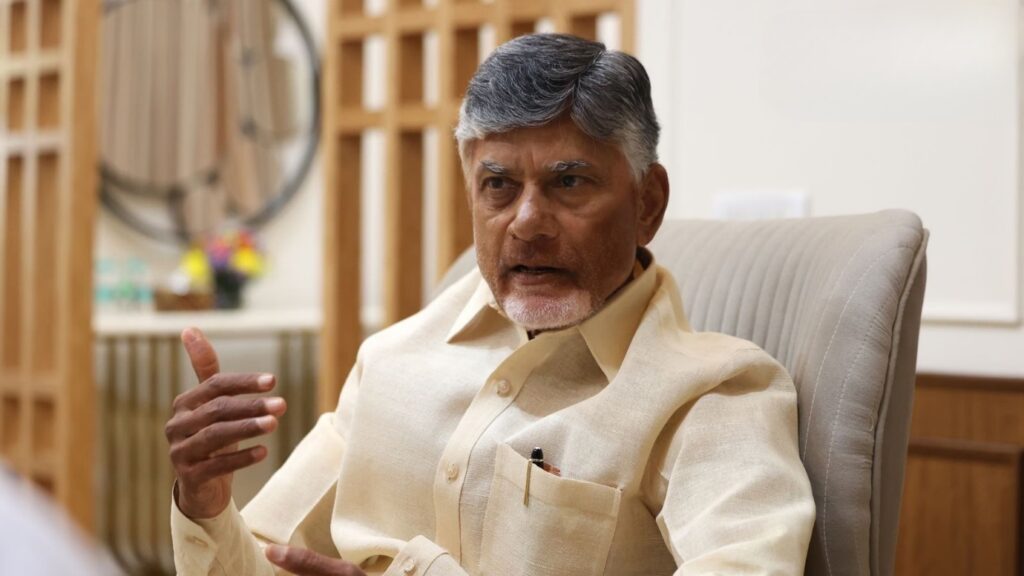
Andhra Pradesh Chief Minister N. Chandrababu Naidu has introduced a draft Population Management Policy, the first of its kind in India. Shifting dramatically from earlier state policies that actively promoted family planning, the new draft policy aims to incentivize families to have more children. The policy, which is currently open for a one-month public consultation, is slated for implementation starting April 1, 2026.
What is the New Population Management Policy?
The core objective of the new policy is to raise the state’s Total Fertility Rate (TFR) from the current 1.5 back to the optimal replacement level of 2.1. It proposes a complete reversal of the previous approach (which penalized large families) by introducing direct financial and structural incentives to encourage couples to have a second or third child.
Need for the Population Management Policy
1. Declining Fertility Rate
- The Total Fertility Rate (TFR) in Andhra Pradesh has declined significantly.
- It fell from 3.0 in 1993 to around 1.5 today.
- A stable population requires a replacement fertility level of about 2.1.
- A lower fertility rate means fewer children are being born, leading to long-term population decline.
2. Risk of an Ageing Population
- If the current trend continues, a large share of the population will become elderly.
- Estimates suggest that about 23% of the population may be above 60 years by 2047.
- An ageing society increases pressure on healthcare systems, pensions, and social welfare schemes.
3. Shrinking Workforce
- Fewer births today will result in a smaller working-age population in the future.
- This may reduce industrial productivity and economic growth.
- Countries such as Japan and South Korea already face similar problems due to very low birth rates.
4. Political Representation Concerns
- In India, Lok Sabha seats are distributed based on population.
- After the next Census and delimitation, states with slower population growth may lose seats.
- Southern states fear a reduction in their representation in Parliament compared to northern states with faster population growth.
Key Features of the Policy
1. Financial Incentives for Childbirth
The government proposes direct financial support to encourage families to have more children.
- ₹25,000 one-time incentive at the birth of a second or third child.
- The aim is to reduce financial concerns associated with raising children.
2. “Poshana–Shiksha–Suraksha” Support Package
Families with a third child will receive additional benefits.
- ₹1,000 monthly financial assistance for the first five years.
- Free education up to the age of 18 years.
- Focus on nutrition, education, and social security for children.
3. Removal of Election Restrictions
- Earlier rules disqualified individuals with more than two children from contesting local body elections.
- The government proposes to remove these restrictions.
- This change aims to eliminate social pressure against larger families.
4. Workplace and Parental Support
To help parents balance family and employment, the policy proposes:
- 12 months of maternity leave for the birth of a third child.
- 2 months of paternity leave.
- Development of working women’s hostels.
- Establishment of more childcare centres and crèches.
These measures are intended to support working parents, especially women.
Expected Benefits of the Policy
1. Stable Workforce for Economic Growth
- A balanced fertility rate ensures a steady supply of young workers.
- This supports industrial growth and long-term economic development.
2. Increase in Female Labour Participation
- Better childcare and maternity support may encourage more women to work.
- The state aims to increase female labour force participation from about 31% to nearly 59%.
- Higher participation can significantly increase state economic output.
3. Strengthening the Demographic Dividend
- A higher proportion of working-age people creates a demographic dividend.
- This can increase productivity, income levels, and economic growth.
4. Maintaining Political Representation
- A stable population size helps the state retain adequate representation in Parliament.
- This is important for maintaining political influence in national decision-making.
Challenges and Concerns
1. Financial Burden on the Government
- Cash incentives, monthly support, and free education for many children require large financial resources.
- The policy may place long-term pressure on the state budget.
2. Difficulty in Changing Social Behaviour
- As societies become more educated and urbanised, families usually prefer fewer children.
- Financial incentives alone may not easily change these social preferences.
3. Pressure on Public Infrastructure
- Higher birth rates may require rapid expansion of:
- Hospitals and pediatric healthcare
- Schools and teachers
- Childcare facilities
- Without adequate planning, public services may become overburdened.
Conclusion
Andhra Pradesh’s Population Management Policy marks a historic paradigm shift in Indian demographic planning. Recognizing that “population is the strongest economic resource,” the state is moving proactively to prevent a future human resource crisis. However, the true success of the policy will depend on whether the state can sustain the massive financial incentives and create a genuinely supportive environment for working mothers.
CARE MCQ
With reference to the draft Population Management Policy of Andhra Pradesh, consider the following statements:
- The primary objective of the policy is to reduce the state’s Total Fertility Rate (TFR) to below 1.5.
- The policy proposes a “Poshana–Shiksha–Suraksha” package that provides free education up to age 18 for a family’s third child.
- Under the new policy, the state government plans to strictly enforce laws that disqualify individuals with more than two children from contesting local body elections.
Which of the statements given above is/are correct?
A. 1 and 2 only
B. 2 only
C. 1 and 3 only
D. 2 and 3 only
Answer: B
Explanation
Statement 1 – Incorrect
- The policy does not aim to reduce the TFR.
- Instead, the objective is to increase the Total Fertility Rate to about 2.1, which is considered the replacement level fertility.
Statement 2 – Correct
- The draft policy proposes a “Poshana–Shiksha–Suraksha” package.
- It includes nutritional support, education benefits, and social security measures, including free education up to 18 years for a family’s third child.
Statement 3 – Incorrect
- Earlier laws disqualified individuals with more than two children from contesting local body elections.
- The new policy proposes to scrap or relax these disqualification provisions, not enforce them.