Table of Contents
Relevance: Location-based mineral resources, Andhra Pradesh economy and geography
For Prelims:
Beach Sand Minerals, Ilmenite, Rutile, Monazite, Zircon, Garnet, Sillimanite, Thorium, Rare Earth Elements, Placer Deposits
For Mains:
Coastal processes, mineral economy, rare earth supply chains, nuclear energy resources, environmental governance
Why in News?
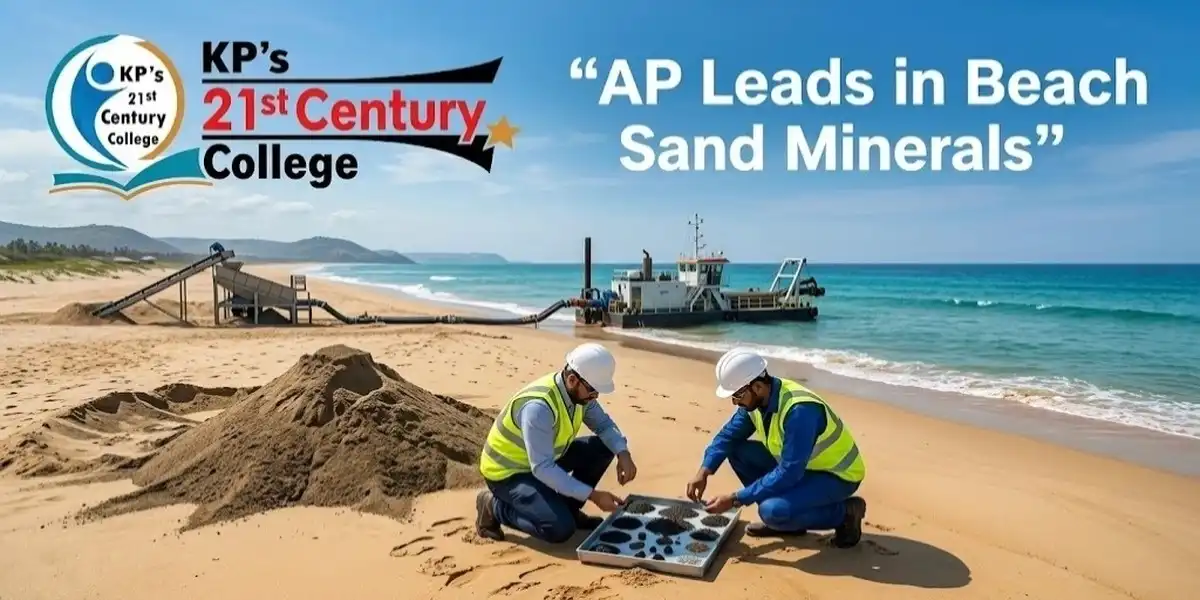
Andhra Pradesh is emerging as a leading State in the exploration and development of Beach Sand Minerals along its eastern coastline. The State holds nearly 25% of India’s total reserves, making it second only to Tamil Nadu, and is increasingly being positioned as a major mineral-based industrial hub.
Coastal Location and Formation of Deposits
- The presence of beach sand minerals in Andhra Pradesh is closely associated with its location along the Bay of Bengal and the sediment transport systems of major rivers.
- The most prominent deposits are located in the northern coastal districts such as Srikakulam and Visakhapatnam, particularly in areas like Gara, Etcherla, Ranasthalam, Bheemunipatnam and Nakkapalli, while coastal belts of West Godavari, Krishna and Konaseema districts also contain significant deposits.
- These minerals are formed through long-term geological processes.
- Rivers such as the Godavari River and the Krishna River transport mineral-rich sediments from the interior plateau towards the coast.
- When these sediments reach the sea, wave action and tidal currents remove lighter particles and concentrate heavier minerals.
- This results in the formation of placer deposits, where economically valuable minerals accumulate along beaches, dunes and coastal plains.
Distribution and Resource Profile in Andhra Pradesh
- Andhra Pradesh has approximately 211 million tonnes of beach sand mineral reserves out of India’s total estimated 838 million tonnes.
- The State has the largest reserves of rutile and monazite in India, while it has the second-largest reserves of ilmenite.
- Several deposits are already under development, and ongoing exploration has revealed additional reserves, indicating strong future potential for expansion.
Mineral Composition and Uses
- Beach sand minerals in Andhra Pradesh consist of a diverse group of heavy minerals with significant industrial applications.
- Ilmenite is widely used for the extraction of titanium dioxide, which is essential in paints, plastics and paper industries, and also has applications in aerospace and engineering due to the strength and corrosion resistance of titanium.
- Rutile, being a higher-grade titanium ore, is used in the production of titanium metal, which is critical for aircraft manufacturing, defence equipment and high-performance engineering components.
- Monazite is particularly important as it contains rare earth elements along with thorium. Rare earth elements are used in advanced technologies, while thorium is relevant for nuclear energy production, making this mineral highly regulated.
- Zircon is used extensively in ceramic industries due to its high thermal stability and resistance to corrosion, and also finds application in nuclear reactors.
- Garnet serves as an industrial abrasive and is used in sandblasting and waterjet cutting processes, while sillimanite is used in refractory industries where materials must withstand very high temperatures, such as furnace linings and industrial kilns.
Role in Energy and Technology Systems
- The importance of beach sand minerals extends into emerging sectors of energy and advanced technology.
- Thorium obtained from monazite is an important resource for India’s long-term nuclear energy programme, which is based on a three-stage strategy aimed at sustainable energy production.
- Rare earth elements present in these minerals are essential for modern technologies, including electric vehicles, renewable energy systems such as wind turbines, and electronics like semiconductors.
- They also play a critical role in defence technologies, making these minerals integral to technological advancement.
Environmental Concerns
- Beach sand mining occurs in ecologically sensitive coastal regions, where disturbances can lead to coastal erosion and habitat degradation.
- Unregulated extraction may also affect groundwater quality and disrupt livelihoods dependent on fisheries and agriculture.
- Therefore, mining activities are regulated under Coastal Regulation Zone norms and Environmental Impact Assessment processes to ensure sustainability.
CARE MCQ
Q. Consider the following statements regarding beach sand minerals:
- Monazite contains thorium and rare earth elements.
- Andhra Pradesh has the largest reserves of ilmenite in India.
- These minerals are formed due to coastal and riverine processes.
Which of the statements given above are correct?
(a) 1 and 3 only
(b) 1 and 2 only
(c) 2 and 3 only
(d) 1, 2 and 3
Answer: (a)
Q. Which of the following geological regions is NOT primarily associated with Carboniferous coal deposits?
(a) Appalachian Basin, USA
(b) Donets Basin (Donbas), Ukraine
(c) South Wales Coalfield, UK
(d) Deccan Traps, India
Ans: (d)
The Deccan Traps are volcanic basalt formations formed during the Cretaceous–Eocene period, and are not associated with Carboniferous coal deposits.
Q. Which of the following statements is correct regarding the distribution of mineral resources in India?
(a) Iron ore is predominantly found in the state of Rajasthan
(b) Mica, a key mineral used in the electronics industry, is mainly found in Jharkhand and Bihar
(c) Kerala is the leading producer of bauxite in India
(d) Diamond mines are extensively located in the state of Punjab
Ans: (b)
Explanation:
India is one of the leading producers of mica, and its major deposits are concentrated in the Koderma–Gaya–Hazaribagh belt, covering parts of Jharkhand and Bihar. This region has historically been known for high-quality mica used in electrical and electronic industries.
Q.Consider the following statements regarding Cobalt:
- Cobalt is primarily used in the production of rechargeable batteries for electric vehicles and portable electronic devices.
- The Democratic Republic of Congo is the world’s leading producer of cobalt.
- Cobalt is a critical mineral due to its importance in various industrial applications and limited sources of supply.
- Cobalt is always found in its pure, metallic form in nature.
How many of the statements given above are correct?
a) Only one
b) Only two
c) Only three
d) All four
Ans: (c)
Explanation:
Statement 1 is correct: A significant portion of global cobalt production is utilized in rechargeable batteries, which are essential for powering electric vehicles, laptops, smartphones, and various other portable electronic devices.
Statement 2 is correct: The Democratic Republic of Congo (DRC) holds the position of the world’s leading cobalt producer, accounting for a substantial share of the global supply. Statement 3 is correct: Cobalt is classified as a critical mineral due to its widespread use in various industries and the concentrated nature of its supply sources, with limited geographical distribution.
Statement 4 is incorrect: Cobalt is typically not found in its pure, metallic form in nature. Instead, it is usually obtained as a byproduct of mining nickel and copper ores, where it occurs in chemically combined forms.
APPSC Mains Question
Q.Discuss the geographical processes responsible for the formation of beach sand mineral deposits in India and analyse the role of Andhra Pradesh in their development.
[250 WORDS]
FAQs
Q. Why are beach sand minerals mainly found along coastal regions?
Ans: They are found along coastal regions because rivers transport mineral-rich sediments from inland areas, and marine processes such as waves and tides concentrate heavier minerals along the shoreline over time.
Q. Why is monazite considered an important mineral?
Ans: Monazite is important because it contains thorium and rare earth elements, which are essential for nuclear energy production and advanced technological applications.
Q. Which rivers contribute to beach sand mineral deposits in Andhra Pradesh?
Ans: Major rivers such as the Godavari and Krishna play a crucial role in transporting mineral sediments from the interior plateau to the coastal regions where they accumulate.
Q. Why is Andhra Pradesh important in beach sand mineral exploration?
Ans: Andhra Pradesh is important because it has a long coastline, favourable geological conditions and a significant share of India’s total reserves, making it a major centre for exploration and development.
Q. What are placer deposits?
Ans: Placer deposits are formed when heavier minerals accumulate after lighter particles are removed by water action, especially along riverbeds and coastal areas.