AgriStack – Digital Public Infrastructure for Agriculture
Table of Contents
Relevance:
GS Paper III – Agriculture, GS Paper III – Science & Technology (Digital Public Infrastructure)
Important Keywords
For Prelims:
- Digital Agriculture Mission, AgriStack components, Farmer Registry, Crop Sown Registry, Geo-referenced village maps, AI in agriculture
For Mains:
- Inclusive growth, governance, DBT reforms
Why in News?
- In the Union Budget 2026, Finance Minister Nirmala Sitharaman described AgriStack as “one of the next UPI” initiatives, highlighting its transformational potential for Indian agriculture.
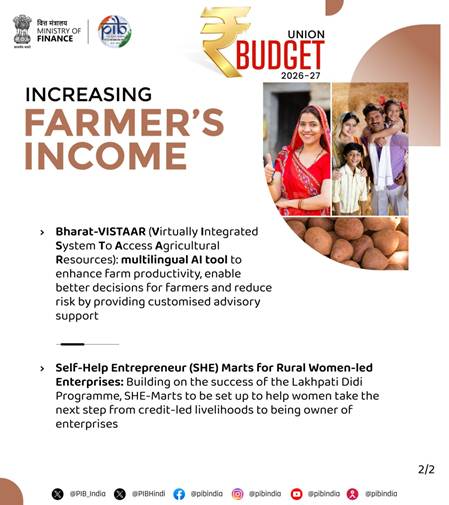
- She announced Bharat-VISTAAR (Virtually Integrated System to Access Agricultural Resources) — a multilingual AI platform that will integrate AgriStack portals with agricultural best-practice packages developed by Indian Council of Agricultural Research.
- The government plans to phase-wise connect AgriStack with major schemes such as Direct Benefit Transfer (DBT) and Minimum Support Price (MSP) procurement to improve efficiency and transparency.
What is AgriStack?
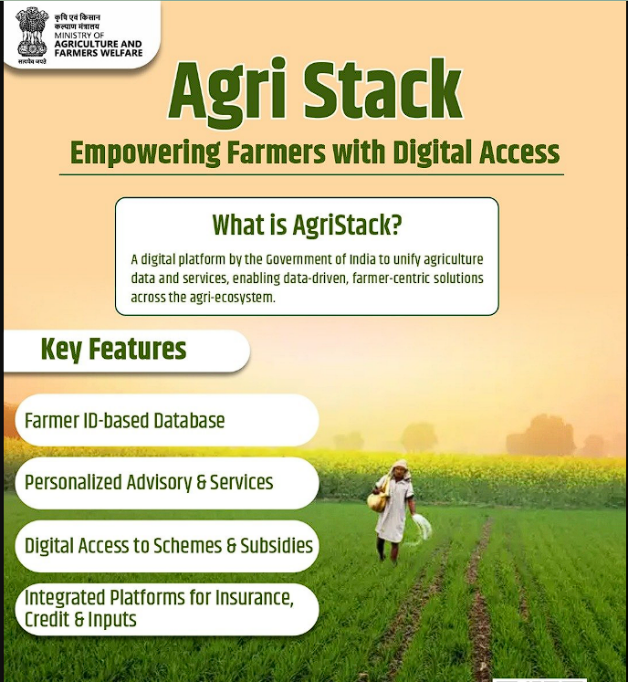
- AgriStack is a Digital Public Infrastructure (DPI) for India’s agriculture sector.
- It was launched in 2024 under the Digital Agriculture Mission.
- Its goal is to consolidate farmer and agricultural data onto a single digital platform.
- The system aims to:
- Improve farm productivity
- Enable data-driven decision-making
- Provide customised advisory services
- Reduce risks for farmers
Why is it called the “next UPI”?
- Like Unified Payments Interface (UPI) transformed digital payments, AgriStack aims to digitally transform agriculture.
- It will connect farmers with:
- Government schemes
- Financial services
- Insurance
- Procurement systems
- Advisory platforms
Three Foundational Registries of AgriStack
1. Farmer Registry
- Provides each farmer with a unique digital Farmer ID (similar to Aadhaar).
- Linked to:
- Land records
- Crops grown
- Livestock ownership
- Demographic & family details
- Benefits and schemes availed
- Target: 11 crore farmers (about 8.62 crore already created).
- Reduces paperwork and minimizes physical visits to offices.
2.Crop Sown Registry
- Contains season-wise data on crops planted.
- Data collected through mobile-based digital crop surveys.
- Target: 30 crore farm plots across 604 districts by Kharif 2026.
- Over 70% coverage already in several states.
3.Geo-referenced Village Maps
- Maps land records with precise geographic coordinates (latitude & longitude).
- 5.4 lakh villages mapped so far out of 6.75 lakh.
- Target completion: March 2027.
How AgriStack Will Help Farmers
- Integration with major services such as:
- Direct Benefit Transfer (DBT)
- Minimum Support Price (MSP) procurement
- Fertiliser distribution
- Crop loans
- Insurance
- Storage
- Advisory services
Expected benefits:
- Faster approvals
- Leak-proof subsidy transfers
- Reduced documentation
- Better access to credit and insurance
- More equitable fertiliser distribution
Other Outcomes of Digital Agriculture Initiatives
1. Digital Crop Survey (DCS)
- Provides plot-level crop visibility.
- Helps estimate sowing patterns across seasons.
- Supports evidence-based planning for:
- Procurement
- Input supply
- Logistics
- Kharif 2025: Conducted in 604 districts, covering 28.5+ crore plots.
State-Level Success Examples
Maharashtra
- Used AgriStack for:
- Scheme delivery
- Disaster relief
- AI-based advisory
- Credit access
- ₹14,000+ crore transferred to 89 lakh farmers for crop losses.
Chhattisgarh
- Institutionalized Farmer ID + DCS for MSP-based paddy procurement.
- Covered 32+ lakh farmers in one season.
- Improved:
- Transparency
- Crop verification
- Timeliness of payments
2. Krishi Decision Support System
- Geo-spatial platform integrating:
- Satellite imagery
- Weather data
- Soil data
- Crop data
- Uses GIS to support agricultural planning and decision-making.
- Provides targeted advisories on crops, soil, and weather.
3. Kisan e-Mitra
- Voice-based AI chatbot for farmer queries (initially PM-KISAN).
- Supports 11 regional languages.
- Handles 8,000+ queries daily.
- 95 lakh+ queries answered so far.
4. National Pest Surveillance System
- Uses AI & Machine Learning to detect pest infestations.
- Enables timely intervention to reduce crop losses.
- Used by 10,000+ extension workers.
- Covers 65 crops and 400+ pests.
- Farmers can upload pest images for guidance.
5. Namo Drone Didi
- Central Sector Scheme to provide 15,000 drones to Women SHGs.
- Outlay: ₹1,261 crore (2023–26).
- Goals:
- Promote advanced agricultural technology
- Improve crop yield
- Reduce operational costs
- Empower rural women
- 500 drones already distributed.
- Study shows:
- Diversified SHG activities
- Improved farm practices
- Increased income opportunities
6.Seed Authenticity Traceability & Holistic Inventory (SATHI)
- Digital platform for:
- Seed production
- Quality certification
- Distribution
- Traceability
- Establishes a National Seed Grid integrating all seed stakeholders into one system.
Current Use Cases
- Farmer ID used for registration under PM-KISAN.
- Some states use it for Pradhan Mantri Fasal Bima Yojana (crop insurance) enrollment.
- Pilot projects have enabled:
- Faster MSP procurement
- Streamlined fertiliser supply
- KCC loan disbursement
UPSC PYQ
What is/are the advantage/advantages of implementing the ‘National Agriculture Market’ scheme? (2017)
- It is a pan-India electronic trading portal for agricultural commodities.
- It provides the farmers access to nationwide market, with prices commensurate with the quality of their produce.
Select the correct answer using the code given below:
(a) 1 only
(b) 2 only
(c) Both 1 and 2
(d) Neither 1 nor 2
Ans: (c)
CARE MCQ
With reference to AgriStack, consider the following statements:
- AgriStack is a Digital Public Infrastructure aimed at integrating farmer-related data on a single platform.
- Each farmer is assigned a unique digital identity similar to Aadhaar.
- Bharat-VISTAAR is a blockchain-based platform for agricultural exports.
- AgriStack is expected to support DBT and MSP procurement systems.
Which of the statements given above are correct?
A) 1, 2 and 4 only
B) 2 and 3 only
C) 1 and 3 only
D) All of the above
Answer: A
Explanation:
- Statements 1 and 2 are core features of AgriStack.
- Statement 3 is incorrect — Bharat-VISTAAR is an AI-enabled multilingual integration tool, not blockchain-based.
- Statement 4 is correct since scheme convergence is a major objective.