
What is an orbit?
An orbit is the curved path that an object in space (such as a star, planet, moon, asteroid or spacecraft) takes around another object due to gravity.
- Gravity causes objects in space that have mass to be attracted to other nearby objects. If this attraction brings them together with enough momentum, they can sometimes begin to orbit each other.
- When rockets launch our satellites, they put them into orbit in space. There, gravity keeps the satellite on its required orbit – in the same way that gravity keeps the Moon in orbit around Earth.
Different orbits
High Earth Orbit / Geosynchronous Orbit
- When a satellite reaches exactly 42,164 kilometers from the center of the Earth (about 36,000 kilometers from Earth’s surface), it enters a sort of “sweet spot” in which its orbit matches Earth’s rotation.
- Because the satellite orbits at the same speed that the Earth is turning, the satellite seems to stay in place over a single longitude, though it may drift north to south. This special, high Earth orbit is called geosynchronous.
Geostationary orbit (GEO)
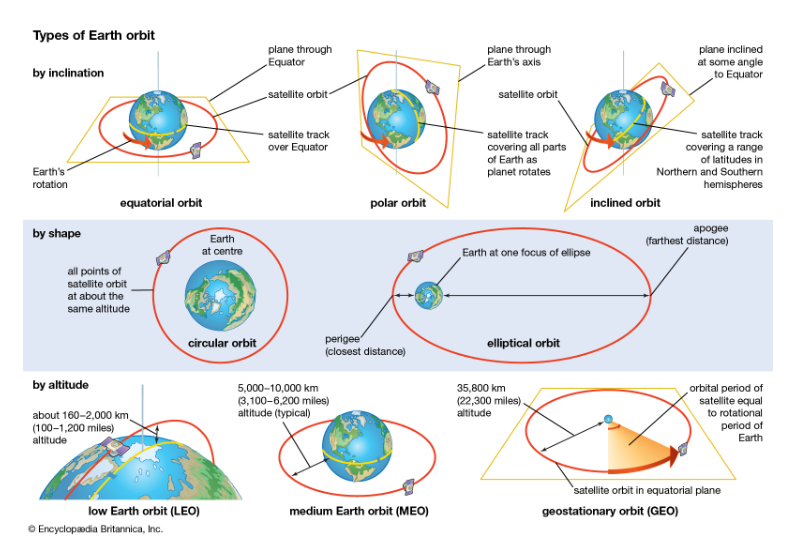
- Satellites in geostationary orbit (GEO) circle Earth above the equator from west to east following Earth’s rotation – taking 23 hours 56 minutes and 4 seconds – by travelling at exactly the same rate as Earth.
- This makes satellites in GEO appear to be ‘stationary’ over a fixed position. In order to perfectly match Earth’s rotation, the speed of GEO satellites should be about 3 km per second at an altitude of 35 786 km.
- This is much farther from Earth’s surface compared to many satellites.
- GEO is used by satellites that need to stay constantly above one particular place over Earth, such as telecommunication satellites.
- This way, an antenna on Earth can be fixed to always stay pointed towards that satellite without moving. It can also be used by weather monitoring satellites, because they can continually observe specific areas to see how weather trends emerge there.
Low Earth orbit (LEO)
- A low Earth orbit (LEO) is, as the name suggests, an orbit that is relatively close to Earth’s surface.
- It is normally at an altitude of less than 1000 km but could be as low as 160 km above Earth – which is low compared to other orbits, but still very far above Earth’s surface.
- LEO’s close proximity to Earth makes it useful for several reasons. It is the orbit most commonly used for satellite imaging, as being near the surface allows it to take images of higher resolution.
- It is also the orbit used for the International Space Station (ISS), as it is easier for astronauts to travel to and from it at a shorter distance.
- However, individual LEO satellites are less useful for tasks such as telecommunication, because they move so fast across the sky and therefore require a lot of effort to track from ground stations.
- Instead, communications satellites in LEO often work as part of a large combination or constellation, of multiple satellites to give constant coverage.
- In order to increase coverage, sometimes constellations like this, consisting of several of the same or similar satellites, are launched together to create a ‘net’ around Earth.
- This lets them cover large areas of Earth simultaneously by working together.
Polar orbit and Sun-synchronous orbit (SSO)
- Satellites in polar orbits usually travel past Earth from north to south rather than from west to east, passing roughly over Earth’s poles.
- Satellites in a polar orbit do not have to pass the North and South Pole precisely; even a deviation within 20 to 30 degrees is still classed as a polar orbit.
- Polar orbits are a type of low Earth orbit, as they are at low altitudes between 200 to 1000 km.
- Sun-synchronous orbit (SSO) is a particular kind of polar orbit. Satellites in SSO, travelling over the polar regions, are synchronous with the Sun.
- This means they are synchronised to always be in the same ‘fixed’ position relative to the Sun. This means that the satellite always visits the same spot at the same local time – for example, passing the city of Paris every day at noon exactly.
- This means that the satellite will always observe a point on the Earth as if constantly at the same time of the day, which serves a number of applications; for example, it means that scientists and those who use the satellite images can compare how somewhere changes over time.
Transfer orbits and geostationary transfer orbit (GTO)
- Transfer orbits are a special kind of orbit used to get from one orbit to another.
- When satellites are launched from Earth and carried to space with launch vehicles such as Ariane 5, the satellites are not always placed directly on their final orbit.
- Often, the satellites are instead placed on a transfer orbit: an orbit where, by using relatively little energy from built-in motors, the satellite or spacecraft can move from one orbit to another.
- This allows a satellite to reach, for example, a high-altitude orbit like GEO without actually needing the launch vehicle to go all the way to this altitude, which would require more effort – this is like taking a shortcut.
- Reaching GEO in this way is an example of one of the most common transfer orbits, called the geostationary transfer orbit (GTO).
