
What Is a Satellite?
- A satellite is a moon, planet or machine that orbits a planet or star.
- For example, Earth is a satellite because it orbits the sun. Likewise, the moon is a satellite because it orbits Earth.
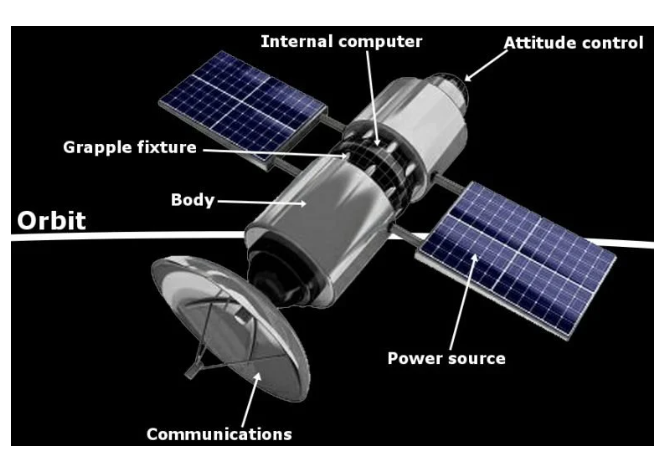
- Usually, the word “satellite” refers to a machine that is launched into space and moves around Earth or another body in space. Earth and the moon are examples of natural satellites.
- Thousands of artificial, or man-made, satellites orbit Earth. Some take pictures of the planet that help meteorologists predict weather and track hurricanes.
- Some take pictures of other planets, the sun, black holes, dark matter or faraway galaxies. These pictures help scientists better understand the solar system and universe.
- Still other satellites are used mainly for communications, such as beaming TV signals and phone calls around the world.
- A group of more than 20 satellites make up the Global Positioning System, or GPS. If you have a GPS receiver, these satellites can help figure out your exact location.
Why Are Satellites Important?
- The bird’s-eye view that satellites have allows them to see large areas of Earth at one time. This ability means satellites can collect more data, more quickly, than instruments on the ground.
- Satellites also can see into space better than telescopes at Earth’s surface. That’s because satellites fly above the clouds, dust and molecules in the atmosphere that can block the view from ground level.
- Before satellites, TV signals didn’t go very far. TV signals only travel in straight lines. So they would quickly trail off into space instead of following Earth’s curve.
- Sometimes mountains or tall buildings would block them. Phone calls to faraway places were also a problem. Setting up telephone wires over long distances or underwater is difficult and costs a lot.
- With satellites, TV signals and phone calls are sent upward to a satellite. Then, almost instantly, the satellite can send them back down to different locations on Earth.
- Sputnik 1 was the first satellite in space. The Soviet Union launched it in 1957.
- In order to fulfil vision and service goals, the Department of space has been developing mainly the satellites for communication, earth observation, scientific, navigation and meteorological purposes.
- Communication satellite
- A communication satellite is like a high-tech messenger in space that helps us send TV signals, phone calls, and internet data around the world.
- The Indian National Satellite (INSAT) system is one of the largest domestic communication satellite systems in Asia-Pacific region with nine operational communication satellites placed in Geo-stationary orbit.
- Established in 1983 with commissioning of INSAT-1B, it initiated a major revolution in India’s communications sector and sustained the same later.
- Earth Observation Satellites
- Earth observation satellites are like high-tech eyes in the sky that help us take detailed pictures and collect information about the Earth’s surface from above, assisting in things like weather forecasting, monitoring the environment, and mapping different areas.
- Starting with IRS-1A in 1988, ISRO has launched many operational remote sensing satellites.
- Today, India has one of the largest constellations of remote sensing satellites in operation.
- Varieties of instruments have been flown onboard these satellites to provide necessary data in a diversified spatial, spectral and temporal resolutions to cater to different user requirements in the country and for global usage.
- The data from these satellites are used for several applications covering agriculture, water resources, urban planning, rural development, mineral prospecting, environment, forestry, ocean resources and disaster management.

- Space Science & Exploration satellites
Space science and exploration satellites are high-tech devices in space that help us learn about planets, stars, and our Earth.
They are like cosmic detectives, sending back pictures and information to scientists on Earth, helping us understand the mysteries of the universe.
Examples are Astrosat, Mangalyan etc

- Navigational Satellites
- Navigation satellites are like cosmic GPS systems that help us find our way on Earth. They send signals to our devices, guiding us accurately.
- An example is ISRO’s NavIC (Navigation with Indian Constellation), which enhances navigation over India and the surrounding region.
