Wetlands are areas intermediate between terrestrial and aquatic habitats, often transitional in nature, located between dry land and deep-water bodies. They experience periodic flooding and support unique flora and fauna adapted to waterlogged conditions.
Definition
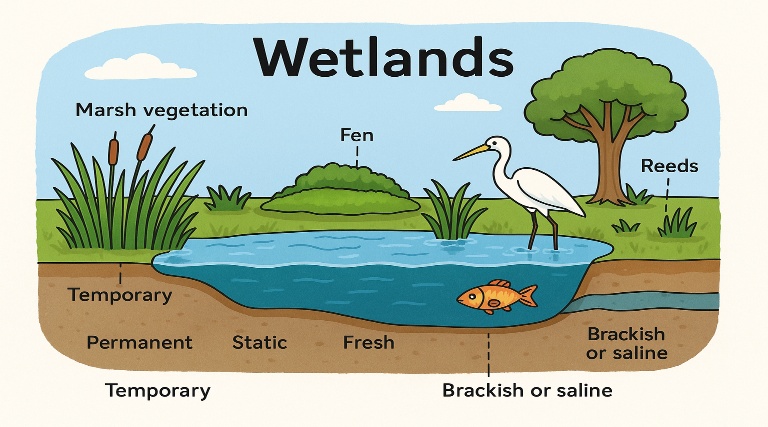
Wetlands are areas of marsh, fen, peatland, or water — whether natural or artificial, permanent or temporary, with water that is static or flowing, fresh, brackish or saline — where the depth of water at low tide does not exceed 6 meters.
 |
Characteristics
- Covered by water or waterlogged soil for at least 7 days during the growing season.
- Presence of specially adapted plant life (hydrophytes).
- Presence of hydric soils, which lack sufficient oxygen for many plants.
Hydric soils Hydric soils are those that are saturated, flooded, or ponded long enough during the growing season to develop anaerobic conditions in the upper part of the soil profile. These conditions favor the growth of plants adapted to wet environments, also known as hydrophytic vegetation. Hydric soils are a key indicator of wetlands. 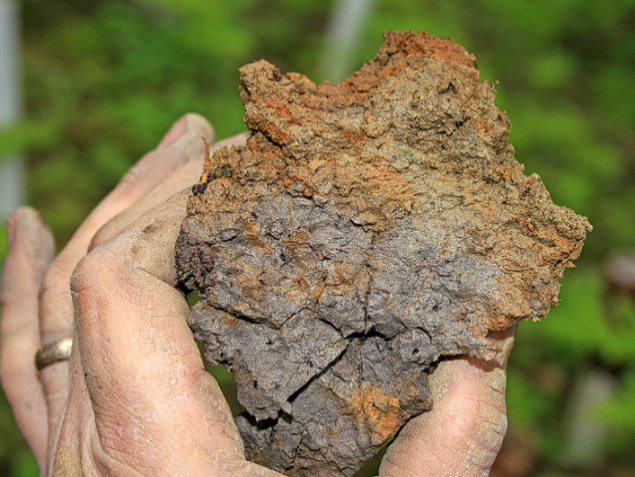
|
Classification of Wetlands
Wetlands can include:
- Lake littorals: Marginal zones of lakes between highest and lowest water levels.
- Floodplains: Areas adjacent to river channels, beyond levees, periodically flooded during high discharge.
- Other marshy or swampy areas where water stagnates due to poor drainage or impervious substrata.
- Bogs, fens, mangroves, which share similar ecological features.
Criteria for Identifying Wetlands of National Importance
(as per Ramsar Convention and NWCP – National Wetland Conservation Programme)
Sites containing representative, rare or unique wetland types
- Sites with representative or unique examples of wetland types within a biogeographic region.
Species and ecological communities
- Support vulnerable, endangered, or critically endangered species.
- Support ecological communities or species critical to biodiversity.
- Serve as critical habitats during life cycles (e.g., breeding, migration, refuge during adverse conditions).
Specific criteria based on waterbirds
- Regularly support 20,000 or more waterbirds.
- Support ≥1% of a population of a species/subspecies of waterbirds.
Specific criteria based on fish
- Support significant indigenous fish species or life stages.
- Serve as important spawning, nursery or migration grounds.
Other ecological and cultural functions
- Provide food, water, recreation, eco-tourism, educational value, and cultural heritage (historical/religious sites).
Functions of Wetlands
- Habitat for aquatic flora, fauna, and migratory birds.
- Filter sediments and nutrients from surface water.
- Recycle nutrients and purify water.
- Mitigate floods and maintain stream flow.
- Recharge groundwater and control urban runoff.
- Provide drinking water, fish, fodder, fuelwood, and raw materials.
- Protect against shoreline erosion and stabilize local climate.
- Support biodiversity and act as genetic reservoirs (e.g., rice varieties).
- Offer livelihoods, tourism, recreation, and preserve cultural heritage.
Reasons for Wetland Depletion
- Conversion of wetlands for agriculture.
- Overgrazing and sand removal from beds.
- Expansion of aquaculture.
- Habitat destruction and deforestation.
- Pollution from domestic sewage, agricultural runoff, and industrial effluents.
- Climate change impacts.
Mitigation Measures
- Survey and demarcation of wetlands.
- Protection of natural and artificial regeneration.
- Protective measures and afforestation.
- Weed control, soil conservation, and wildlife conservation.
- Removal of encroachments and eutrophication abatement.
- Environmental awareness and education.
Comparison: Lake vs. Wetland (Shallow Lake)
| S. No. | Characteristic | Lake | Wetland (Shallow Lake) |
|---|
| 1. | Origin | Various processes | Fluvial/Geomorphic processes |
| 2. | Water turnover | Permanent | Permanent or Temporary |
| 3. | Water level changes | Relatively small | Relatively large |
| 4. | Littoral:Pelagial ratio | Small | Large |
| 5. | Thermal stratification | Yes | No |
| 6. | Vertical mixing | Thermally regulated | Wind regulated |
| 7. | Dominant producer | Phytoplankton | Macrophytes |
| 8. | Food chain | Grazing pathway | Detritus pathway |
| 9. | Nutrient cycles | Microbial loops less important | Microbial loop dominant |
| 10. | Productivity | Low | High |
| 11. | Trophic status | Oligotrophic | Mostly Eutrophic (except desirable in bogs) |
| 12. | Biodiversity | Generally low | Generally high |
| 13. | Flood control | Less significant | Significant |
| 14. | Groundwater recharge | Negligible / Low | Low–High |
| 15. | Waste treatment | No | Yes |
| 16. | Management objectives | Control of eutrophication, high water quality | Biodiversity conservation, specific functions |