
Venus: The Hottest Planet in the Solar System
Introduction
Venus, the second planet from the Sun, is Earth’s closest planetary neighbor. Despite its similar size and structure to Earth, Venus is often called “Earth’s evil twin” due to its extreme conditions. It has a dense atmosphere that traps heat, making it the
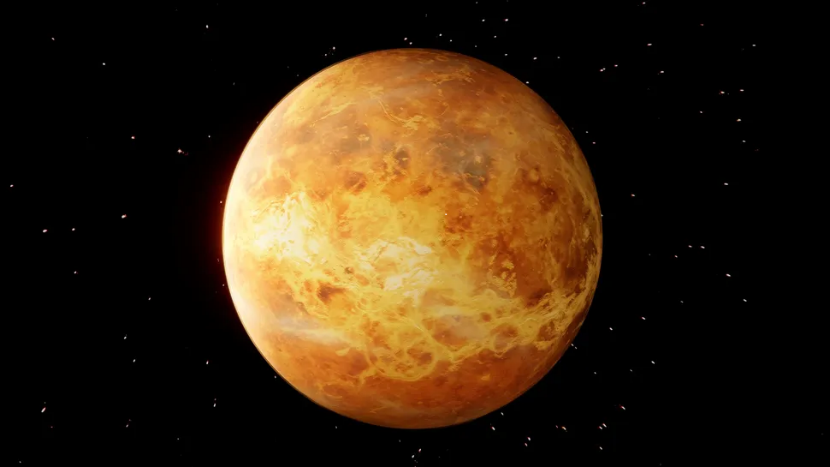
hottest planet in the Solar System. Venus rotates slowly and in the opposite direction compared to most planets, leading to unique atmospheric and surface phenomena.
- Named after Venus, the Roman goddess of love and beauty.
- It is the only planet named after a female deity.
- Most surface features on Venus are named after women, including goddesses and historical figures.
Potential for Life
- Surface conditions are too extreme for life as we know it, with temperatures exceeding 900°F (475°C) and a thick carbon dioxide-rich atmosphere.
- However, 30 miles (50 km) above the surface, temperatures range between 86°F to 158°F (30°C to 70°C), which could potentially support extremophile microbes.
- Unusual dark streaks in the clouds, absorbing ultraviolet light, have led scientists to consider the possibility of microbial life, though there is no concrete evidence yet.
- The presence of iron chloride and sulfur compounds might contribute to the cloud formations and their unusual behavior.
Size and Distance
- Venus orbits the Sun at an average distance of 67 million miles (108 million km) or 0.72 AU.
- Sunlight takes about 6 minutes to reach Venus.
- Venus has a diameter of 12,104 km (7,521 miles), slightly smaller than Earth (12,756 km).
- At its closest, Venus is 38 million km (24 million miles) from Earth, but the maximum separation reaches 261 million km (162 million miles).
Orbit and Rotation
- A Venusian day (one full rotation) lasts 243 Earth days, making it the slowest rotating planet.
- A Venusian year (one full orbit around the Sun) is 225 Earth days, meaning a day on Venus is longer than its year!
- Retrograde Rotation: Venus rotates backward compared to most planets, meaning the Sun rises in the west and sets in the east.
- Because of its slow rotation and thick atmosphere, one Venusian solar day (from sunrise to sunrise) lasts 117 Earth days.
- Venus has an axial tilt of only 3 degrees, meaning it does not experience noticeable seasons like Earth.
Moons
- Venus has no natural moons.
- However, it has a quasi-satellite, an asteroid named Zoozve (2002 VE68), which temporarily orbits near Venus but is not a true moon.
Rings
- Venus has no ring system.
Formation
- Venus formed 4.6 billion years ago from the same protoplanetary disk that created the rest of the Solar System.
- Like Earth, it once had oceans, but they evaporated due to the intense greenhouse effect.
- Studying Venus can provide insights into planetary evolution and climate change.
Structure
Venus has a structure similar to Earth, consisting of:
- Core: A metallic iron-nickel core, possibly partially liquid.
- Mantle: A hot, molten rock layer that drives volcanic activity.
- Crust: A solid outer shell, likely thinner than Earth’s but more stable due to a lack of plate tectonics.
Surface Features
- Volcanic Activity: Venus has more volcanoes than any other planet, with over 1,600 major volcanoes.
- Tectonic Activity: The surface is reshaped by volcanic flows and pancake domes—large, flat, lava formations.
- Mountains and Highlands:
- Maxwell Montes, the tallest mountain, rises 11 km (36,000 feet), higher than Mount Everest.
- Ishtar Terra and Aphrodite Terra are the largest highland regions.
- Unique Formations:
- “Tick” domes—odd volcanoes with spurs resembling ticks.
- Tesserae terrain—complex ridges and grooves formed by intense heat and pressure.
- Impact Craters: Venus has fewer impact craters than Mercury or Mars, suggesting its surface is relatively young, about 150 million years old.
Atmosphere
- Venus has a thick and toxic atmosphere, composed mostly of carbon dioxide (96.5%) with clouds of sulfuric acid.
- Extreme Greenhouse Effect: The dense atmosphere traps heat, making Venus hotter than Mercury, even though it is farther from the Sun.
- High Atmospheric Pressure: The surface pressure is 92 times greater than Earth’s, equivalent to being 900 meters (3,000 feet) underwater.
- Hurricane-Force Winds: Winds in the upper atmosphere reach speeds of 360 km/h (224 mph), circulating the planet every 4 Earth days.
Magnetosphere
- Unlike Earth, Venus lacks a strong intrinsic magnetic field.
- Instead, it has an induced magnetic field created by interactions between its ionosphere and solar wind.
- The absence of a protective magnetic field makes Venus vulnerable to atmospheric erosion by solar wind.
Exploration and Scientific Significance
Past Missions
- Soviet Venera Program (1961–1984):
- Venera 7 (1970) was the first spacecraft to land on another planet.
- Venera 9 and 10 provided the first images from the surface.
- NASA’s Magellan (1990–1994):
- Used radar mapping to reveal Venus’ volcanic landscape.
- ESA’s Venus Express (2006–2014):
- Studied the atmosphere and climate patterns.
- JAXA’s Akatsuki (2015–present):
- Observes Venus’ thick cloud cover and wind dynamics.
Future Missions
- NASA’s VERITAS (2029): Will map the surface in high detail.
- NASA’s DAVINCI+ (2031): Will study the atmosphere and search for signs of past water.
- ESA’s EnVision (2030s): Aims to investigate surface and subsurface geology.
