UPSC Daily Current Affairs - 6th February 2026
Relevance:
GS Paper III – Disaster Management
Important Keywords
For Prelims:
- National Disaster Management Authority (NDMA), Disaster Victim Identification (DVI), Mass Fatality Incidents, National Dental Data Registry, Interpol DVI Standards.
For Mains:
- Scientific Disaster Response, Humanitarian Forensics, Institutional Preparedness, Dignity of the Dead, Disaster Governance, Role of Technology in Disaster Management, Coordination in Multi-Agency Response.
Why in News?
The National Disaster Management Authority (NDMA) has released India’s first-ever national guidelines and Standard Operating Procedures (SOPs) for Disaster Victim Identification (DVI) to ensure scientific identification and dignified handover of human remains during mass fatality events.


Background and Need
- Triggered by major disasters such as the Air India crash (Ahmedabad), Sangareddy chemical explosion, Uttarakhand flash floods, bridge collapse, and Delhi car bomb blast.
- Earlier gaps included:
- Lack of SOPs
- Shortage of trained forensic personnel
- Poor coordination among agencies
- Infrastructure deficits such as mortuaries and cold storage
- Emphasizes the humanitarian and legal responsibility of providing closure to families.

Key Provisions of the NDMA DVI Guidelines
1. Four-Stage Scientific Identification Process
The guidelines prescribe a structured protocol to ensure accuracy and prevent mix-ups:
- Systematic Recovery: Methodical retrieval of human remains from disaster locations.
- Post-Mortem Data Collection: Recording fingerprints, DNA samples, dental structures, and physical identifiers.
- Ante-Mortem Data Collection: Gathering medical records, dental history, and physical descriptions from families.
- Reconciliation: Scientific matching of ante-mortem and post-mortem data before confirming identity and releasing remains.
2. Integration of Advanced Forensic Techniques
The guidelines emphasize modern forensic science to improve identification rates.
- National Dental Data Registry: Creation of a centralized dental database since teeth and jaws often survive extreme conditions and provide reliable identification markers.
- Forensic Odontology and Archaeology: These fields enable identification even months or years after disasters, especially when remains are buried or degraded.
- Avoidance of Mass Autopsies: Physical autopsies for every victim are discouraged in large-scale fatality events to improve efficiency without compromising scientific standards.
3. Humanitarian and Rights-Based Approach
The framework promotes the concept of “humanitarian forensics,” ensuring that disaster response respects cultural practices and community customs. It also mandates emotional support and psychological counselling for affected families, acknowledging that disaster management must balance scientific precision with compassion.
4. Institutional and Implementation Measures
NDMA plans to operationalize the guidelines nationwide through structural reforms.
- Establishment of specialized forensic teams ideally in every state.
- Targeted training of experts across forensic disciplines.
- Creation of clear organizational hierarchies to improve coordination among local, state, and central agencies.
- Adoption of global best practices from INTERPOL, tailored to India’s disaster risk profile shaped by climate change, rapid urbanization, and industrial hazards.
Significance
- The guidelines mark a major shift toward a scientific and institutionalized disaster response system.
- Strengthen disaster governance and preparedness.
- Integrate science, technology, ethics, and humanitarian values into response mechanisms.
- Uphold the dignity of the deceased while protecting the rights of families.
- Enable faster legal closure, including issuance of death certificates and compensation.
- Address India-specific vulnerabilities such as climate-induced disasters and urban accidents.
Challenges in Disaster Victim Identification
- Rapid Decomposition: High humidity and temperatures accelerate body deterioration, making visual identification difficult.
- Condition of Remains: Bodies may be charred, fragmented, or commingled after explosions or fires.
- Displacement: Floods and landslides can carry bodies far from the incident site.
- Infrastructure Deficits: Shortage of mortuary spaces, cold-chain transport, and storage facilities.
- Coordination Gaps: Presence of multiple agencies without unified command can lead to confusion.
- Data Limitations: Lack of centralized biometric databases complicates matching unidentified bodies with missing persons.
Measures to Further Strengthen DVI
- Pre-Disaster Data Repository: Linking health records such as the Ayushman Bharat Health Account (ABHA) with optional biometric markers like dental scans or implant serial numbers could enable quicker identification.
- Digital Forensics: Use of smartwatches, mobile phones, biometric locks, and AI-based facial reconstruction to support rapid preliminary identification.
- Portable DNA Labs: Deploying rapid DNA machines at disaster sites can drastically reduce waiting time for families.
- Tamper-Proof Records: Blockchain-based chain-of-custody systems can ensure transparency and legal credibility of forensic data.
- International DVI Cooperation: Pre-signed treaties with neighboring countries and major tourism partners would allow instant sharing of biometric and DNA data during cross-border disasters.
Conclusion
The NDMA’s Disaster Victim Identification guidelines represent a historic paradigm shift toward a technologically advanced, scientifically robust, and humanitarian disaster management framework. By institutionalizing standardized protocols such as the National Dental Data Registry and strengthening forensic capacity, India enhances its preparedness while ensuring dignity for the deceased and providing timely legal and emotional closure for affected families.
CARE MCQ
Q. Consider the following statements regarding the NDMA’s Disaster Victim Identification (DVI) Guidelines:
- The guidelines recommend establishing a National Dental Data Registry for victim identification.
- They mandate mass autopsies for all victims in large-scale disasters.
- The identification process includes reconciliation of ante-mortem and post-mortem data.
- Statement 1 – Correct: Dental records are proposed as a durable identification tool.
- Statement 2 – Incorrect: The guidelines advise against mass autopsies.
- Statement 3 – Correct: Scientific reconciliation is a core step in the four-stage process.
Relevance:
(GS Paper III – Science & Technology)
Important Keywords
For Prelims:
- Lithium-ion batteries, Sodium-ion batteries, Advanced Chemistry Cells, Production Linked Incentive (PLI), Energy density, Critical minerals, Battery Energy Storage Systems
For Mains:
- Energy security, Critical mineral dependency, Supply chain resilience, Clean energy transition, Strategic autonomy, Manufacturing ecosystem, Alternative battery technology
Why in News?
India’s rapid expansion in electric mobility and renewable energy storage has intensified dependence on lithium-ion batteries. However, structural vulnerabilities linked to critical mineral dependence, import reliance, and geopolitical risks have prompted calls to diversify battery technologies. Sodium-ion batteries are emerging as a viable alternative capable of strengthening India’s long-term energy security and industrial resilience.
Batteries as the Backbone of Modern Economies
Batteries today underpin a wide range of applications—from consumer electronics and electric vehicles to grid-scale energy storage and household appliances. As energy systems shift towards renewables, batteries are no longer auxiliary technologies but foundational infrastructure critical to economic growth, energy security, and decarbonisation.
Lithium-Ion Batteries: Dominant but Not Ideal
Lithium-ion batteries dominate global markets due to:
- High energy density
- Long cycle life
- Low self-discharge
Decades of investment have led to large-scale manufacturing capacity and sharp cost reductions, with prices falling from about $1,100 per kWh in the early 2010s to nearly $108 per kWh by 2025.
However, this dominance masks key structural challenges:
- Dependence on critical minerals such as lithium, cobalt, nickel and graphite
- Geographical concentration of mineral reserves and refining capacity
- Exposure to price volatility and geopolitical risks
As global demand accelerates, these vulnerabilities are likely to intensify.
- Lithium-ion Battery: Structure
- A lithium-ion battery consists of the following main components:
- Anode (negative electrode)
- Cathode (positive electrode)
- Electrolyte
- Separator
- Two current collectors (positive and negative)
Cathode
- Typically made of lithium metal oxides, such as:
- Lithium Cobalt Oxide (LiCoO₂)
- Lithium Manganese Oxide (LiMn₂O₄)
- Lithium Iron Phosphate (LiFePO₄)
- The choice of cathode material determines key performance characteristics like energy density, voltage and stability.
Anode
- Usually composed of graphite
- During discharge: lithium ions move from the anode to the cathode through the electrolyte.
- During charging: lithium ions move back from the cathode to the anode.
Electrolyte
- Acts as a conductive medium that allows the movement of lithium ions between the anode and cathode.
- Typically consists of a lithium salt dissolved in a solvent.
Separator
- A permeable membrane placed between the anode and cathode.
- Prevents short circuits while allowing lithium ions to pass through.
Rechargeability
- Lithium-ion batteries are rechargeable.
- They can be recharged hundreds to thousands of times, depending on:
- Battery chemistry
- Usage conditions such as overcharging or undercharging
- A lithium-ion battery consists of the following main components:


India’s Battery Manufacturing Ambitions and Constraints
- India has sought to build domestic battery capacity through initiatives such as the PLI scheme for Advanced Chemistry Cells (2021), under which around 40 GWh of capacity has been allocated. Yet, actual deployment remains limited, with only about 1 GWh commissioned so far.
More critically:
- Domestic lithium reserves remain limited and unproven
- Processing, cathode–anode manufacturing, and separator ecosystems are underdeveloped
- Import dependence for lithium-ion batteries is likely to persist
This underscores the need for parallel investment in alternative battery technologies.
Sodium-Ion Batteries: Performance Perspective
Sodium-ion batteries exhibit lower specific energy than lithium-ion batteries due to sodium’s higher atomic mass. However, this gap is often overstated.
Key points:
- Layered oxide sodium-ion chemistries already outperform polyanionic and Prussian blue analogues
- Energy density is approaching that of lithium iron phosphate (LFP) batteries
- Ongoing material and cell-level optimisation is expected to further narrow the gap
- Laboratory and pilot-scale research suggest even greater future potential
Safety Advantage of Sodium-Ion Technology
Safety is a major strength of sodium-ion batteries:
- Lower peak temperature rise during thermal runaway compared to lithium-ion cells
- No classification as “Dangerous Goods” for transport
Lithium-ion batteries require:
- Shipment at ≤30% state of charge
- Strict handling due to copper current collectors and short-circuit risks
Sodium-ion batteries:
- Use aluminium current collectors on both electrodes
- Can be safely stored and transported at zero volts
- Reduce logistics costs and handling risks
Manufacturing Compatibility and Material Security
Sodium-ion batteries offer strong industrial advantages:
- Compatible with existing lithium-ion manufacturing lines with minor modifications
- Lower capital barriers for adoption
- Reduced exposure to critical mineral supply chains
Material advantages include:
- Sodium derived from abundant resources such as soda ash
- Elimination of several critical minerals
- Use of aluminium instead of copper, reducing cost and weight
These features enhance supply chain resilience and strategic autonomy.
Why Sodium-Ion Batteries Matter for India
- Globally:
- ~70 GWh sodium-ion manufacturing capacity operational by 2025
- Expected to scale to ~400 GWh by 2030
- Projected to undercut lithium-ion battery costs by 2035
For India, sodium-ion batteries:
- Reduce dependence on imported critical minerals
- Improve safety and logistics
- Strengthen energy security
- Support long-term clean energy goals
Policy and Ecosystem Recommendations
To mainstream sodium-ion technology:
- Extend upstream manufacturing support to include sodium-ion chemistries
- Design future PLI frameworks for flexible multi-chemistry production
- Update standards, safety codes, and certification frameworks
- Encourage EV manufacturers to approve sodium-ion platforms
- Support R&D, demonstration projects, and early deployment in:
- Grid storage
- Two- and three-wheeler EVs
- Stationary applications
Conclusion
India’s energy transition requires resilience as much as scale. While lithium-ion batteries will continue to play a role, their material and geopolitical constraints demand diversification. Sodium-ion batteries offer a safer, resource-secure, and manufacturing-compatible alternative. By aligning industrial policy, regulation, and market incentives, India can build a future-ready battery ecosystem where sodium-ion technology strengthens energy security and strategic autonomy.
UPSC PYQ
In the context of electric vehicle batteries, consider the following elements: (IAS 2025)
- Cobalt
- Graphite
- Lithium
- Nickel
How many of the above usually make up battery cathodes?
- Only one
- Only two
- Only three
- All the four
Answer: C
Explanation
- Cathode materials in Li-ion batteries are typically lithium metal oxides, such as:
- LCO (Lithium Cobalt Oxide)
- NMC (Nickel Manganese Cobalt Oxide)
- NCA (Nickel Cobalt Aluminium Oxide)
- Hence, Lithium, Cobalt and Nickel are cathode constituents.
- Graphite is not a cathode material; it is used in the anode.
Therefore, three elements (1, 3, and 4) usually make up battery cathodes.
CARE MCQ
With reference to the applications of Lithium-ion batteries, consider the following:
- Portable electronic devices
- Aerospace systems
- Hybrid and electric vehicles
- Medical implantable devices
Which of the above are applications of Lithium-ion batteries?
- 1 and 2 only
- 1, 2 and 3 only
- 1, 2, 3 and 4
- 2 and 4 only
Answer: C
Explanation:
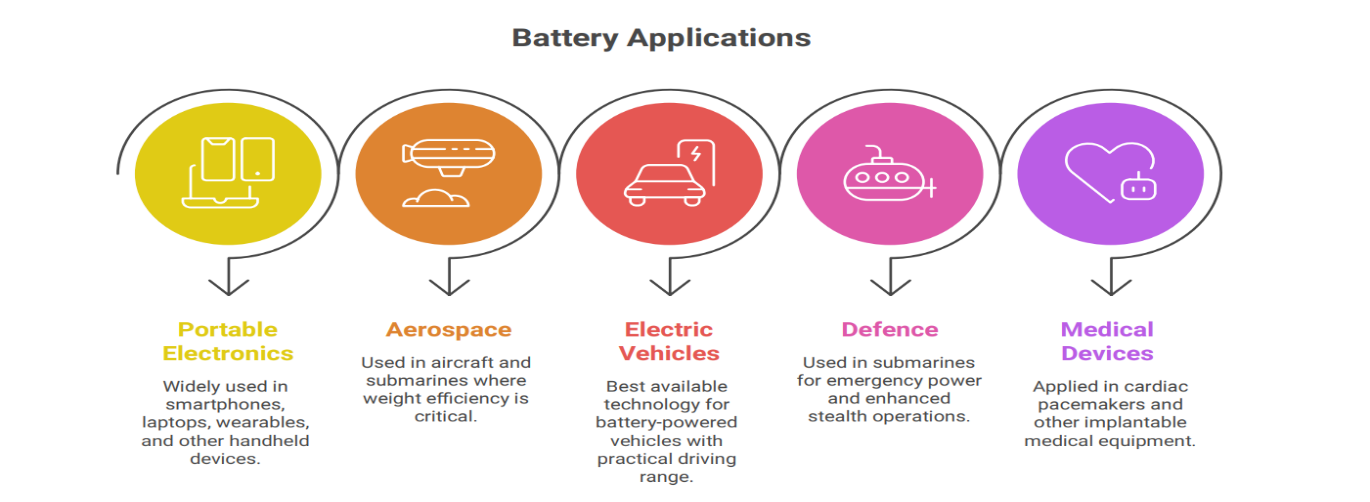
- Portable electronic devices such as smartphones and laptops extensively use Lithium-ion batteries due to high energy density and lightweight design.
- Aerospace systems prefer Lithium-ion batteries where weight reduction and efficiency are critical (e.g., aircraft electrical systems).
- Hybrid and electric vehicles rely on Lithium-ion batteries for higher driving range and reduced fossil-fuel dependence.
- Medical implantable devices, including cardiac pacemakers, use Lithium-ion batteries for reliability and long operational life.