UPSC Daily Current Affairs - 1st December 2025
Source: The Hindu , PIB
Relevance: GS Paper-II (Health), Social Justice, Government Programmes; Prelims – Diseases, Acts, WHO facts)
Key Concepts for Prelims and Mains:
For Prelims:
- What HIV is, how it spreads, symptoms, diagnosis, prevention (PrEP/PEP), WHO definitions, ART, global statistics, The National AIDS Control Programme (NACP) facts.
For Mains:
- Why HIV is incurable, public health response, human rights, India’s NACP evolution, policy challenges, theme of 2025, structural gaps, Government Steps for HIV/AIDS Awareness.
Why in News?
- World AIDS Day observed on December 1.
- Theme for 2025: “Overcoming disruption, transforming the AIDS response.”
- New scientific discussion revisits why HIV remains incurable even after 42 years of global research.
- India highlights success under NACP (National AIDS & STD Control Programme) and HIV/AIDS (Prevention and Control) Act, 2017.

Background / Present Status
- HIV first identified in 1983 by Françoise Barré-Sinoussi & Luc Montagnier (Institut Pasteur).
- Globally, 4 million people infected historically; only a handful have been cured, all through bone-marrow transplants (not scalable).
- ART (antiretroviral therapy) converts HIV from a fatal disease → lifelong chronic condition, but not a cure.
- India’s HIV prevalence declined from 0.33% (2010) → 0.20% (2024), far below global average (7%).
- India supplies 70% of global ART medicines.


HIV Virus INFECTION – PRELIMS FACTS
What is HIV
- Human Immunodeficiency Virus → attacks CD4 white blood cells.
- Leads to immune system weakening.
- AIDS = advanced stage of untreated HIV infection.
Transmission
HIV spreads through infected body fluids:
- Blood, semen, vaginal fluids, breast milk.
- Mother-to-child: pregnancy, delivery, breastfeeding.
NOT transmitted by:
- Kissing, hugging, shaking hands.
- Sharing food/water.
- Sharing utensils.

WHO Definition – Advanced HIV Disease (AHD)
- CD4 count < 200 cells/mm³ OR
- WHO Stage 3 or 4 illness.
- All children < 5 years with HIV → automatically classified as AHD.
Signs & Symptoms (Stage-wise)
Early infection (within weeks):
- Fever
- Headache
- Rash
- Sore throat
Progressive weakening of immunity:
- Swollen lymph nodes
- Weight loss
- Diarrhoea
- Cough
- Fever
Severe stage (AIDS):
- TB, cryptococcal meningitis
- Severe bacterial infections
- Cancers: lymphomas, Kaposi’s sarcoma
Risk Factors
- Unprotected anal/vaginal sex
- Having another STI
- Alcohol/drug use during sexual activity
- Sharing needles/syringes
- Unsafe injections, blood transfusions
- Unsterile medical procedures
- Needle-stick injuries (health workers)
Diagnosis
- Rapid tests → same-day results.
- Self-testing allowed.
- Confirmatory testing is compulsory.
- Antibodies develop in ~28 days → “Window Period”.
Infants
- Antibody tests not reliable.
- Must use virological testing at birth or 6 weeks.
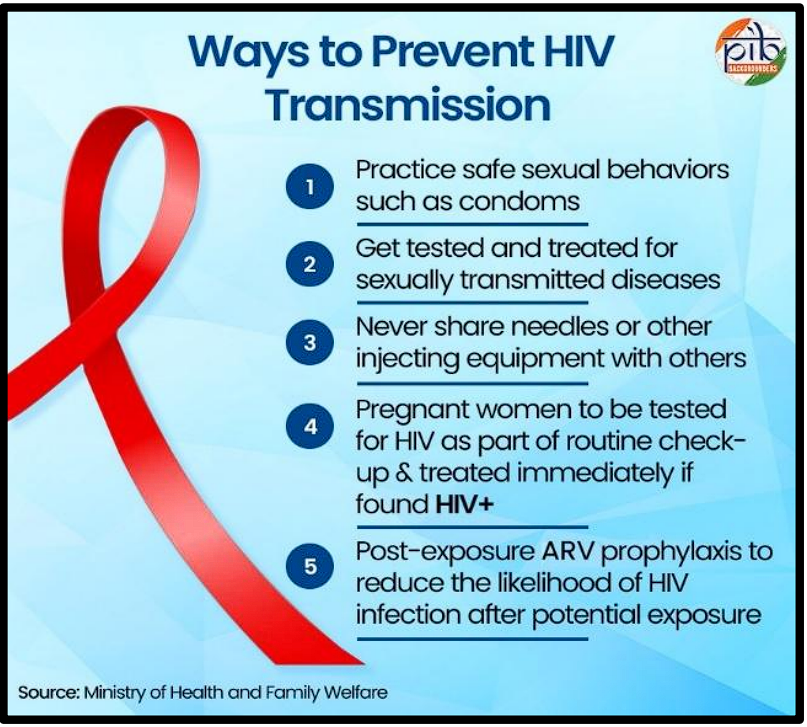
Prevention
- Use condoms (male/female)
- Get tested regularly
- Male circumcision
- Harm-reduction for drug users
- Prevent mother-to-child transmission (ART for pregnant women)

WHO-Recommended PrEP (Pre-Exposure Prophylaxis) Options:
- Oral TDF-based PrEP
- Dapivirine vaginal ring
- Long-acting injectable cabotegravir
- Long-acting injectable lenacapavir
PEP (Post-Exposure Prophylaxis):
- Must be taken within 72 hours of exposure.
Treatment – ART
- Lifelong antiretroviral therapy.
- Prevents viral replication.
- Allows immune recovery.
- People on ART with undetectable viral load do not transmit HIV.
- Pregnant women with HIV must receive ART → prevents transmission to baby.
New developments:
- Long-acting injectable ART (e.g., lenacapavir)
- Treatments for opportunistic infections like cryptococcal meningitis.
WHO Response
- Guided by Global Health Sector Strategies (GHSS) 2022–2030.
- Goal: End AIDS by 2030 (SDG 3.3).
- Focus: universal health coverage, primary health care, high-risk groups.

Why HIV Is So Hard to Treat
1. Integration into Human DNA (Retrovirus Nature)
- HIV converts RNA → DNA (reverse transcription) and integrates into host cell DNA.
- Viral DNA becomes indistinguishable from human DNA → impossible to remove without killing host cells.
2. Viral Latency (Silent Reservoirs)
- After integration, HIV can become dormant.
- These latent cells:
- Produce no viral particles
- Are invisible to immune system
- Cannot be targeted by ART
Stopping ART → dormant cells reactivate → infection returns.
3. High Mutation Rate (Moving Target)
- HIV mutates extremely fast, creating thousands of variants inside one person.
- Immune system cannot recognise & eliminate all variants.
4. Attacks Immune Cells Themselves
- HIV destroys CD4+ T-cells — the very cells that coordinate immunity.
- This leads to immune exhaustion and vulnerability to other infections.
Why No Vaccine Exists Yet
- HIV mutates too rapidly → no stable target for vaccine.
- Deep latency and integration make sterilising immunity practically impossible.
- Virus hides inside long-lived immune cells for decades.
Current Global Situation
- ART suppresses viral load to undetectable levels → transmission becomes almost zero.
- But lifelong therapy is necessary; missing doses → viral rebound + drug resistance.
- Still no functional cure and no preventive vaccine.

The National AIDS Control Programme (NACP)
It has evolved through five phases, shifting from basic awareness to comprehensive prevention, testing, treatment, and sustainability.
NACP I (1992–1999)
- Launched India’s first comprehensive HIV/AIDS prevention and control programme.
- Aim: Slow the spread of HIV and reduce morbidity, mortality, and overall impact of AIDS.
NACP II (1999–2006)
- Focused on two key objectives:
- Reduce the spread of HIV in India.
- Strengthen long-term national capacity to respond to HIV/AIDS.
NACP III (2007–2012)
- Goal: Halt and reverse the HIV epidemic by 2012.
- Strategy:
- Scale up prevention among High-Risk Groups (HRGs) and the general population.
- Integrate prevention, care, support, and treatment services.
- Key addition: Creation of District AIDS Prevention and Control Units (DAPCUs) for district-level coordination and monitoring, including stigma/discrimination reporting.

NACP IV (2012–2017)
- Goal: Accelerate reversal of the epidemic and ensure an integrated response.
- Objectives:
- 50% reduction in new infections (compared to 2007 baseline).
- Provide comprehensive care, support, and treatment for all PLHIV.
- Extended (2017–2021) to advance the goal of Ending AIDS by 2030.
- Major initiatives during extension:
- HIV/AIDS (Prevention and Control) Act, 2017) – It prohibits discrimination against people living with HIV (PLHIV), ensures confidentiality, and mandates informed consent for testing and treatment while promoting prevention and access to care.
- Mission Sampark – Its purpose was to “bring back” people living with HIV (PLHIV) who had stopped antiretroviral therapy (ART) — i.e. to trace and re-engage those “lost to follow-up”. It uses a community-based testing and follow-up approach.
- ‘Test and Treat’ policy (initiating ART for all diagnosed cases)
- Routine Universal Viral Load monitoring
NACP V (2021–2026)
Launched as a Central Sector Scheme with an outlay of Rs. 15,471.94 crore, Phase-V aims to build on past achievements and address persistent challenges. The goal of this Phase is to support the United Nations’ Sustainable Development Goal 3.3 by helping end the HIV/AIDS epidemic as a public health threat by 2030 through comprehensive risk use of prevention, testing, and treatment services.
Key Strategic Interventions under NACP-V
- Reducing New HIV Infections
- Strengthen peer-led Targeted Interventions (TIs) and Link-Worker Schemes.
- Provide tailored prevention packages for high-risk groups and specific geographies.
- Scale up services for injecting drug users, prisons, and community-based models.
- Sustain behaviour-change communication for general population, adolescents, and youth.
- Reducing AIDS-Related Mortality / Improving Treatment & Care
- Expand HIV counselling and testing services with active case-finding.
- Ensure universal access to high-quality ART with rapid initiation and updated guidelines.
- Strengthen linkage from screening to treatment; reduce loss-to-follow-up; optimize viral load testing.
- Provide integrated care, including SRH services for women and support for children with HIV.
- Eliminating Vertical (Mother-to-Child) Transmission
- Align with national maternal & child health programmes for HIV/syphilis testing in pregnancy.
- Roll out dual HIV-syphilis test kits for antenatal screening.
- Ensure timely treatment linkage, ART adherence, retention, family planning, early infant diagnosis, and private-sector involvement.
- Universal Access to STI/RTI Services
- Strengthen DSRC clinics and integrate STI/RTI services within HIV platforms.
- Promote active case-finding, update guidelines, and improve labs & supply chains.
- Engage the private sector and coordinate with the broader health system.
- Reducing Stigma & Discrimination
- Strengthen community systems supporting PLHIV and key populations.
- Conduct stakeholder sensitization, communication campaigns, and expand social protection.
Reinforce policies under the HIV & AIDS (Prevention and Control) Act, 2017.
Government Steps for HIV/AIDS Awareness
1. Strengthening Nationwide Awareness
- NACO runs extensive multimedia and digital campaigns to increase HIV/AIDS awareness, especially among youth.
2. Outdoor Outreach
- Hoardings, bus panels, kiosks, folk performances, and IEC vans used for mass outreach and promoting HIV-related services.
3. Community-Level Awareness
- Grassroot workers (SHGs, Anganwadi Workers, ASHAs, Panchayati Raj members) trained to promote behaviour change and awareness.
4. Targeted Interventions (TIs)
- 1,587 TI projects (as of Oct 2025) implemented to ensure high-risk groups receive prevention, testing, treatment, and care services.
5. Anti-Stigma Campaigns
- Nationwide thematic campaigns launched in workplaces, health facilities, schools, and communities to reduce stigma and support PLHIV.
6. Appointment of Ombudsmen
- Under the HIV and AIDS (Prevention and Control) Act, 2017, Ombudsmen appointed in 34 States/UTs to address discrimination cases.
Conclusion
India’s HIV/AIDS response has evolved from crisis control to a rights-based, community-driven model. Through expanded testing, ART access, targeted outreach, anti-stigma efforts, and strong state-community partnerships, India has achieved a decline in HIV/AIDS greater than the global average—reflecting resilience, innovation, and commitment to safeguarding the dignity and rights of all.
UPSC PYQ
Q. AIDS is caused by the Human Immunodeficiency Virus (HIV). The transmission of HIV infection generally occurs through: CDS – I (2017)
A. eating contaminated food and water
B. transfusion of contaminated blood and blood products
C. inhaling polluted air
D. shaking hand with infected person
Answer: B
Explanation
- HIV = Human Immunodeficiency Virus, attacks CD4 (Cluster of Differentiation 4) T-cells.
- Main modes of transmission:
- Contaminated blood / blood products
- Unprotected sexual contact
- Infected needles/syringes
- Mother-to-child (pregnancy, childbirth, breastfeeding)
- NOT transmitted by: food, water, air, touch, hugging, sharing utensils.
CARE MCQ
Q. Pre-Exposure Prophylaxis (PrEP) recommended by WHO for HIV prevention includes which of the following?
- Oral Tenofovir-based PrEP
- Dapivirine vaginal ring
- Long-acting injectable cabotegravir
Select the correct answer using the code given below:
A. 1 only
B. 1 and 2 only
C. 2 and 3 only
D. 1, 2 and 3
Answer: D
Source: Down To Earth, WHO,
Relevance: GS-III: Environment
Key Concepts for Prelims and Mains:
For Prelims:
Indoor Air Pollution (IAP), Household Air Pollution (HAP), Indoor Air Quality (IAQ), Particulate Matter (PM₂.₅ / PM₁₀), VOCs (benzene, toluene, xylene), Carbon Monoxide (CO), Nitrogen Dioxide (NO₂), Sulphur Dioxide (SO₂), Ozone, Black Carbon, Methane (SLCPs), Biomass Fuels (wood, dung, crop residue), Kerosene Lamps, COPD, Spirometry, Air-Purifying Plants
For Mains:
- Indoor air pollution as a silent killer, Livelihood risks from indoor pollution, Climate co-benefits of clean cooking, Black carbon emissions, Indoor green infrastructure, Nature-based solutions (NbS),
Why in News?
Indoor air pollution has re-emerged as a major public health concern after new findings revealed that indoor air can be 2.5 times more polluted than outdoor air, and in extreme cases, up to 100 times worse. This deterioration—caused by harmful substances, household materials and everyday emissions—contributes to 4.1% of global deaths annually, prompting renewed discussion on affordable mitigation measures such as air-purifying plants.
Indoor Air Pollution: Definition, Key Pollutants
Indoor air pollution refers to contamination of air inside homes, offices, schools and closed environments.
It affects 4.1% of global deaths annually and remains a “silent killer” in developing countries.Major Indoor Pollutants
- Carbon monoxide (CO)
- Nitrogen dioxide (NO₂)
- Sulphur dioxide (SO₂)
- Ozone
- Particulate Matter (PM₂.₅ / PM₁₀)
- VOCs (benzene, toluene, xylene, ethyl benzene) from:
- wall paint, adhesives, furnishings
- cooking and heating
- mosquito repellents, deodorants
- fabrics and synthetics
- human respiration
India does not have a uniform IAQ protocol, complicating monitoring and enforcement.
Health Impacts: What WHO Data Shows
Annual Global Burden
- 3.2 million deaths every year due to household air pollution.
- 86 million healthy life years lost in 2019 (DALYs).
- Major burden falls on women and children in LMICs.
Breakdown of Deaths Linked to Household Air Pollution
- 32% – Ischaemic Heart Disease
- 23% – Stroke
- 21% – Lower Respiratory Infections (LRI)
- 44% of pneumonia deaths in children under 5
- 19% – Chronic Obstructive Pulmonary Disease (COPD)
- 6% – Lung Cancer
What is Chronic Obstructive Pulmonary Disease (COPD)?
What is COPD?
- A progressive and irreversible lung disease causing long-term breathing difficulty.
- Characterised by inflammation, narrowing of airways, and damage to alveoli (air sacs).
Key Causes
- Tobacco smoking (active + passive) – leading cause
- Indoor air pollution (biomass: wood, dung, crop residue; coal; kerosene)
- Occupational exposure — dust, fumes, chemicals
- Childhood respiratory infections, poor lung growth
- Asthma in childhood

Diagnosis
- Suspected with typical symptoms.
- Confirmed by spirometry (measures lung function).
- Often missed in LMICs due to lack of diagnostic facilities.
Complications
People with COPD have higher risk of:
- Pneumonia, flu
- Lung cancer
- Heart disease
- Weak bones, muscle loss
- Depression & anxiety
Preventive Measures
- Stop smoking
- Reduce indoor air pollution
- Ensure ventilation
- Use clean fuels
- Get vaccines (flu & pneumonia)
Best Indoor Air-Purifying Plants
- Areca Palm (Dypsis lutescens)
- Weeping Fig (Ficus benjamina)
- Spider Plant (Chlorophytum comosum)
- Peace Lily (Spathiphyllum wallisii)
- Bamboo Palm (Chamaedorea seifrizii)
These plants are low-maintenance, suitable for Indian homes, and effective against VOCs, PM, SO₂, and NO₂.
Beyond Plants: Development, Equity & Climate Linkages
Health Inequality
- Poor households using biomass and kerosene face the highest indoor pollution and health risks.
- Women and children remain the most exposed.
Livelihood & Time Poverty
- Fuelwood collection reduces time for education and paid work.
- Illness from IAP reduces household income and increases medical expenditure.
Climate Change
- Traditional stoves emit black carbon and methane, short-lived climate pollutants with high warming potential.
Safety Risks
- Burns, accidental fires and kerosene poisoning are common in dense slum settlements.
Policy & Programme Response
Clean Cooking Initiatives
- Pradhan Mantri Ujjwala Yojana (PMUY) for LPG access; improving refill affordability remains crucial.
Energy & Building Policies
- Need for national IAQ standards, building codes mandating ventilation and low-emission materials.
Urban Missions
- Smart Cities / AMRUT can integrate green building norms, rooftop gardens and indoor greening.
Public Health
- IAP should be integrated into National Health Mission, TB and NCD control strategies.
Way Forward
Adopt IAQ Standards & Monitoring
- MoEFCC + MoHFW + BIS to frame India-specific IAQ norms and certify low-emission paints, furnishings, appliances.
Scale Up Clean Fuels
- Strengthen PMUY with targeted subsidies, last-mile LPG delivery, electric/biogas cooking pilots.
Promote Indoor Green Infrastructure
- Encourage air-purifying plants in schools, anganwadis, hospitals, metro stations and low-income housing.
Behavioural Change
- Simple practices: cross-ventilation, avoiding trash burning, limiting incense/coil use, safe storage of chemicals.
Focus on Vulnerable Groups
- Women-centric awareness programmes, inclusion of IAP in maternal & child health counselling.
CARE MCQ
Q. Consider the following plants often recommended for improving indoor air quality:
- Areca palm (Dypsis lutescens)
- Weeping fig (Ficus benjamina)
- Spider plant (Chlorophytum comosum variegatum)
- Peace lily (Spathiphyllum wallisii)
- Bamboo palm (Chamaedorea seifrizii)
How many of the above are commonly used as low-maintenance air-purifying indoor plants?
(a) Only two
(b) Three
(c) Four
(d) All five
Answer: (d) All five