UPSC CARE Mains Practice 24th March 2026
Mains Practice Questions for the Day
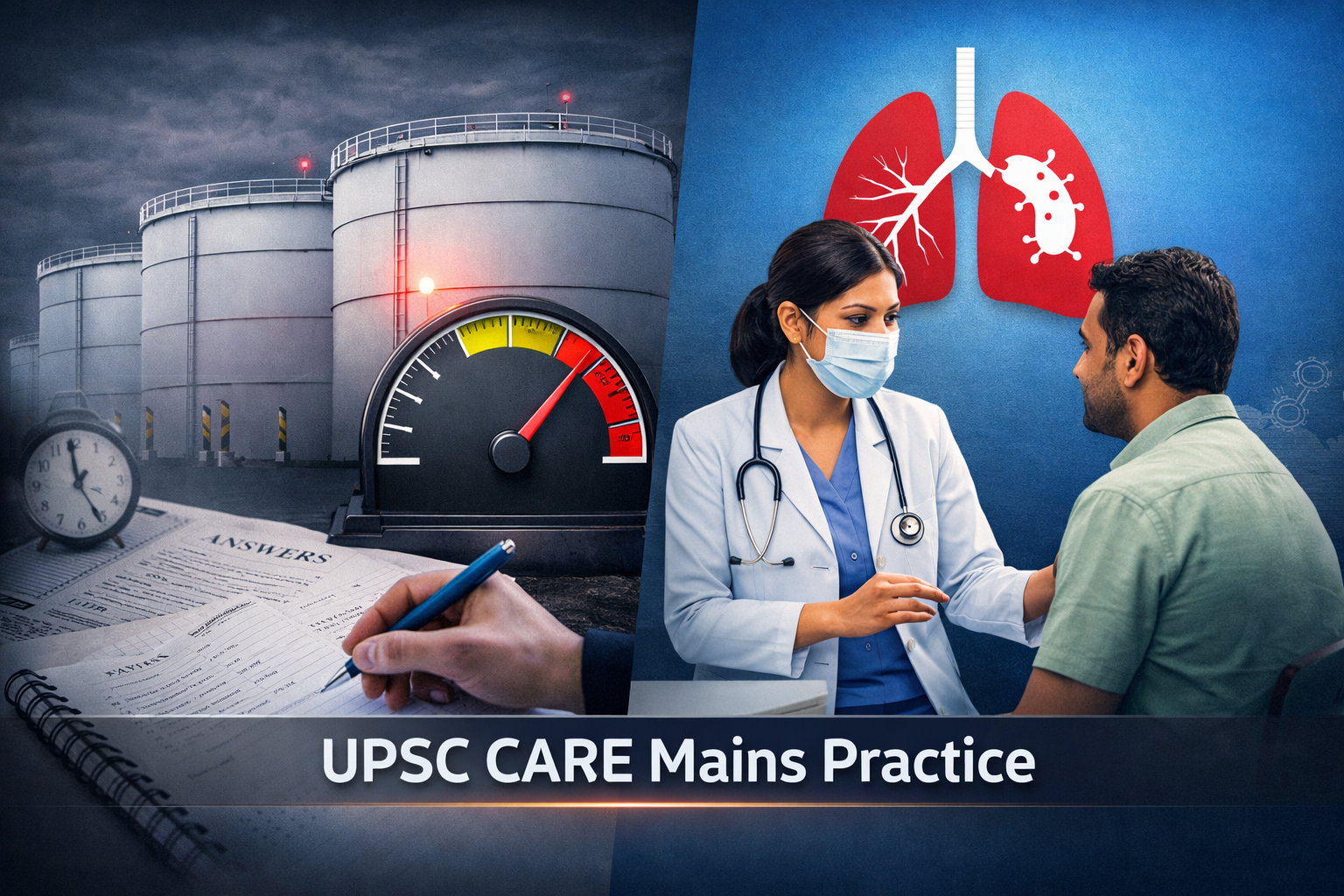
- India’s Strategic Petroleum Reserves (SPR) are crucial for ensuring energy security in the context of rising geopolitical uncertainties. Discuss the current status, challenges, and the need for expanding SPR capacity in India.
- “Tuberculosis (TB) in India persists as a socio-economic and governance challenge rather than merely a medical issue.”Discuss the limitations of the disease-specific approach and examine the need for a person-centred, integrated healthcare model for TB elimination.
Q. India’s Strategic Petroleum Reserves (SPR) are crucial for ensuring energy security in the context of rising geopolitical uncertainties. Discuss the current status, challenges, and the need for expanding SPR capacity in India.
(GS Paper III – Economy – Energy Security, Infrastructure)
Introduction:
Strategic Petroleum Reserves (SPR) are emergency crude oil stockpiles maintained by the government to manage short-term supply disruptions. In the context of rising geopolitical tensions, particularly in West Asia, the adequacy of India’s SPR has become a critical concern for energy security.
Body
Current Status of SPR in India
- Total SPR capacity: 5.33 million tonnes (MMT)
- Current storage: ~3.37 MMT (≈64% filled)
- Coverage: Only ~9.5 days of crude oil requirement
- Locations: Visakhapatnam, Mangaluru, and Padur
- Total oil reserves (including commercial stocks): ~74 days, below the IEA benchmark of 90 days
Challenges
1. High Import Dependence
- India imports over 88% of its crude oil, making it vulnerable to external shocks.
2. Inadequate Storage Capacity
- SPR capacity is insufficient to handle prolonged disruptions.
3. Geopolitical Vulnerability
- Around 40–50% of imports pass through the Strait of Hormuz, a conflict-prone region.
4. Delayed Expansion Projects
- Planned reserves at Chandikhol and Padur expansion remain pending.
5. Dynamic Reserve Levels
- Stock levels fluctuate with market conditions, reducing reliability during crises.
Need for Expanding SPR
1. Strengthening Energy Security
- Ensures uninterrupted supply during global crises and conflicts.
2. Price Stabilisation
- Enables government to release oil during price spikes and refill during low-price periods.
3. Strategic Autonomy
- Reduces dependence on volatile global markets and enhances policy independence.
4. Commercial Benefits
- Storage leasing (e.g., UAE’s ADNOC) improves economic efficiency and global integration.
Way Forward
- Accelerate Phase-II SPR expansion projects
- Aim to meet 90-day IEA benchmark
- Diversify crude import sources
- Integrate SPR with energy transition strategies
Conclusion:
India’s partially filled SPR highlights structural vulnerabilities in its energy security framework. Expanding and optimising SPR capacity is essential to ensure resilience, stability, and strategic preparedness in an increasingly uncertain global energy landscape.
Q. “Tuberculosis (TB) in India persists as a socio-economic and governance challenge rather than merely a medical issue.”Discuss the limitations of the disease-specific approach and examine the need for a person-centred, integrated healthcare model for TB elimination.
(GS Paper II – Health, Governance & Social Sector)
Introduction:
Tuberculosis (TB), caused by Mycobacterium tuberculosis, remains a significant public health challenge in India despite being preventable and curable. Its persistence indicates that TB is not merely a medical problem but is closely linked to socio-economic conditions and governance gaps.
Body
TB as a Socio-Economic and Governance Challenge
TB is influenced by multiple social determinants of health:
- Poverty, undernutrition, and overcrowding increase vulnerability.
- Comorbidities such as diabetes and HIV aggravate disease severity.
- Social stigma leads to delayed diagnosis and poor treatment adherence.
- Weak health systems and unequal access to care hinder effective control.
Thus, TB reflects a cycle of disease, deprivation, and systemic inadequacies.
Limitations of Disease-Specific Approach
The conventional disease-centric approach has several shortcomings:
- Treats TB in isolation, ignoring comorbidities and patient context.
- Neglects nutritional, behavioural, and socio-economic factors.
- Leads to poor treatment outcomes, relapse, and drug resistance.
- Results in fragmented service delivery and inefficiencies.
Need for Person-Centred, Integrated Approach
A shift towards integrated healthcare is essential:
- Holistic care addressing TB along with diabetes, respiratory and mental health conditions.
- Universal Health Coverage (UHC) ensuring affordable and continuous care.
- Multi-sectoral convergence integrating health, nutrition, sanitation, and social protection.
- Improves early diagnosis, treatment adherence, and overall outcomes.
Government Initiatives
India has adopted a multi-dimensional strategy:
- National TB Elimination Programme (NTEP) with Detect–Treat–Prevent–Build approach.
- Nikshay Portal for patient tracking and monitoring.
- Nikshay Poshan Yojana providing nutritional support.
- PM TB Mukt Bharat Abhiyaan promoting community participation.
Conclusion:
Eliminating TB requires a paradigm shift from treating a disease to addressing the patient holistically. Strengthening health systems, addressing social determinants, and ensuring inclusive governance are crucial for achieving TB elimination in India.