

- The tripartite struggle for control of Kanauj during the 8th and 9th centuries was a pivotal period in Indian history, involving the Pala, Pratihara, and Rashtrakuta dynasties. Let’s break down the key events:
Phase I:
- Around 790 AD, the conflict began with a clash between Dharmapala of the Pala dynasty and Vatsaraja of the Pratihara dynasty. Dharmapala was defeated by Vatsaraja at Prayag.
- Subsequently, Vatsaraja was defeated by Dhruva, the Rashtrakuta king.
- Dharmapala managed to briefly take control of Kanauj after Vatsaraja’s downfall but was defeated again by Dhruva.
- However, Dhruva couldn’t consolidate his victory due to the need to return to the south to protect his own kingdom.
- The Rashtrakutas faced internal struggles after Dhruva’s death in 793 CE, leading to their withdrawal from Northern India.
- Dharmapala seized the opportunity and regained Kanauj, installing Chakrayudha on the throne. He further expanded his influence through successful expeditions, establishing control over much of Northern India.
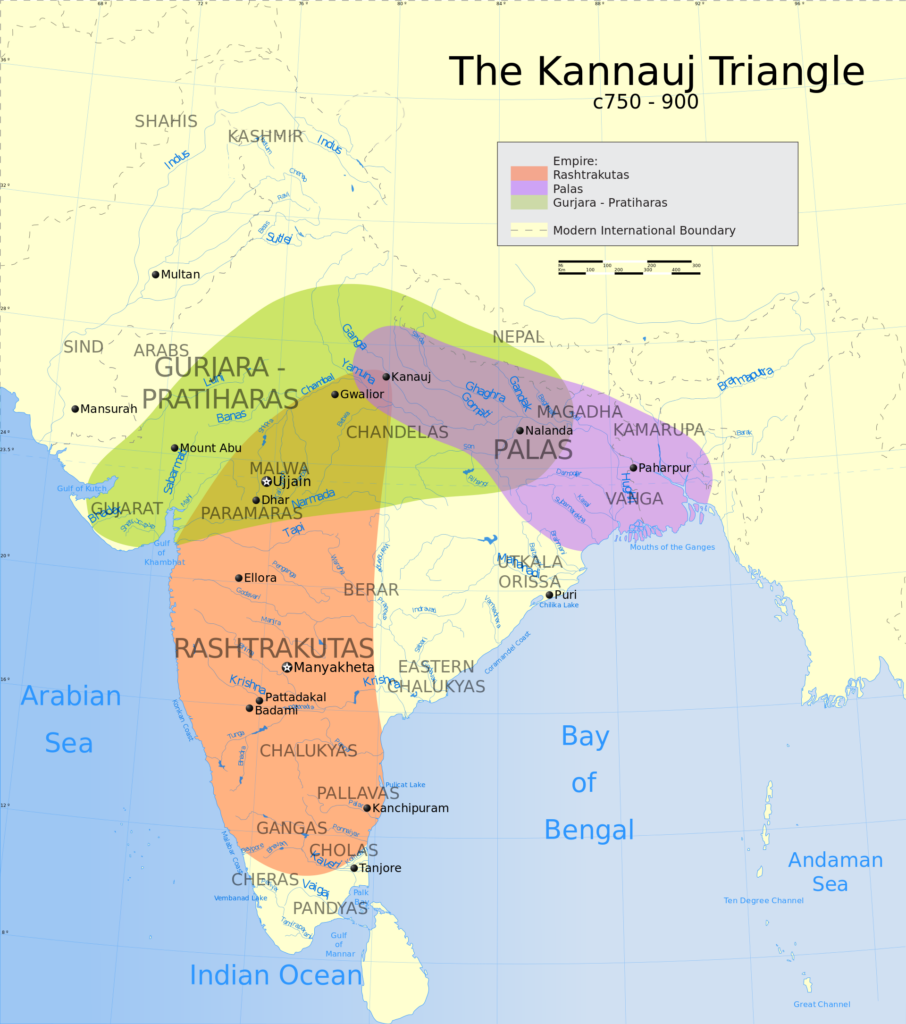
Phase II:
- Nagabhatta II, successor of Vatsaraja, invaded Kanauj and expelled Chakrayudha, establishing Pratihara control.
- A battle between Nagabhatta II and Dharmapala became inevitable, resulting in Nagabhatta II defeating Dharmapala near Munger.
- Despite Nagabhatta II’s initial success, he was soon overthrown by Govinda III, the Rashtrakuta king and successor of Dhruva.
- Govinda III’s victory was short-lived as he soon left for the Deccan.
- By the end of the 9th century, the power of the Rashtrakutas and Palas began to decline, while the Pratiharas emerged victorious and established themselves as rulers of central India.
Indeed, the weakening of established Indian dynasties facilitated the expansion of Islamic empires such as the Ghaznavids and the Delhi Sultanate, ultimately reshaping the political and cultural landscape of the Indian subcontinent. Thus, the repercussions of the tripartite struggle extended far beyond the immediate dynastic rivalries, influencing the course of Indian history for centuries to come.
Decline of Rastrakutas
- Indra III (915-927), the grandson of Amoghavarsha, rejuvenated the declining Rashtrakuta empire. He achieved a significant victory by defeating Mahipala, the Pratihara ruler, and plundering Kannauj, thereby elevating his status as the preeminent ruler of his time. Additionally, Krishna II engaged in conflicts against the Paramaras of Malwa and the Eastern Chalukyas of Vengi. He also initiated a military campaign against the emerging power of the Cholas in Tanjore, who had supplanted the Pallavas of Kanchi.
- In 949, Krishna III achieved a notable triumph by defeating Parantaka I, the Chola ruler, and incorporating the northern territories of the Chola kingdom into his domain. He further extended his conquests to Rameswaram, where he erected a victory pillar and constructed a temple. However, following his demise, a coalition of adversaries united and launched a concerted attack on the Rashtrakutas. In 972, the capital city of Malkhed was besieged, resulting in its ransacking and destruction, signifying the ultimate downfall of the Rashtrakuta dynasty.
