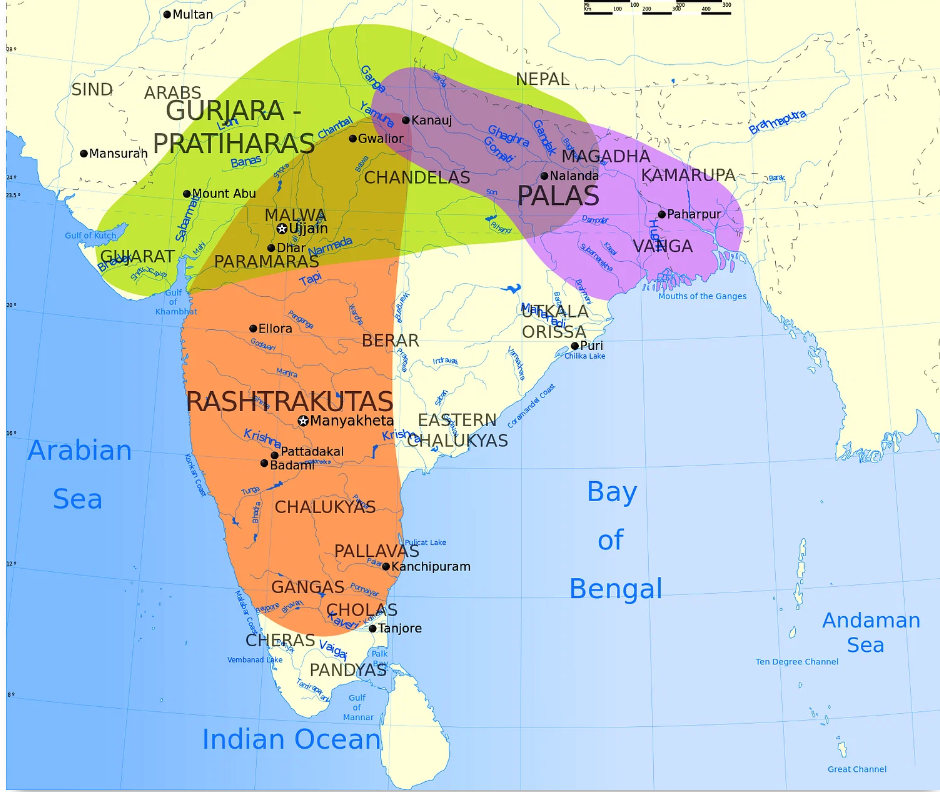
- The Gurjara-Pratiharas emerged as the earliest Rajput rulers, led initially by Harischandra. Under his leadership, they expanded their realm across Rajputana, establishing their capital at Bhinmal. The Gurjaras had various branches, with one governing Gujarat and another in Avanthi.
- Despite early efforts by the Pratihara rulers to expand into the upper Ganga valley and Malwa, they faced defeat from Rashtrakuta rulers Dhruva and Gopal III. The Rashtrakutas emerged victorious in 790 and again in 806–07, forcing the Pratiharas to retreat to the Deccan and allowing the Palas to rise unopposed. The Rashtrakutas’ primary focus seemed to be the domination of Malwa and Gujarat.
- Bhoja is recognized as the true founder and greatest ruler of the Pratihara empire. He revitalized the empire, reclaiming Kanauj by around AD 836, which then served as the empire’s capital for nearly a century. He is sometimes referred to as Mihir Bhoja to differentiate him from Bhoja Paramara of Ujjain, who ruled slightly later. Bhoja likely passed away around 885, succeeded by his son Mahendrapala I.
- Mahendrapala I, ruling until about 908–09, upheld his father’s empire and extended its influence over Magadha and northern Bengal. The Pratiharas dominated northern India for over a century, from the early ninth to the middle of the tenth century.
The Pratiharas were patrons of learning and literature. The great Sanskrit poet and dramatist, Rajashekhar, lived at the court of Mahipala, a grandson of Bhoja. The Pratihara also embellished Kanauj with many fine buildings and temples. Bhoja was a devotee of Vishnu, and adopted the title of ‘Adivaraha’ which has been found inscribed in some of his coins.
Key Rulers:
- Nagabhata I (730-756 AD):
- Founder of the dynasty, renowned for defeating Arab forces.
- Vatsaraja (775-800 AD):
- Pursued an aggressive imperial policy, defeating Pala king Dharmapala.
- Nagabhatta II (800-833 AD):
- Expanded the empire through alliances with other states, capturing Kanauj and defeating Dharmapala and Rashtrakuta king Govinda III.
- Bhoja I (836-885 AD):
- Restored the dynasty’s fortunes and expanded territory by defeating Krishna II and capturing Malwa and Gujarat. Known for his devotion to Vishnu and grand titles like ‘Adivaraha’.
Architectural Contributions of Bhoja I:
- Teli-ka-Mandir, Gwalior: A Hindu temple in Gwalior Fort dedicated to Shiva, Vishnu, and Matrikas. Unique for its rectangular sanctum and integration of Nagara and Valabhi Prasada architectural styles, showcasing the Gurjara Pratihara-Gopagiri style North Indian architecture, reflecting “musical harmonics” in its design.
- Mahendrapala I (885-910 AD):
- Maintained and expanded the empire while earning titles like ‘Mahendrayudha’ and ‘Nirbhayanarendra’. Known for patronizing learned men, including his guru Rajashekhara, a prominent figure in Indian literature.
Administration under Pratiharas:
- The administration of the Pratiharas was centralized around the authority of the kings, who held significant power and bore grand titles such as ‘Parmeshwara’, ‘Maharajadhiraja’, and ‘Parambhaterak’. They oversaw the appointment of officials and the execution of charitable works. Samantas, or feudal lords, played a crucial role by providing military support to the kings and advising them on various matters. Notably, there were no mentions of a council of ministers during this period.
- The administrative structure comprised various officials responsible for different functions:
- Kottapala: Managed the forts, serving as the highest officer.
- Tantrapala: Represented the king in the samanta states.
- Dandapashika: Held the highest position in the police department.
- Dandanayaka: Oversaw military and judicial affairs.
- Dutaka: Carried out orders and grants of the king to specified individuals.
- Bhangika: Wrote orders related to charities and grants.
- Vynaharina: Provided legal advice, presumably a legal expert.
- Baladhikrat: Chief of the army.
- The state was divided into numerous bhuktis, each containing several mandals, cities, and villages, facilitating efficient administration. Villages were locally administered, with Mahattars overseeing village affairs and Gramapatis advising on village matters. Urban administration was managed by councils such as Goshthi, Panchakula, Sanviyaka, and Uttar sobha.
- Despite the absence of a formal council of ministers, this well-organized administrative setup allowed the Pratiharas to efficiently defend India from Arab attacks.
Decline of the Pratihara Empire
- Between 915 and 918, the Rashtrakuta monarch, Indra III, launched an assault on Kanauj, dealing a significant blow to the Pratihara empire. As a consequence, Gujarat fell under Rashtrakuta control. This loss was particularly impactful as Gujarat served as a crucial center for overseas trade and the primary route for North Indian goods to reach West Asian markets.
- In a subsequent incursion around 963, another Rashtrakuta ruler, Krishna III, invaded northern India and emerged victorious against the Pratihara ruler. This defeat hastened the disintegration of the Pratihara empire, marking the rapid decline of their influence.
- During a period of temporary weakness in the Gurjara-Pratihara empire, several feudatories seized the opportunity to assert their independence, establishing their own states. Among these were prominent dynasties such as:
- Paramaras of Malwa: They carved out an independent realm in the region of Malwa, central India, with their capital at Dhara (present-day Dhar).
- Chandelas of Bundelkhand: They established their authority in the Bundelkhand region, with their capital at Khajuraho. The Chandelas are renowned for their architectural marvels, particularly the temples at Khajuraho.
- Kalachuris of Mahakoshal: The Kalachuris asserted their independence in the Mahakoshal region, centered around present-day eastern Madhya Pradesh and parts of Chhattisgarh.
- Tomaras of Haryana: They emerged as a significant power in the Haryana region, consolidating their control over territories around Delhi and Haryana.
- Chahamanas of Shakambhari: Also known as the Chauhans, they established their rule in the Shakambhari region, present-day Rajasthan. The Chahamanas later rose to prominence as rulers of the kingdom of Ajmer and Delhi.
- These feudal lords took advantage of the weakening central authority of the Gurjara-Pratiharas to assert their independence and establish their own autonomous states, shaping the political landscape of medieval India.