
The Kessler syndrome
(also called the Kessler effect, collisional cascading or ablation cascade), proposed by the NASA scientist Donald J. Kessler in 1978, is a scenario in which the density of objects in low Earth orbit (LEO) is high enough that collisions between objects could cause a cascade where each collision generates space debris that increases the likelihood of further collisions.
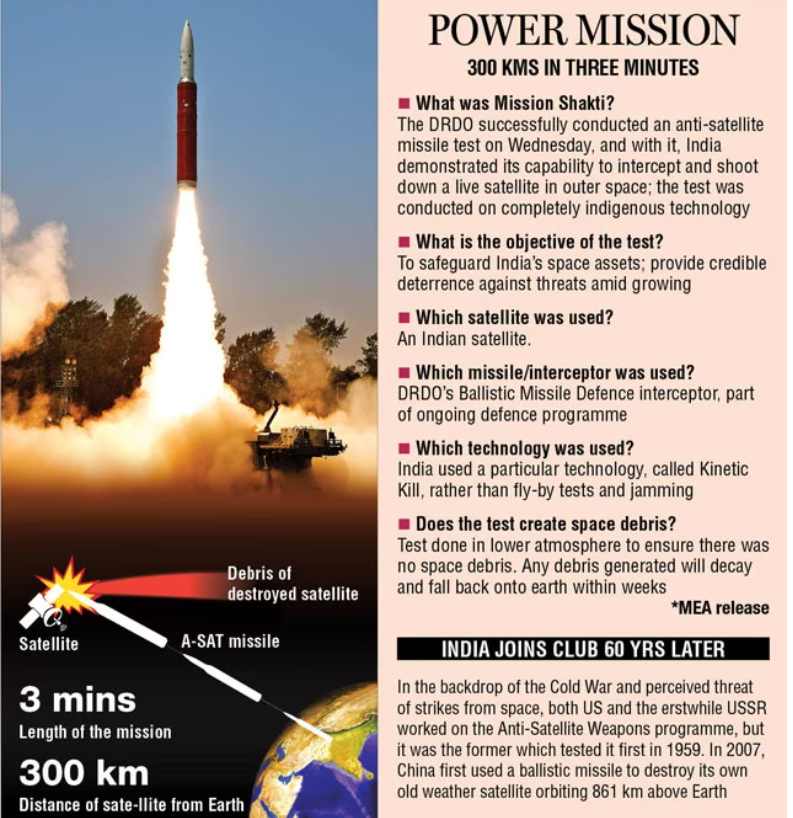
Mission Shakti
- Mission Shakti was undertaken to develop highly-potent Anti-satellite weapons (ASAT).
- It is a joint programme of the Defence Research and Development Organisation (DRDO) and the Indian Space Research Organisation (ISRO).
- Anti-satellite (ASAT) System is missile-based system to attack moving satellites.
- It has successfully destroyed a live satellite in the Low Earth Orbit (an altitude of 300 km).
- With this test India is now in the league of three countries after the U.S., Russia, and China to have such technology.
PM Modi “directs” ISRO to land man on moon by 2040
Prime Minister Narendra Modi has directed the Indian Space Research Organisation (ISRO) to establish an indigenous space station named “Bharatiya Antariksha Station” by 2035.
- Additionally, he called for an Indian to land on the moon by 2040.
- These ambitious goals were outlined during a review of the Gaganyaan mission, India’s first manned space mission scheduled for 2025.
- The roadmap for moon exploration includes a series of Chandrayaan missions, the development of a new generation launch vehicle, construction of a new launch pad, and the establishment of human-centric laboratories and associated technologies.
- The Prime Minister also urged scientists to work on interplanetary missions, such as a space vehicle to orbit Venus and one to land on Mars. The cost and feasibility of these plans will be important considerations.
