Why in News?
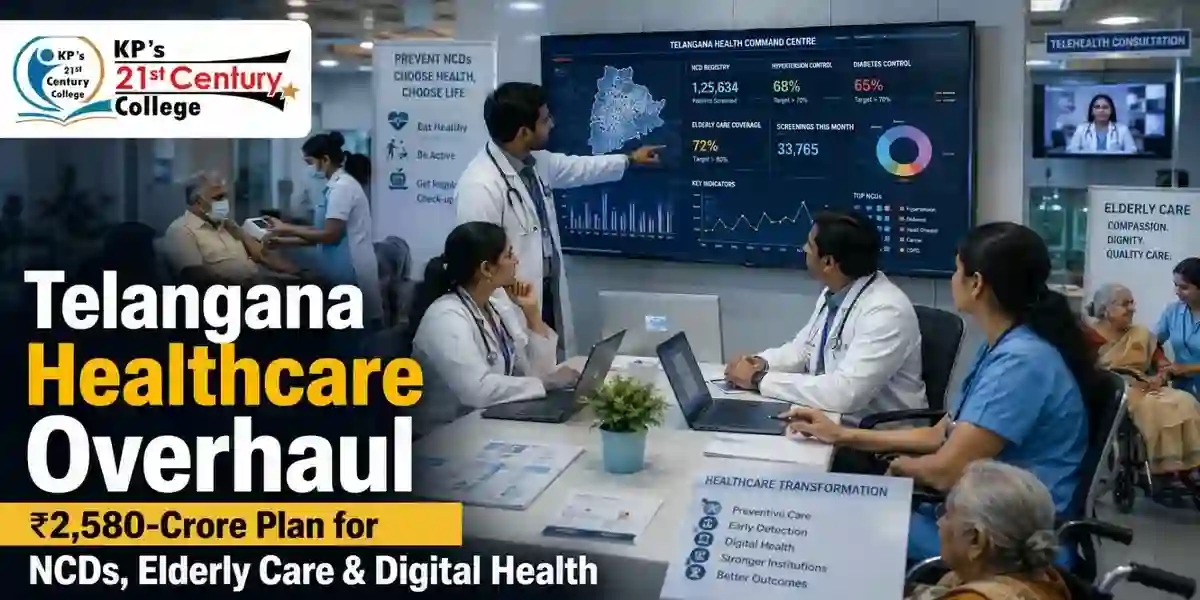
Telangana is considering a ₹2,580-crore, or US$300 million, World Bank loan for a major healthcare transformation programme called the Telangana Strategic Vision for Attaining Sustainable Transformation in Health Care (TG-SVASTH).The proposal is detailed in the World Bank’s final draft Environment and Social Systems Assessment (ESSA) prepared for Project P512286.The programme focuses on the growing burden of non-communicable diseases, women’s health, elderly care, preventive healthcare, digital transformation and health-system governance.
What is TG-SVASTH?
TG-SVASTH (Telangana Strategic Vision for Attaining Sustainable Transformation in Health Care).is a proposed health-system reform programme intended to help Telangana respond to its changing disease burden and demographic profile.
It seeks to strengthen:
- Management of non-communicable diseases
- Women’s healthcare
- Elderly healthcare
- Preventive and early-screening services
- Digital-health systems
- Governance and monitoring
- Institutional capacity
- Healthcare access for vulnerable sections
The programme represents a planned transition from a predominantly disease-specific and hospital-centric model towards integrated, person-centred and preventive healthcare.
Financing Architecture
Proposed Loan
- Amount: ₹2,580 crore
- Equivalent: US$300 million
- Lending institution: International Bank for Reconstruction and Development
- Recipient: Government of India
- Implementing department: Telangana Department of Health, Medical and Family Welfare
Program-for-Results Mechanism
The World Bank proposes to provide financing through the Program-for-Results mechanism.
Under PforR:
- Funds are linked to agreed performance targets.
- Disbursement depends on verified results.
- Financing is not based merely on expenditure.
- Institutional performance and measurable outcomes gain greater importance.
Thus, the programme links financial assistance with improvements in health-system delivery and governance.
Why Does Telangana Need a Health-System Shift?
Telangana already has an extensive public-health network consisting of:
- Sub-centres
- Primary health centres
- Urban primary health centres
The State has also recorded:
- Improvement in maternal mortality indicators
- Improvement in infant mortality indicators
- High institutional-delivery rates
However, the nature of the health challenge is changing.
Emerging Disease Burden
The State is witnessing a rise in:
- Diabetes
- Hypertension
- Cardiovascular diseases
- Cancers
Unlike many acute illnesses, these conditions require:
- Early detection
- Long-term treatment
- Regular monitoring
- Lifestyle counselling
- Continuous follow-up
Demographic Change
An ageing population is creating greater demand for:
- Elderly healthcare
- Long-term care
- Home-based services
- Regular monitoring
- Person-centred support
Therefore, Telangana must move beyond a healthcare model centred mainly on hospitals and individual diseases.
Three Major Result Areas
1. Improving Quality and Accessibility
The first result area focuses on improving healthcare services for:
- Patients with non-communicable diseases
- Women
- Elderly persons
The emphasis is on both quality of care and accessibility of services.
2. Preventive Healthcare and Digital Transformation
The second result area seeks to strengthen preventive healthcare by:
- Encouraging early screening
- Improving community awareness
- Reducing avoidable hospitalisation
- Expanding digital-health systems
- Supporting continuous monitoring
This approach aims to identify health risks before they develop into severe and costly medical conditions.
3. Governance and Institutional Capacity
The third result area focuses on strengthening:
- Health-system governance
- Monitoring mechanisms
- Institutional capacity
- Accountability
- Administrative performance
This is significant because better health outcomes depend not only on hospitals and doctors, but also on effective management, monitoring and coordination.
Focus on Elderly Care
The report gives specific attention to home-based care for elderly persons.
It recommends:
- Operational guidelines
- Training mechanisms
- Safe delivery protocols
- Effective monitoring
- Capacity building of health personnel
Home-based services can support elderly persons who may find it difficult to regularly visit health facilities.
The programme therefore recognises elderly care as an important part of mainstream public-health planning.
Focus on Vulnerable Groups
TG-SVASTH seeks to improve healthcare access for:
- Scheduled Tribe communities
- Women
- Elderly citizens
- Persons with disabilities
The focus on vulnerable groups indicates that the programme is designed not merely to improve overall health indicators, but also to address inequalities in access.
Grievance Redress and Institutional Safety
The proposed reforms include strengthening grievance-redress systems.
These mechanisms will also address complaints related to:
- Sexual exploitation
- Abuse
- Harassment
Such systems are intended to improve:
- Institutional accountability
- Patient protection
- Responsiveness of health facilities
- Safety within the healthcare system
Environmental and Social Systems Assessment
The World Bank’s ESSA examines the environmental and social systems connected with the proposed programme.
The action plan includes:
- Training health personnel
- Strengthening environmental safeguards
- Strengthening social safeguards
- Improving healthcare accessibility
- Enhancing monitoring systems
- Improving accountability
- Building institutional capacity
These measures are intended to ensure that health-system expansion is socially inclusive and institutionally sustainable.
Significance of TG-SVASTH
1. Response to the NCD Transition
The programme recognises that Telangana’s disease burden is increasingly shaped by chronic conditions rather than only communicable diseases.
2. Shift Towards Prevention
Early screening and awareness can reduce disease severity and avoidable hospitalisation.
3. Person-Centred Healthcare
The programme seeks to organise services around the needs of patients rather than around individual diseases or institutions.
4. Elderly-Care Integration
Home-based care brings ageing-related healthcare into the formal public-health framework.
5. Digital Health Transformation
Digital systems can support monitoring, continuity of care and better coordination.
6. Inclusive Healthcare
Special attention to Scheduled Tribes, women, elderly citizens and persons with disabilities can reduce inequalities in healthcare access.
7. Results-Based Governance
PforR financing links funds with measurable achievements, strengthening accountability and performance orientation.
8. Health-System Resilience
Institutional reforms and capacity building can help Telangana respond to future disease and demographic challenges.
Conclusion
TG-SVASTH reflects Telangana’s attempt to realign its healthcare system with emerging realities. Rising non-communicable diseases and an ageing population require continuous, preventive and person-centred care rather than an exclusively hospital-based response.
By combining early screening, digital transformation, elderly home care, vulnerable-group inclusion and institutional reform, the programme seeks to build a more resilient, inclusive and sustainable healthcare system. Its results-based financing model also places greater emphasis on measurable outcomes and accountability.