
Taifa 1 Mission
- Launch Vehicle- Falcon 9, SpaceX
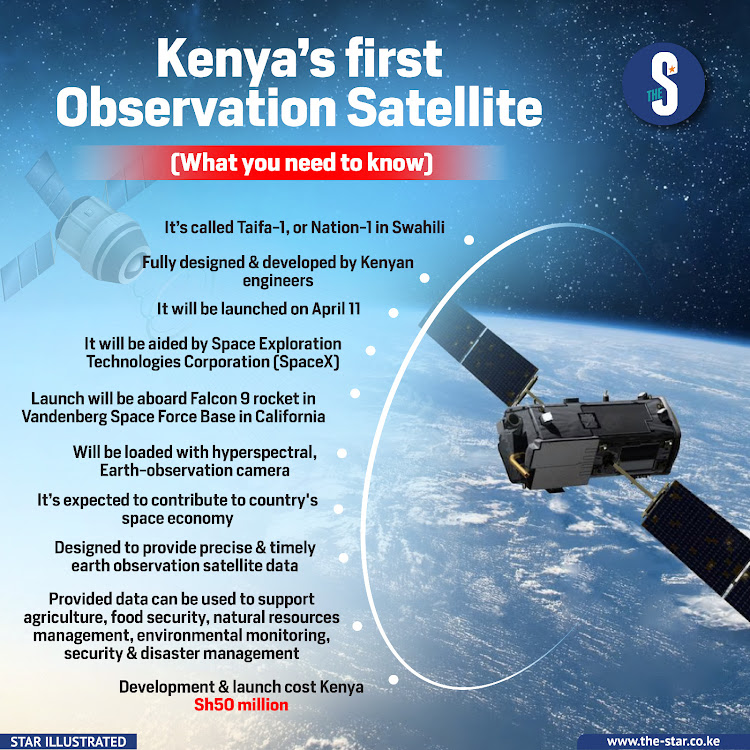
- Taifa-1 Sat is Kenya’s first operational earth observation satellite.
- It is equipped with an optical camera that takes pictures simultaneously in multispectral and panchromatic modes enabling it to operate within and beyond the visible light spectrum.
- The satellite is the first of what is intended to be a constellation of small earth observation satellites, with subsequent systems expected to be of higher capability.
- observation satellites, with subsequent systems expected to be of higher capability.
Juice mission
- Launch: 14 April 2023
- Launch location: Europe’s Spaceport in French Guiana
- Launch vehicle: Ariane 5
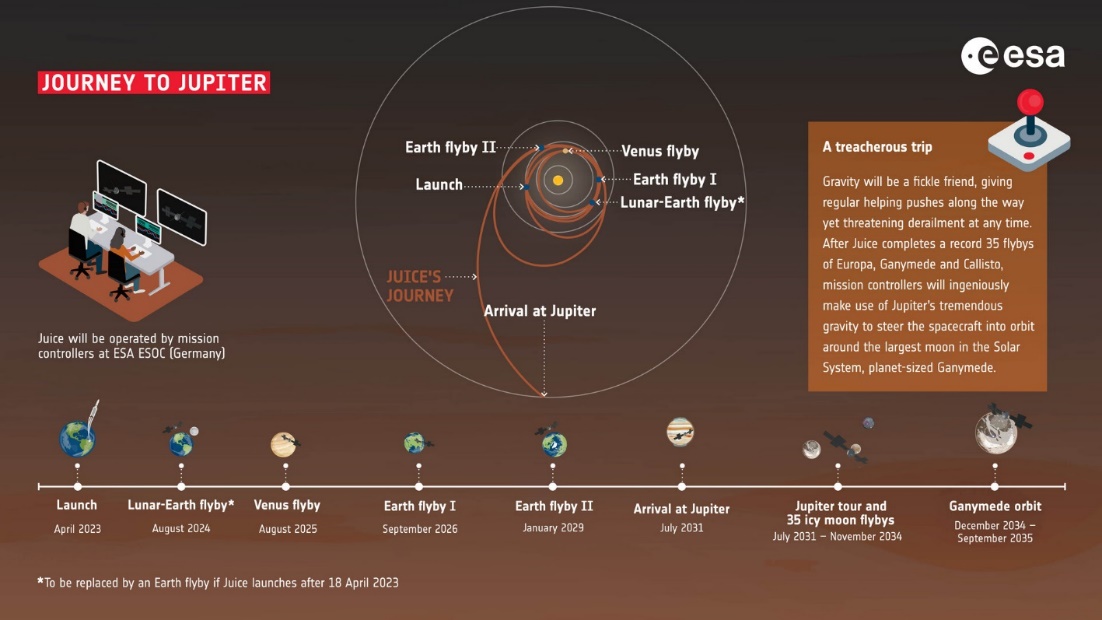
- ESA’s Jupiter Icy Moons Explorer, Juice, will make detailed observations of the giant gas planet and its three large ocean-bearing moons – Ganymede, Callisto and Europa – with a suite of remote sensing, geophysical and in situ instruments.
- The mission will characterise these moons as both planetary objects and possible habitats, explore Jupiter’s complex environment in depth, and study the wider Jupiter system as an archetype for gas giants across the Universe.
BepiColombo
- BepiColombo is an international mission comprised of two spacecraft riding together to Mercury to orbi
 t and to study the planet from unique vantage points. The European Space Agency (ESA) provided one orbiter. The Japan Aerospace Exploration Agency (JAXA) supplied the second orbiter.
 - BepiColombo launched in October 2018 and is scheduled to begin orbiting Mercury in 2025.
- ESA’s Mercury Planetary Orbiter (MPO) will study the planet’s surface and interior.
- JAXA’s Mercury Magnetospheric Orbiter (MIO) will study the planet’s magnetic field.
- These are the first Mercury missions for the ESA and Japan. Only two other spacecraft have visited Mercury: NASA’s Mariner 10 and MESSENGER.
Scientific Instruments
Mercury Planetary Orbiter (MPO): 2,540 pounds (1,150 kilograms)
1. BELA–BepiColombo Laser Altimeter
2. ISA–Italian Spring Accelerometer
3. MPO-MAG–Magnetic Field Investigation
4. MERTIS–Mercury Radiometer and Thermal Imaging Spectrometer
5. MGNS–Mercury Gamma-Ray and Neutron Spectrometer
6. MIXS–Mercury Imaging X-ray Spectrometer
7. MORE–Mercury Orbiter Radio Science Experiment
8. PHEBUS–Probing of Hermean Exosphere by Ultraviolet Spectroscopy
9. SERENA–Search for Exosphere Refilling and Emitted Neutral Abundances (neutral and ionized particle analyzer)
10. SIMBIO-SYS–Spectrometers and Imagers for MPO BepiColombo Integrated Observatory
11. SIXS–Solar Intensity X-ray and Particle Spectrometer
Mercury Magnetospheric Orbiter (MMO): 606 pounds (275 kilograms):
1. MMO-MGF–Mercury Magnetometer
2. MPPE–Mercury Plasma Particle Experiment
3. PWI–Mercury Plasma Wave Instrument
4. MSASI–Mercury Sodium Atmospheric Spectral Imager
5. MDM–Mercury Dust Monitor
Other missions of ESA
- The Laser Interferometer Space Antenna (LISA) will be the first space-based gravitational wave observatory. Selected to be ESA’s third large-class mission, it will address the science theme of the Gravitational Universe. LISA will consist of three spacecraft separated by 2.5 million km in a triangular formation, following Earth in its orbit around the Sun. Launch is expected in 2037.
- Athena – Advanced Telescope for High-ENergy Astrophysics – will be an X-ray telescope designed to address the Cosmic Vision science theme ‘The Hot and Energetic Universe’. By combining a large X-ray telescope with state-of-the-art scientific instruments, Athena will be able to make an important contribution to answering these questions. In 2014, Athena was selected as the second large (L-class) mission in ESA’s Cosmic Vision programme.
- Ariel, the Atmospheric Remote-sensing Infrared Exoplanet Large-survey, was selected as the fourth medium-class mission in ESA’s Cosmic Vision programme. It will study what exoplanets are made of, how they formed and how they evolve, by surveying a diverse sample of about 1000 extrasolar planets, simultaneously in visible and infrared wavelengths. It is the first mission dedicated to measuring the chemical composition and thermal structures of hundreds of transiting exoplanets, enabling planetary science far beyond the boundaries of the Solar System.
- PLAnetary Transits and Oscillations of stars (PLATO) is the third medium-class mission in ESA’s Cosmic Vision programme. Its objective is to find and study a large number of extrasolar planetary systems, with emphasis on the properties of terrestrial planets in the habitable zone around solar-like stars. PLATO has also been designed to investigate seismic activity in stars, enabling the precise characterisation of the planet host star, including its age.
- clearspace-1
The first mission to remove a piece of space debris from orbit, Clearspace-1 will rendezvous with, capture and safely bring down a large derelict object for a safe atmospheric reentry
- The Atmospheric Limb Tracker for Investigation of the Upcoming Stratosphere (Altius) mission carries a high-resolution spectral imager and uses a limb-sounding technique to deliver profiles of ozone and other trace gases in the upper atmosphere to support services such as weather forecasting, and to monitor long-term trends. Altius is developed within ESA’s Earth Watch programme and financed mainly by Belgium with contributions from Canada, Luxembourg and Romania.
- As part of the world’s first test of asteroid deflection, Hera will perform a detailed post-impact survey of the target asteroid, Dimorphos – the orbiting moonlet of a binary asteroid system known as Didymos. Now that NASA’s DART mission has impacted the moonlet, Hera will turn the grand-scale experiment into a well-understood and repeatable planetary defence technique. Demonstrating new technologies from autonomous navigation around an asteroid to low gravity proximity operations, Hera will be humankind’s first probe to rendezvous with a binary asteroid system and Europe’s flagship Planetary Defender.
