
Solar Radiation
The Earth’s surface receives most of its energy from the sun in the form of short wavelengths. This energy is termed “insolation,” short for incoming solar radiation.As a geoid, Earth captures only a fraction of the sun’s energy. On average, it receives 1.94 calories per square centimeter per minute at the top of the atmosphere.
Variability of Insolation
Insolation varies during the day, throughout seasons, and over the year due to several factors:
- Rotation of the Earth: The daily rotation causes variation in the amount of insolation received at any point on Earth.
- Angle of the Sun’s Rays’ Inclination:
- Depending on the latitude, the sun’s rays can be more or less direct, affecting the intensity of insolation.
- Higher latitudes receive slanting rays which cover more area and thus have less energy per unit area.
- Length of the Day: Longer days in summer result in more insolation compared to shorter days in winter.
- Atmospheric Transparency:
- The atmosphere’s transparency affects how much solar radiation reaches the surface.
- Water vapor, ozone, and other gases in the troposphere absorb some of the incoming solar radiation.
- Configuration of Land: The aspect and topography of land can influence the amount of insolation received.
Spatial Distribution of Insolation
- Insolation at the Earth’s surface ranges from about 320 Watts/m² in the tropics to about 70 Watts/m² at the poles.
- Maximum Insolation: Subtropical deserts receive the most insolation due to low cloud cover.
- Equatorial Region: Receives less insolation compared to the tropics due to higher cloud cover.
- Latitudinal Variation: At the same latitude, continents typically absorb more insolation than oceans.
- Seasonal Variation: Middle and higher latitudes receive less insolation in winter than in summer.
Heating and Cooling of the Atmosphere
The heating and cooling of the atmosphere occur through various processes, primarily driven by the interaction between the Earth’s surface and solar radiation. Here are the main processes involved:
Conduction
- Conduction is the process by which heat is transferred through direct contact between molecules at different temperatures.
- When the Earth’s surface absorbs insolation (incoming solar radiation), it heats the air that is in direct contact with it.
- This heat is then passed to the adjacent air molecules, heating the lower layers of the atmosphere.
Convection
-
- Convection refers to the vertical movement of air.
- When air near the Earth’s surface warms, it expands and rises due to a decrease in density.
- Cooler air descends to replace the rising warm air, creating a convective current.
Advection
-
- Advection is the horizontal transfer of heat through the movement of air masses.
- Unlike convection, which is vertical, advection involves the lateral movement of air.
- Advection plays a significant role in redistributing heat across different regions.
- It is particularly important in influencing diurnal (day and night) temperature variations and weather changes in middle latitudes.
- In tropical areas, advection can lead to events such as the ‘loo’ winds experienced in northern India during the summer.
Terrestrial Radiation
-
- The Earth absorbs insolation and heats up, subsequently becoming a radiating body.The Earth emits this absorbed energy in the form of long-wave radiation.
- This long-wave radiation is absorbed by atmospheric gases, particularly carbon dioxide and other greenhouse gases.
- It contributes to the greenhouse effect, which helps maintain the Earth’s average temperature.
Heat Budget of the Earth
The heat budget is the statement that depicts the balance of heat in terms of influx and outflux.The Earth, as a whole, regulates its temperature to ensure that it neither gains nor loses heat over time.The amount of heat received in the form of insolation and the amount lost by the earth through terrestrial radiation is equal. On average, the earth receives 1360 watt/m2 or 1.99 langley/min energy at the height of around 800 kms above the earth’s surface. This energy is referred to as the solar constant. There are certain mechanisms through which the earth maintains its ambient surface temperature by balancing insolational influx with insolational outflux.
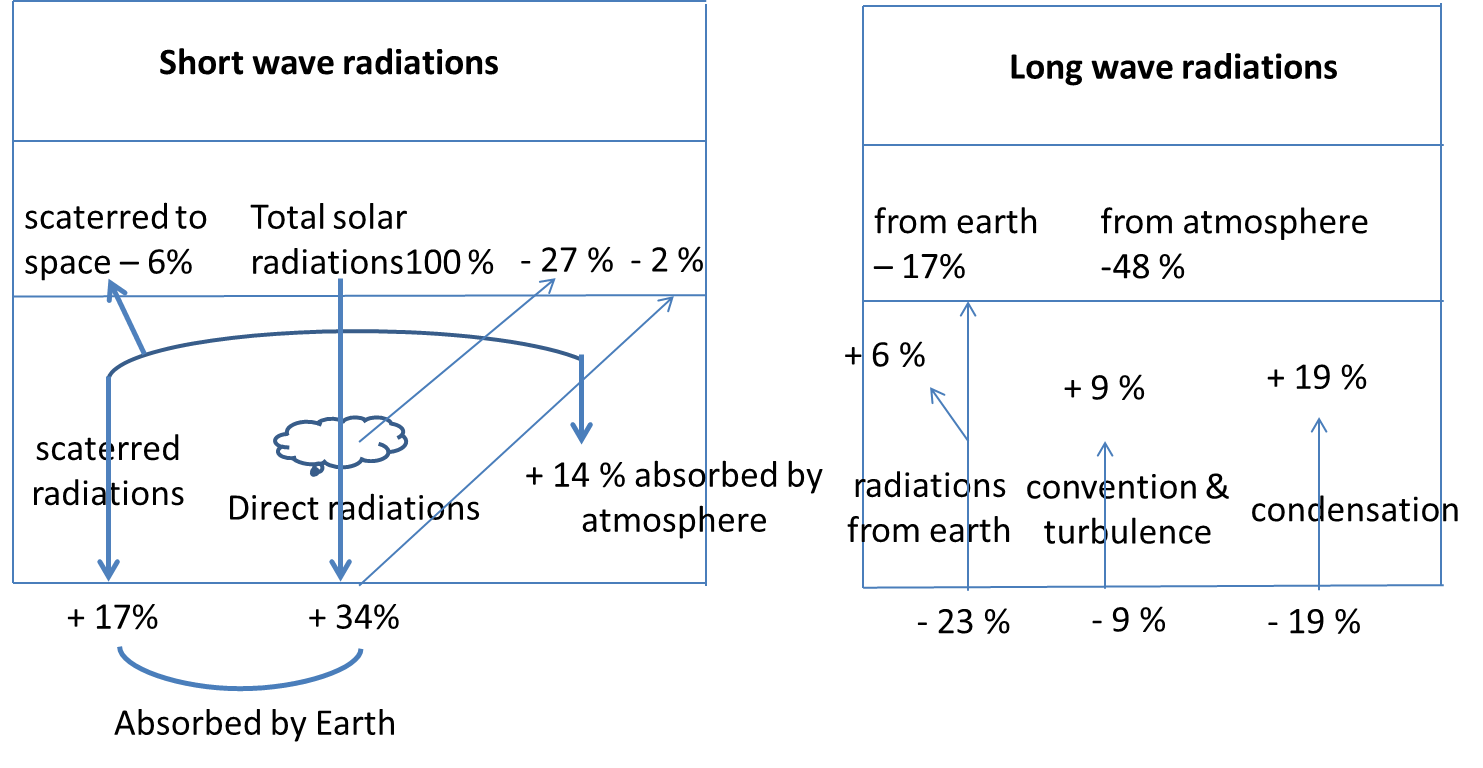
- Suppose the insolation received at the top of the atmosphere is 100 units.
- As the energy travels through the atmosphere, some of it is reflected, scattered, and absorbed, with only the remaining portion reaching the Earth’s surface.
- Nearly 35 units are reflected back to space even before reaching the earth’s surface.
- Of these 35 units, 27 are reflected from the tops of clouds and 2 units from snow and ice-covered regions of the Earth. The total reflected radiation is known as the Earth’s albedo.
- The 65 units that are remaining, are absorbed such that 14 units are absorbed within the atmosphere and 51 units by the earth’s surface.
- The Earth emits 51 units as terrestrial radiation.
- Of these 51 units, 17 are directly radiated into space, while the remaining 34 are absorbed by the atmosphere.Out of 34 units absorbed by the atmosphere, 6 units are absorbed directly by the atmosphere, 9 units through convection and turbulence and 19 units through latent heat of condensation.
- 48 units absorbed by the atmosphere are also radiated back into space [14 units (from insolation) + 34 units (from terrestrial radiation)].
- Thus, the total radiation returning from the earth and the atmosphere respectively is 17 units + 48 units = 65 units which balance the total of 65 units received from the sun.
- This is termed the heat balance of the earth and explains, why the earth neither warms up nor cools down despite the huge transfer of heat that takes place.
Albedo
- Albedo is the amount of light that is reflected back by the clouds, scattering from the dust and reflection from the earth’s surface without being absorbed.
- The value of albedo differs from the surface to surface.
- The effect of albedo can be seen in urban areas where the cities experience higher average temperatures than the surrounding suburban or rural areas. This phenomenon is known as the Urban Heat Island Effect.
Variation in the net energy balance at the Earth’s surface
- The earth as a whole maintains a balance between the influx insolation and the outgoing terrestrial radiation. However, this does not hold true at different latitudes.
- The amount of insolation received at different latitudes varies from place to place.
- There is a surplus in the net radiation balance between 40 degrees north and south, while the polar regions experience a deficit.
- Excess heat from the tropics is transferred toward the poles, preventing the tropics from becoming progressively hotter due to excess heat, and the polar regions from remaining permanently frozen due to extreme deficits.
- In the tropical zone, insolation surpasses terrestrial radiation, resulting in a surplus of heat.
- In the polar regions, heat loss exceeds heat gain, making them areas of heat deficit.
- The imbalance of heat is nullified to some extent by ocean currents and winds, which transfer heat from surplus heat regions to deficit heat regions through the process known as Latitudinal Heat Balance.

The Earth’s heat budget refers to the balance between incoming solar radiation (insolation) and outgoing terrestrial radiation. This balance ensures that the Earth maintains a relatively constant temperature over time.
