
- India is a tropical country. It has enormous possibilities of tapping solar energy. Photovoltaic technology converts sunlight directly into electricity.
- Solar energy is fast becoming popular in rural and remote areas. Some big solar power plants are being established in different parts of India which will minimise the dependence of rural households on firewood and dung cakes, which in turn will contribute to environmental conservation and adequate supply of manure in agriculture.
Photovoltaic technology
- Photovoltaics (often shortened as PV) gets its name from the process of converting light (photons) to electricity (voltage), which is called the photovoltaic effect.

Silicon Solar Cells
- The vast majority of today’s solar cells are made from silicon and offer both reasonable prices and good efficiency (the rate at which the solar cell converts sunlight into electricity).
- These cells are usually assembled into larger modules that can be installed on the roofs of residential or commercial buildings or deployed on ground-mounted racks to create huge, utility-scale systems.
Thin-Film Solar Cells
- Another commonly used photovoltaic technology is known as thin-film solar cells because they are made from very thin layers of semiconductor material, such as cadmium telluride or copper indium gallium diselenide. The thickness of these cell layers is only a few micrometers—that is, several millionths of a meter.
- Thin-film solar cells can be flexible and lightweight, making them ideal for portable applications—such as in a soldier’s backpack—or for use in other products like windows that generate electricity from the sun.
- Some types of thin-film solar cells also benefit from manufacturing techniques that require less energy and are easier to scale-up than the manufacturing techniques required by silicon solar cells.
III-V Solar Cells
- A third type of photovoltaic technology is named after the elements that compose them. III-V solar cells are mainly constructed from elements in Group III—e.g., gallium and indium—and Group V—e.g., arsenic and antimony—of the periodic table.
- These solar cells are generally much more expensive to manufacture than other technologies. But they convert sunlight into electricity at much higher efficiencies. Because of this, these solar cells are often used on satellites, unmanned aerial vehicles, and other applications that require a high ratio of power-to-weight.
Silicon heterojunction solar cells

- The “hetero” in heterojunction refers to the different layers of semiconductor material sandwiched together to form a solar cell. Silicon heterojunction cells (SHJs) contain a base layer of crystalline silicon coated in thin layers of amorphous silicon.
- Each layer can generate electricity from different ranges of wavelengths of light, making the whole cell more efficient than a traditional silicon solar cell, which only has one layer of semiconductor material.
Bio-Solar Cells
- Imagine getting energy from the sun, but instead of relying solely on technology, we use the power of living things. That’s what bio-solar cells are about—combining biology and solar technology to create electricity.
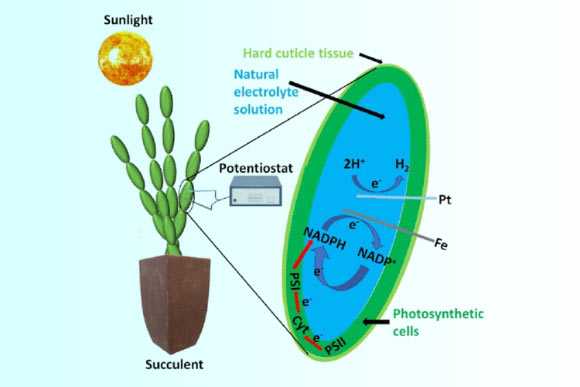
How They Work:
- Photosynthesis: Plants are excellent at capturing sunlight through a process called photosynthesis. Bio-solar cells leverage this natural ability.
- Electron Production: During photosynthesis, plants produce electrons. These electrons can be harnessed to create an electric current.
- Solar Technology: Scientists design special devices that can interact with the electrons produced by plants. These devices often include materials that can efficiently capture and transport the electrons.
Pros:
- Renewable: Relies on the natural process of photosynthesis, making it a renewable energy source.
- Environmentally Friendly: Bio-solar cells are generally environmentally friendly because they don’t rely on non-renewable resources or produce harmful emissions.
- Integration with Nature: By incorporating living organisms like plants, bio-solar cells can be integrated into natural environments.
Cons:
- Efficiency Challenges: Bio-solar cells are still in the early stages of development, and their efficiency in converting sunlight into electricity is not as high as some traditional solar technologies.
- Complexity: Integrating biological components with solar technology can be complex and may require careful optimization.
- Research and Development: Further research is needed to improve the performance and scalability of bio-solar cells for practical applications.
Perovskite
- Perovskite solar cells represent a class of photovoltaic devices that use materials with a perovskite crystal structure. The term “perovskite” refers to the arrangement of atoms in the crystal lattice, resembling the mineral perovskite.

- Crystal Structure: Perovskite solar cells utilize organic-inorganic hybrid materials with a perovskite crystal structure. Commonly used perovskite materials include methylammonium lead iodide (CH3NH3PbI3) and others.
- Photovoltaic Performance: Perovskite materials have gained attention in the field of photovoltaics due to their excellent light-absorption properties and the ability to efficiently convert sunlight into electrical energy.
- High Efficiency: Perovskite solar cells have demonstrated remarkable power conversion efficiencies, rivaling traditional silicon-based solar cells. Researchers have achieved efficiencies exceeding 25%, making them one of the most promising candidates for next-generation solar technology.
- Flexibility and Versatility: Perovskite solar cells can be fabricated as thin films, enabling flexibility and ease of integration into various applications. They can be deposited on flexible substrates, making them suitable for applications where traditional rigid solar panels may not be practical.
- Cost-Effective Manufacturing: Perovskite solar cells can be produced using relatively simple and cost-effective fabrication techniques, such as solution processing. This has the potential to significantly reduce manufacturing costs compared to traditional solar technologies.
- Challenges: Despite their promising characteristics, perovskite solar cells face challenges, including issues related to stability, toxicity of some precursor materials, and scalability for large-scale production. Ongoing research focuses on addressing these challenges to make perovskite solar cells commercially viable.
Jawaharlal Nehru National Solar Mission
The Jawaharlal Nehru National Solar Mission, also known as National Solar Mission, is one of the eight key National Mission’s which comprise India’s National Action Plan on Climate Change (NAPCC). NAPCC was launched on 30th June 2008 which identified development of solar energy technologies in the country as a National Mission. The mission was approved on January 11, 2010 by the government.
- The Mission has set the ambitious target of deploying 20,000 MW of grid connected solar power by 2022, which was revised to 1,00,000 MW by 2022 during June 2015.
Will India meet its solar mission targets by 2030
- The Indian solar industry is undergoing a significant transformation as the country strives to achieve its ambitious renewable energy targets. With a commitment to add 350 GW of renewable energy by 2030, solar power is expected to contribute around 55% of the total installed capacity.
Challenges:
- Dependency on Imports: India heavily relies on imports for key solar components, leading to substantial capital outflows.
Government Initiatives:
- Import Duty: The government has imposed a 40% duty on imported solar modules to promote domestic manufacturing.
- PLI Scheme: The Production Linked Incentive (PLI) Scheme aims to boost manufacturing capabilities and exports in the solar sector.
- BIS Certification: Mandatory BIS certification sets quality benchmarks for domestic manufacturers, benefiting both industry and customers.
- ALMM: The Approved List of Models and Manufacturers ensures the reliability of solar PV manufacturers, fostering industry growth.
Challenges for Customers:
- Cost of Ownership: Rising costs and GST rates have impacted the residential rooftop segment, slowing down installations.
- DISCOM Ecosystem: The shift to solar faces challenges in the existing DISCOM ecosystem, impacting cost competitiveness.
Solar Companies’ Contribution:
- Research & Development: Solar companies are investing in R&D for more efficient solar ecosystems, such as shark bifacial panels.
- Energy Storage Trends: Trends in energy storage, like lithium batteries, are gaining popularity, addressing high energy consumption during specific hours.
- Loom Solar’s Initiative: Loom Solar, a Faridabad-based start-up, introduces a novel business model, “The Solar Entrepreneur,” encouraging new entrepreneurs to enter the solar market through a franchise system.
