
- Allasani Peddanna in his Manucharitam refers the existence of four castes – Brahmins, Kshatriyas, Vaisyas and Sudras – in the Vijayanagar society. Foreign travelers left vivid accounts on the splendour of buildings and luxurious social life in the city of Vijayanagar. Silk and cotton clothes were mainly used for dress. Perfumes, flowers and ornaments were used by the people. Paes mentions of the beautiful houses of the rich and the large number of their household servants. Nicolo Conti refers to the prevalence of slavery. Dancing, music, wrestling, gambling and cock-fighting were some of the amusements.
- The position of women had not improved. However, some of them were learned. Gangadevi, wife of Kumarakampana authored the famous work Maduravijayam. Hannamma and Thirumalamma were famous poets of this period. According to Nuniz, a large number of women were employed in royal palaces as dancers, domestic servants and palanquin bearers. The attachment of dancing girls to temples was in practice. Paes refers to the flourishing devadasi system. Polygamy was prevalent among the royal families. Sati was honoured and Nuniz gives a description of it.
Religion
- The Sangama rulers were chiefly Saivaites and Virupaksha was their family deity. But other dynasties were Vaishnavites. Srivaishnavism of Ramanuja was very popular. But all kings were tolerant towards other religions. Borbosa referred to the religious freedom enjoyed by everyone. Muslims were employed in the administration and they were freely allowed to build mosques and worship. A large number of temples were built during this period and numerous festivals were celebrated. The Epics and the Puranas were popular among the masses.
- According to the accounts of the foreign travelers, the Vijayanagar Empire was one of the wealthiest parts of the world at that time The prosperity can be attributed to the growth of agriculture, industries, trade and commerce. The state followed a wise irrigation policy. New tanks were built and dams were constructed across the rivers like Tunghabadra. Industries were also encouraged by the state. Commerce was inland, coastal and overseas. Calicut was the most important port onthe Malabar coast.
- According to Abdur Razzaq, it is to be believed, that there were as many as 300 sea-ports in the Vijayanagar empire. There were commercial relations with the islands in the Indian Occean, the Malaya Archipelago, Burma, China, Arabia, Persia, South Africa, Abyssinia and Portugal. The exports from the Vijayanagar empire were cloth, rice, iron, salt, petre, sugar and spices. The imports were horses, elephants, pearls, copper, coral, mercury, China silk and velvet. The art of ship building was well-known.
- Diamond mines were located in Kurnool and Anantapur district. Vijayanagar was also a great centre of trade. The coins of the empire were those of gold, copper and silver. There were emblems of different gods and animals (Varaha) on them.
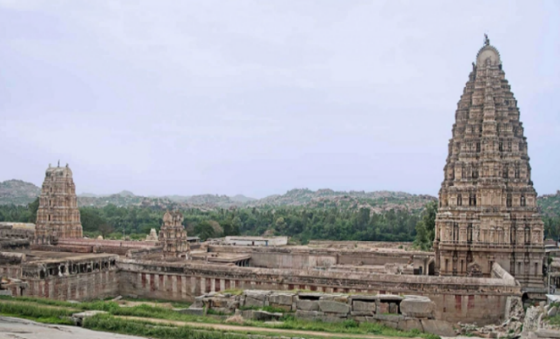
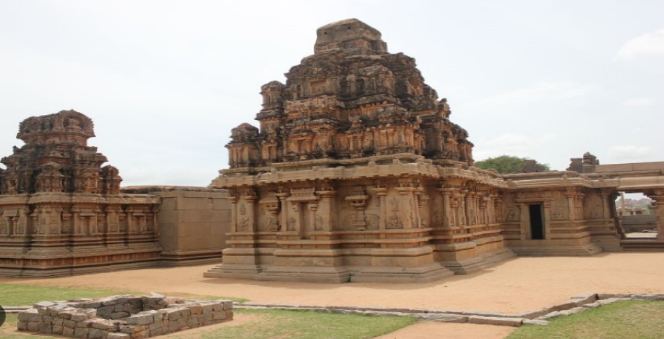
Fig. Hazara ramaswamy Temple Fig: Hazara Ramaswamy Temple
- The temple building activity further gained momentum during the Vijayanagar rule. The chief characteristics of the Vijayanagara architecture were the construction of tall Raya Gopurams or gateways and the Kalyanamandapam with carved pillars in the temple premises. The sculptures on the pillars were carved with distinctive features. The horse was the most common animal found in these pillars. Large mandapams contain one hundred pillars as well as one thousand pillars in some big temples. These mandapams were used for seating the deity on festival occasions.
- The most important temples of the Vijayanagar style were found in the Hampi ruins or the city of Vijayanagar. Vittalaswamy and Hazara Ramaswamy temples were the best examples of this style.
- The Varadharaja and Ekamparanatha temples at Kanchipuram stand as examples for the magnificence of the Vijayanagara style of temple architecture. The Raya Gopurams at Thiruvannamalai and Chidambaram speak the glorious epoch of Vijayanagar. They were continued by the Nayak rulers in the later period. The metal images of Krishna Deva Raya and his queens at Tirupati are examples for casting of metal images.
UPSC PYQS
Ques.1: What was the important reason for the fall of Vijayanagara Empire?
(a) Unity among the Muslim rulers
(b) Internal instability and weakness of Princes
(c) Moplah’s rebellion
(d) Economic banktruptcy
Ques.2: Ruins of Vijayanagar empire can be seen at
(a) Hospet (b) Hampi
(c) Halebid (d) Madurni
Ques.3: Consider the following events:
1. Reign of Krishna Deva Raya of Vijayanagara
2. Construction of Qutub Minar
3. Arrival of Portugese in India
4. Death of Firoz Tughlaq
(a) 2, 4, 3, 1 (b) 2, 4, 1, 3
(c) 4, 2, 1, 3 (d) 4, 2, 3, 1
Ques.4: Consider the following statement:
1. Narasimha Saluva ended the Sangama dynasty and seized the throne for himself and started the Saluva dynasty.
2. Vira Narasimha deposed the last Saluva ruler and seized the throne for himself.
3. Vira Narasimha was succeeded by his younger brother, Krishnadeva Raya.
4. Krishnadeva Raya was succeeded by his half-brother, Achyuta Raya.
Which of the statements given above are correct?
(a) 1, 2 and 3 (b) 2, 3 and 4
(c) 1 and 4 (d) 1, 2, 3 and 4
Ques.5: When Raja Wodeyar founded the kingdom of Mysore, who was the ruler of the Vijayanagar Empire?
(a) Sadasiva (b) Tirumala
(c) Ranga 2 (d) Venkata 2
Ques.6: Who of the following founded a new city on the south bank of a tributary to river Krishna and undertook to rule his new kingdom as the agent of a deity to whom all the land south of the river Krishna was supposed to belong?
(a) Amoghavarsha 1 (b) Ballala 2
(c) Harihara 1 (d) Prataparudra 2
Ques.7: Building ‘Kalyaana Mandapas’ was a notable feature in the temple construction in the kingdom of
(a) Chalukya (b) Chandela
(c) Rashtrakuta (d) Vijayangara
Ques.8: According to Portugese writer Nuniz, the women in Vijayanagara Empire were expert in which of the following areas?
1. Wrestling 2. Astrology
3. Accounting 4. Soothsaying
Select the correct answer using the code given below
(a) 1, 2 and 3 only (b) 1, 3 and 4 only
(c) 2 and 4 only (d) 1, 2, 3 and 4
Ques.9: Who of the following founded a new city on the south bank of a tributary to river Krishna and undertook to rule his new kingdom as the agent of a deity to whom all the land south of the river Krishna was supposed to belong?
(a) Amoghavarsha I (b) Ballala II
(c) Harihara I (d) Prataparudra II
Ques.1: What was the important reason for the fall of Vijayanagara Empire? (1979)
(a) Unity among the Muslim rulers
(b) Internal instability and weakness of Princes
(c) Moplah’s rebellion
(d) Economic banktruptcy
Ques.2: Ruins of Vijayanagar empire can be seen at (1984)
(a) Hospet (b) Hampi
(c) Halebid (d) Madurni
Ques.3: Consider the following events: (2000)
1. Reign of Krishna Deva Raya of Vijayanagara 2. Construction of QutubMinar
3. Arrival of Portugese in India 4. Death of FirozTughlaq
(a) 2, 4, 3, 1 (b) 2, 4, 1, 3
(c) 4, 2, 1, 3 (d) 4, 2, 3, 1
Ques.4: Consider the following statement: (2004)
1. Narasimha Saluva ended the Sangama dynasty and seized the throne for himself and started the Saluva dynasty.
2. Vira Narasimha deposed the last Saluva ruler and seized the throne for himself.
3. Vira Narasimha was succeeded by his younger brother, Krishnadeva Raya.
4. Krishnadeva Raya was succeeded by his half-brother, Achyuta Raya.
Which of the statements given above are correct?
(a) 1, 2 and 3 (b) 2, 3 and 4
(c) 1 and 4 (d) 1, 2, 3 and 4
Ques.5: When Raja Wodeyar founded the kingdom of Mysore, who was the ruler of the Vijayanagar Empire? (2006)
(a) Sadasiva (b) Tirumala
(c) Ranga 2 (d) Venkata 2
Ques.6: Who of the following founded a new city on the south bank of a tributary to river Krishna and undertook to rule his new kingdom as the agent of a deity to whom all the land south of the river Krishna was supposed to belong? (2015)
(a) Amoghavarsha 1 (b) Ballala 2
(c) Harihara 1 (d) Prataparudra 2
Ques.7: Building ‘Kalyaana Mandapas’ was a notable feature in the temple construction in the kingdom of (2019)
(a) Chalukya (b) Chandela
(c) Rashtrakuta(d) Vijayangara
Ques.8: According to Portugese writer Nuniz, the women in Vijayanagara Empire were expert in which of the following areas? (2021)
1. Wrestling 2. Astrology
3. Accounting 4. Soothsaying
Select the correct answer using the code given below
(a) 1, 2 and 3 only (b) 1, 3 and 4 only
(c) 2 and 4 only (d) 1, 2, 3 and 4
Ques.9: With reference to Indian history, which of the following statements is/are correct? (2021)
1. The Nizamat of Arcot emerged out of Hyderabad State.
2. The Mysore Kingdom emerged out of Vijayanagara Empire.
3. Rohilkhand Kingdom was formed out of the territories occupied by Ahmad Shah Durrani.
Select the correct answer using the code given below:
(a) 1 and 2 (b) 2 only
(c) 2 and 3 (d) 3 only
Hint & Solution
UPSC
1. (a)
2. (b)
3. (a)
4. (d)
5. (c)
6. (c)
7. (d)
8. (d)
9. (c)
Previous Year
1. (a)
- The Vijayanagar Empire, which flourished in southern India from the 14th to the 17th century, faced significant challenges from various Muslim kingdoms in the Deccan region. These Muslim kingdoms, such as the Bahmani Sultanate and the Deccan Sultanates, formed alliances and coordinated their efforts to bring down the Vijayanagar Empire.
- The unity among the Muslim rulers played a crucial role in the downfall of the Vijayanagar Empire. They formed coalitions, launched joint military campaigns, and strategically attacked the Vijayanagar Empire from different fronts. The combined military strength and coordination of the Muslim rulers overwhelmed the Vijayanagar Empire and led to its defeat in the decisive Battle of Talikota in 1565.
- While internal instability and weakness of princes (b), Moplah’s rebellion (c), and economic bankruptcy (d) may have been contributing factors, the unity among the Muslim rulers stands out as the primary reason for the fall of the Vijayanagar Empire.
2. (b)
- Hampi, located in the state of Karnataka, India, is home to the magnificent ruins of the Vijayanagar Empire. Hampi was the capital city of the Vijayanagar Empire, which thrived from the 14th to the 16th century.
- The ruins of Hampi are spread across a vast area and consist of numerous temples, palaces, marketplaces, and other structures that showcase the architectural and artistic excellence of the Vijayanagar Empire. The site is recognized as a UNESCO World Heritage Site and is a major tourist attraction, attracting visitors from around the world.
- Hospet, another town in Karnataka, is located near Hampi and serves as a gateway to the Hampi ruins. Halebid and Madurni, on the other hand, are not associated with the Vijayanagar Empire but are known for their own historical and architectural significance.
3. (a)
- Krishnadevaraya was an emperor of the Vijayanagara Empire who reigned from 1509–1529. He is the third ruler of the Tuluva Dynasty. Krishna Deva Raya benefited from the able Prime Minister Timmarusu, who was regarded by the emperor as a father figure and was responsible for his coronation.
- Qutab Minar is a 73 m-high tower of victory, built in 1193 by Qutab-ud-din Aibak immediately after the defeat of Delhi’s last Hindu kingdom. The tower has five distinct storeys, each marked by a projecting balcony and tapers from a 15 m diameter at the base to just 2.5 m at the top.
- It was the Portuguese who first discovered a direct sea route to India. Portuguese sailor Vasco da Gama arrived at Calicut an important sea port located on the South-West India on May 20, 1498 AD.
- Sultan Firoz Shah Tughlaq was a Turkic Muslim ruler of the Tughlaq Dynasty, who reigned over the Sultanate of Delhi from 1351 to 1388. His father’s name was Rajab who had the title Sipahsalar. He died in 1388.
4. (d)
- Sangama dynasty was founded by Harihara-I.
- Saluva dynasty was founded by Narasimha Saluva by defeating Dev Rayua-II of Sangama dynasty.
- Taluva dynasty was founded by ViraNarasimha and was succeeded by Krishna deva Raya and Achyuta Raya.
5. (d)
- Indigenous chieftains from Karnataka rose to become the founders of a dynasty after a series of internal bickerings with other local chieftains. Vijaya and Krishna, two brothers were responsible for the establishment of this small feudatory state of Vijayanagara Empire. Vijaya ascended the throne under the assumed name of Yaduraja in 1399 A.D. To begin with, this was a very small state containing only parts of Mysore district. Mysore was the capital city.
6. (c)
- Harihara I, also known as Hakka Raya, was the founder of the Vijayanagara Empire. He founded a new city on the south bank of the Tungabhadra River, a tributary of the Krishna River, and undertook to rule his new kingdom as the agent of a deity to whom all the land south of the Krishna River was supposed to belong.
7. (d)
- Vijayanagara Empire was a prominent empire in South India during the 14th to 16th century CE. The empire was known for its architectural and cultural achievements. The construction of temples was an integral part of the empire’s culture, and the temples were built with intricate carvings and sculptures. The Kalyana Mandapa was a notable feature in the temple construction during the Vijayanagara Empire.
- Kalyana Mandapa: – Kalyana Mandapa is a hall meant for conducting marriages and other auspicious ceremonies. – It is a significant feature of South Indian temple architecture.
- The Kalyana Mandapa is usually situated in front of the main shrine or at a distance from it. – The Mandapa has pillars with intricate carvings and sculptures.
- The roof of the Kalyana Mandapa is usually supported by pillars.
Importance of Kalyana Mandapa in Vijayanagara Empire:
- The Vijayanagara Empire was known for its patronage of art and architecture.
- The construction of temples was a significant part of the empire’s cultural and religious identity.
- The Kalyana Mandapa was an important feature in the temple construction during the Vijayanagara Empire.
- The Kalyana Mandapa provided a space for conducting marriages and other auspicious ceremonies.
- The Mandapa was built with intricate carvings and sculptures, reflecting the artistic and architectural prowess of the empire.
- Conclusion: In conclusion, the construction of Kalyana Mandapas was a notable feature in the temple construction during the Vijayanagara Empire. The Mandapa provided a space for conducting marriages and other auspicious ceremonies and was built with intricate carvings and sculptures, reflecting the artistic and architectural prowess of the empire.
8. (d)
Women in Vijayanagara Empire
- The Vijayanagara Empire was a South Indian empire that existed from 1336 to 1646.
- Women in the Vijayanagara Empire enjoyed a relatively higher status compared to other parts of India during that time.
- They were educated and had access to the art, literature, and music of the kingdom. Expertise of Women
- According to Portuguese writer Nuniz, women in the Vijayanagara Empire were experts in various fields.
- They were skilled in wrestling, astrology, accounting, and soothsaying.
- Wrestling: Women in the Vijayanagara Empire were trained in wrestling and were known to participate in the sport.
- Astrology: Women were also skilled in astrology and were consulted for horoscopes and predictions.
- Accounting: Women in the empire were also trained in accounting and were responsible for managing the household finances.
- Soothsaying: Women were also skilled in soothsaying or predicting the future based on omens and signs. Conclusion
- Women in the Vijayanagara Empire were well-educated and skilled in various areas.
- They enjoyed a relatively higher status compared to other parts of India during that time.
9. (b)
- The Nizam of Arcot emerged as an independent state after the weakening of the Mughal empire in the first half of the eighteenth century. It was a protectorate of the Hyderabad state, but it did not emerge out of it. Hence statement 1 is not correct.
- Mysore kingdom emerged as a powerful state under the Wodeyar dynasty, which initially served as a vassal of the Vijaynagar empire. Hence statement 2 is correct
- Rohilkhand state arose in the modern districts of Rampur, Bareilly etc. under the declining Mughal empire in 1721. Ahmad Shah Durrani started invading India in 1748. Hence statement 3 is not correct.
