

Early Life and Accession to Throne
- Shah Jahan was one of the four sons of Jahangir. His original name was Khurram. He was born on 5th January, 1592, at Lahore from a Hindu mother. His mother was the daughter of Mota Raja Udai Singh called Jagat Gosain and famous as Jodha Bai. While young, Khurram was a favourite of Akbar. He was smart, intelligent and ambitious. No effort was spared to give him the best education.
- When Shah Jahan ascended the throne in Agra his position was secure and unchallenged. Yet the affairs of the empire needed attention. The Afghan Pir Lodi, with the title Khanjahan, who had been governor of the southern provinces of the empire was hostile. Despite Shah Jahan’s order transferring him from the government of the Deccan, he aligned with Murtaza Nizam Shah II, the Sultan of Ahmed-Nagar, and conspired against Shah Jahan. As the situation turned serious, Shah Jahan proceeded to the Deccan in person. The newly appointed governor of the Deccan, Iradat Khan, who received the title Azam Khan led the imperial army and invaded the Balaghat. Seeing the devastation caused by the imperial troops, Murtaza changed his attitude towards Khanjahan.
- Khanjahan thereupon fled from Daulatabad into Malwa, but was pursued and finally slain. Peace thus having been restored in the Deccan, Shah Jahan left the Deccan after dividing it into four provinces:
- Ahmednagar with Daulatabad;
- Khandesh;
- Berar; and
- Telengana.
- The viceroyalty of the four provinces was conferred by Shah Jahan on his son Aurangzeb, then eighteen years of age.Thus the Deccan was brought under the effective control of the Mughal Empire during the reign of Shah Jahan.
Conquests of Shah Jahan I
- Ahmad Nagar, which offered resistance to the Mughals, was annexed despite the efforts of Malik Ambar. Shah Jahan, with the support of Mahabat Khan, subdued the Nizam Shahi rulers of Ahmad Nagar in 1636. When the Shi’ite Qutub Shahi ruler of Golkonda imprisoned his own minister Mir Jumla it was used as a pretext by Aurangzeb to invade Golkonda. A treaty made the Qutub Shahi ruler a vassal of the Mughal Empire.
- In 1638 Shah Jahan made use of the political intrigues in the Persian Empire and annexed Kandahar, conquered by Akbar and lost by Jahangir.
- The Portuguese had authority over Goa under their viceroy. In Bengal they had their chief settlements in faraway Hugli. Shah Jahan ordered the Mughal Governor of Bengal, to drive out the Portuguese from their settlement at Hugli. About 200 Portuguese at Hugli owned nearly 600 Indian slaves. They had forced many of them to be baptised into the Christian faith. Moreover Portuguese gunners from Goa had assisted the Bijapur forces against the Mughals. Though the Portuguese defended themselves valiantly, they were easily defeated.
- A contemporary of Louis XIV of France, Shah Jahan ruled for thirty years. In his reign the famous Peacock Throne was made for the King.
Personalities who visited during the reign of Shah Jahan
- Bernier (French physician and traveller),
- Tavernier (French gem merchant and traveller), and
- Mandelslo (German adventurer and traveller),
- Peter Mundy (English Trader) and
- Manucci (Italian writer and traveller)
Art and Architecture under Shah Jahan
- Shah Jahan was a great builder and he has rightly been called “The Prince of Builders.” The architectural Style of Shah Jahan’s buildings was different from that of his predecessors. Humayun’s Mausoleum, the Buildings of Fatepur Sikri, Akbar’s Tomb at Sikanadra and that of Itimad-ud- Daula at Agra belonged to the Indo-persian Style of Architecture. The pre-Shah Jahan buildings were remarkable for their massiveness and strength.
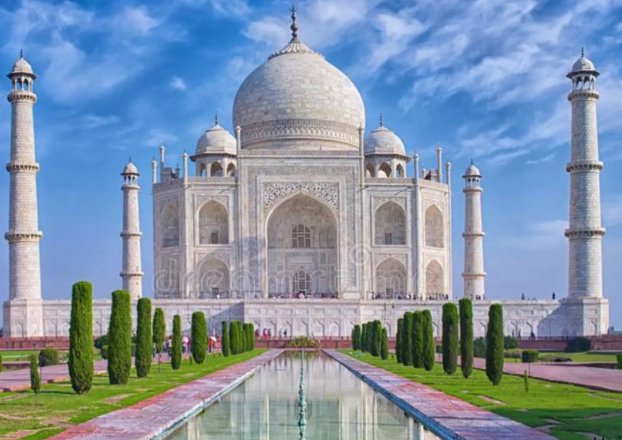
- On the other hand, the buildings of Shah Jahan are characterised by “elegance rather than by strength and by the lavish use of extraordinary costly decoration.” Shah Jahan preferred to use marble instead of red stone used by Akbar and Jahangir in their buildings.
- Shah Jahan built a large number of buildings in the Agra Fort. Few of them include Moti Masjid and Musalmman Burj.He also built the” The Taj Mahal”.It is the epitome of Mughal architecture, a blend of Indian, Persian and Islamic styles. It was built to immortalize his wife Mumtaz Mahal. In his reign the famous Peacock Throne was made for the King.
Golden Age of Mughal Period
It is pointed out that the Reign of Shah Jahan was the Golden Age of the Mughal Period. The Mughal Empire reached its high watermark in his time. There was peace and prosperity in the country. Land was fertile and the revenues of the state were abundant. Export trade was carried on profitably. No wonder, Shah Jahan built a large number of buildings which were undoubtedly masterpieces of Mughal Architecture.
War of Succession
- The last years of Shah Jahan’s reign were clouded by a bitter war of succession among his four sons – Dara Shikoh (crown prince), Shuja (governor of Bengal), Aurangazeb (governor of Deccan) and Murad Baksh (governor of Malwa and Gujarat).
- Towards the end of 1657, Shah Jahan fell ill at Delhi for some time but later recovered. But the princes started fighting for the Mughal throne.
- Aurangazeb emerged victorious in this struggle. He entered the Agra fort after defeating Dara Shikoh. He forced Shah Jahan to surrender.Shah Jahan lived captive for eight long years lovingly nursed by his daughter Jahanara. He died in 1666 and buried beside his wife’s grave in the Taj Mahal.
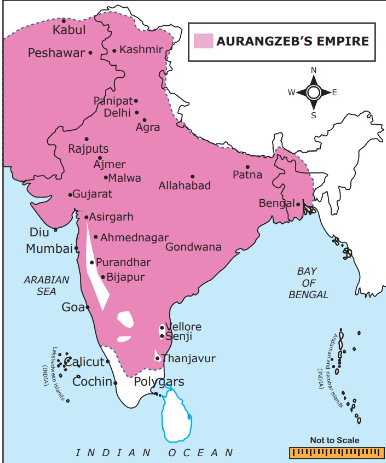
- Aurangazeb was one of the ablest of the Mughal kings. He assumed the title Alamgir, World Conqueror. His own Reign (1658–1707) covers the second half of the seventeenth century and stands forth as a most important epoch in the annals of our country.
- Under him the Mughal Empire reached its greatest extent, and the largest single state in India to the rise of the British Power was formed. From Ghzani to Chittagong, from Kashmir to the Karnatak, the continent of India obeyed one sceptre. Islam made its last onward movement in India in this reign.
- The Empire thus formed, while unprecedented in size, was one political unit.
Deccan Policy of Aurangzeb
- The Deccan policy of the Mughals started from the reign of Akbar, who conquered Khandesh and Berar. Jahangir fought against Malik Amber of Ahmadnagar. During the Shah Jahan’s reign, Aurangazeb, as governor of Deccan, followed an aggressive Deccan policy. When he became the Mughal emperor, for the first twenty five years, he concentrated on the northwest frontier. At that time, the Maratha ruler, Sivaji carved out an independent Maratha kingdom in the territories of north and south Konkan.
- To contain the spread of the Marathas, Aurangazeb decided to invade Bijapur and Golkonda. He defeated Sikandar Shah of Bijapur and annexed his kingdom. Then, he proceeded against Golkonda and eliminated the Kutb Shahi dynasty. It was also annexed by him. In fact, the destruction of the Deccan kingdoms was a political blunder on the part of Aurangazeb. The barrier between the Mughals and the Marathas was removed and there ensued a direct confrontation between them. Also, his Deccan campaigns exhausted the Mughal treasury. According to J.N. Sarkar, the Deccan ulcer ruined Aurangazeb.
Religious Policy of Aurangzeb
- Aurangazeb was a staunch and orthodox Muslim in his personal life. His ideal was to transform India into an Islamic state.
- He created a separate department to enforce moral codes under a high-powered officer called Muhtasib. Drinking was prohibited. Cultivation and use of bhang and other drugs were banned.
- Aurangazeb forbade music in the Mughal court. He discontinued the practice of Jarokhadarshan. He also discontinued the celebration of Dasarah and royal astronomers and astrologers were also dismissed from service.
- Initially Aurangazeb banned the construction of new Hindu temples and repair of old temples. Then he began a policy of destroying Hindu temples. The celebrated temples at Mathura and Benares were reduced to ruins. In 1679, he reimposed jiziya and pilgrim tax. He was also not tolerant of other Muslim sects. The celebration of Muharram was stopped. His invasions against the Deccan sultanates were partly due to his hatred of the Shia faith He was also against the Sikhs and he executed the ninth Sikh Guru Tej Bahadur. This had resulted in the transformation of Sikhs into a warring community.
Effects of Anti-Hindu Policy
- His religious policy was responsible for turning the Rajputs, the Marathas and Sikhs into the enemies of Mughal empire. It had also resulted in the rebellions of the Jats of Mathura and the Satnamis of Mewar. Therefore, Aurangazeb was held responsible for the decline of the Mughal empire.
Estimate of Aurangzeb:
- In his private life, Aurangazeb was industrious and disciplined. He was very simple in food and dress. He earned money for his personal expenses by copying Quran and selling those copies. He did not consume wine. He was learned and proficient in Arabic and Persian languages. He was a lover of books. He was devoted to his religion and conducted prayers five times a day. He strictly observed the Ramzan fasting.
- In the political field, Aurangazeb committed serious mistakes.He misunderstood the true nature of the Maratha movement and antagonized them. Also, he failed to solve the Maratha problem and left an open sore. His policy towards Shia Deccan Sultanates also proved to be a wrong policy.
- His religious policy was also not successful. Aurangazeb was an orthodox Sunni Muslim. But his move to apply his religious thought rigidly in a non-Muslim society was a failure. His antagonistic policies towards non-Muslims did not help him to rally the Muslims to his side. On the other hand it had strengthened political enemies of the Mughal Empire.
- Babur’s accession to the throne in 1526 marked the beginning of the Great Mughal era, which lasted until Aurangzeb’s demise in 1707. An era in Indian history came to an end with the passing of Aurangzeb. The Mughal empire was the biggest in India at the time of Aurangzeb’s passing. However, the Mughal Empire collapsed around fifty years after his passing.
The reasons responsible for the decline of the Mughal empire in India are:
Wars of Succession:
- The Mughals did not follow any law of succession like the law of primogeniture.
- Consequently, each time a ruler died, a war of succession between the brothers for the throne started.
- This weakened the Mughal Empire, especially after Aurangzeb.
- The nobles, by siding with one contender or the other, increased their own power.
Aurangzeb’s harsh Policies and weak successors
- The stability of the Mughal empire was harmed by Aurangzeb’s strict religious beliefs and his treatment of Hindus.The Rajputs, who had made significant contributions to the power of the Empire, abandoned him.They had served as strongholds, but Aurangzeb’s policies transformed them into enmities.The Mughal Empire’s resources had been depleted by the conflicts with the Sikhs, Marathas, Jats, and Rajputs.
- The Aurangzeb successors were weak and fell prey to the plots and intrigues of the divided nobles.They were ineffective generals who couldn’t put down uprisings.The Mughal Empire had become weak due to the lack of a capable army, an effective bureaucracy, and a strong leader.Following Bahadur Shah’s rule, a long line of feeble, useless, and opulent Kings rose to power.
Foreign Invasions and rise of Regional Powers
- The Mughals’ final reserves of power were depleted by foreign invasions, which accelerated their fall.More wealth was lost as a result of the invasions of Nadir Shah and Ahmad Shah Abdali.The Mughal Empire had become too large to be controlled by any ruler from one centre i.e. Delhi.The Great Mughals were efficient and exercised control over ministers and army, but the later Mughals were poor administrators.As a result, the distant provinces became independent. The rise of independent states led to the disintegration of the Mughal Empire.
- The decline of the Mughal Empire was due to social, economic, political and institutional factors. By 1813, the British government took away the power that allowed the East India Company’s monopoly and later, the company worked on behalf of the government. In 1857, the Indian Rebellion occured which prompted the British colonial office to exile the last emperor, Bahadur Shah II, and take complete control of the Indian subcontinent.
UPSC PYQS
Ques.1: Which one of the following was the cause of disintegration of the Mughal Empire?
(a) War of succession among sons of Aurangzeb
(b) Attacks of Nadir Shah and Ahmad Shah Abdali
(c) Revolts of various communities like Jats, Sikhs, Rajputs, etc.
(d) All of the above mentioned factors contributed to the downfall of the Mughal Empire
Ans: (d)
Ques.2: Who were ‘Jagirdars’ during the reign of Akbar?
(a) Large estate owners
(b) Officials of state who were given ‘jagir’ in place of cash pay
(c) Revenue collectors
(d) Autonomous rulers under Akbar
Ans: (b)
Ques.3: What was not the most important feature of land revenue system of Akbar?
(a) Collection of land revenue in kind or cash
(b) Collection of land revenue based on accurate measurement of land
(c) Collection of land revenue directly at the central treasury
(d) Fixation of taxes
Ans: (c)
Ques.4: Which Mughal ruler introduced the Mansabdari system in India?
(a) Akbar (b) Humayun
(c) Shahjahan (d) Babar
Ans: (a)
Ques.5: With reference to Mian Tansen, which one of the following statements is not correct?
(a) Tansen was the title given to him by Emperor Akbar.
(b) Tansen composed Dhrupads on Hindu gods and goddesses.
(c) Tansen composed songs on his patrons.
(d) Tansen invented many Ragas.
Ans: (a)
Ques.6: Who among the following Mughal Emperors shifted emphasis from illustrated manuscripts to album and individual portraits?
(a) Humayun (b) Akbar
(c) Jahangir (d) Shah Jahan
Ans: (c)
Ques.7: Consider the following:
The arrival of Babur into India led to the introduction of gunpowder in the subcontinent introduction of the arch and dome in the region’s architecture establishment of Timurid dynasty in the region
Select the correct answer using the code given below:
(a) 1 and 2 only (b) 3 only
(c) 1 and 3 only (d) 1, 2 and 3
Ans: (b)
Ques.8: Ibadat Khana at Fatehpur Sikri was
(a) the mosque for the use of Royal Family
(b) Akbar’s private prayer chamber
(c) the hall in which Akbar held discussions with scholars of various religions
(d) the room in which the nobles belonging to different religions gathered to discuss religious affairs
Ans: (c)
Previous Year Questions – 11
Ques.1: Consider the following European missions during the Mughal period:
1. Thoman Roe 2. Tavernier
3. Rudolf Acquaviva
The correct chronological order of their visits is
(a) 1 – 2 – 3 (b) 2 – 3 – 1
(c) 2 – 1 – 3 (d) 3 – 1 – 2
Ans: (d)
- After completing his studies Acquaviva was chosen by his superiors for the prestigious and challenging Indian missions.He travelled to Lisbon, starting point for the voyage east. There he was ordained a priest and sailed for India in 1578.
- In January 1615, Sir Thomas Roe presented his credentials to the emperor Jahangir as the Ambassador of the King of England. The objective of Thomas Roe was to finish what was left unfinished by Captain Hawkins.
- Jean-Baptiste Tavernier was a 17th-century French gem merchant and traveler. Tavernier, a private individual and merchant traveling at his own expense, covered, by his own account, 60,000 leagues in making six voyages to Persia and India between the years 1630 and 1668.
Ques.2: Which one of the following pairs is not correctly matched?
(a) Jahangir: William Hawkins (b) Akbar: Sir Thomas Roe
(c) Shahjahan :Travernier (d) Aurangzeb :Manucci
Ans: (b)
- Sir Thomas Roe also visited the court of Jahangir. He was an ambassador of James – I, king of England. Tavernier’s account covers the reign of Shahjahan and Aurangzeb
Ques.3: Which one of the following is a monument constructed by Sher Shah? (1993)
(a) Kil-Kuhna Mosque at Delhi
(b) Atala Masjid at Jaunpur
(c) Bara Sona Masjid at Gaur
(d) Quwwat-ul-Islam Mosque at Delhi
Ans: (a)
- Built by Sher Shah Suri in 1541 as a congregational mosque, “Qila-Kuhna” or “Qal’a-i-Kuhna” roughly translates into “Mosque of the Old Fort”. This handsome structure, along with Sher Mandal, is the only two surviving structures of Delhi’s Purana Qila, which was conceptualized and started by Sher Shah but took final shape only under the scalpel of Humayun. The Qila-i-Kuhana mosque with its 5 bay structure and 3 domes is similar in an architectural style that of precedents of Sher Shah Suri and Humayun-the Sayyids and the Lodis. Thus, the monument built by Sher Shah is Qila-i-Kulna Masjid, Delhi.
- Atala Masjid- In 1408 A.D., Ibrahim Shah Sharki built the Atala Masjid which came to be considered as the ideal for the construction of the other mosques of Jaunpur.
- Bara Sona Masjid- Built-in 1526 by Sultan Nusrat Shah the Baradarwazi or Bara Sona Masjid (literally large golden mosque) is the largest building still standing in Gaur.
- Quwwat-ul-Islam Mosque- It was sponsored by Qutb-ud-din Aibak, founder of the Mamluk dynasty. It is the earliest extant mosque built by the Delhi Sultans.
Ques.4: ‘Mansabdars’ in Mughal period were
(a) Landlords and Zamindars (b) Officials of the state
(c) Those who had to give revenue (d) Revenue collectors
Ans: (b)
- The Mansabdars were a system of ranking and administration introduced by Emperor Akbar in the Mughal Empire. Mansabdars were appointed officials who held military and administrative positions in the empire. They were given ranks or “mansabs” that determined their status, salary, and military responsibilities.
- The Mansabdars served as both military commanders and administrative officers. Their duties included maintaining troops, collecting revenue, managing administrative affairs, and overseeing the implementation of imperial policies. They played a crucial role in the governance and military structure of the Mughal Empire.
Ques.5: Which one of the following was the cause of disintegration of the Mughal Empire?
(a) War of succession among sons of Aurangzeb
(b) Attacks of Nadir Shah and Ahmad Shah Abdali
(c) Revolts of various communities like Jats, Sikhs, Rajputs, etc.
(d) All of the above mentioned factors contributed to the downfall of the Mughal Empire
Ans: (d)
- The disintegration of the Mughal Empire can be attributed to a combination of factors, including:
- (a) War of succession among the sons of Aurangzeb: After the death of Aurangzeb in 1707, a series of conflicts erupted among his sons over the throne. This internal strife weakened the empire and led to regional fragmentation.
- (b) Attacks of Nadir Shah and Ahmad Shah Abdali: In the 18th century, the Mughal Empire faced invasions from external forces, most notably Nadir Shah of Persia in 1739 and Ahmad Shah Abdali of Afghanistan in the 1760s. These invasions resulted in significant territorial losses and further weakened the empire.
- (c) Revolts of various communities like Sikhs, Jats, Rajputs: Various communities and regions within the Mughal Empire, such as the Sikhs in Punjab, Jats in the Mathura region, and Rajputs in Rajasthan, launched revolts against Mughal authority. These rebellions challenged Mughal control and further contributed to the disintegration of the empire.
- Overall, the combination of internal conflicts, external invasions, and regional uprisings led to the gradual decline and disintegration of the once-mighty Mughal Empire.
Ques.6: Which of the following is not true about Mughal army?
(a) Mughal army was mainly standing army
(b) It hard large cavalry
(c) When Mughal army used to come out, it seemed as if population of a big city is emerging
(d) It had large infantry
Ans: (a)
- Although its origins, like the Mughals themselves, were in the cavalry-based armies of central Asia, its essential form and structure was established by the empire’s third emperor, Akbar. The army had no regimental structure and the soldiers were not directly recruited by the emperor.
Ques.7: Akbar found the Din-iIlahi primarily to
(a) Put an end to the difference between the Hindus and the Muslims
(b) Establish a national religion which would be acceptable to both the Muslims and the Hindus
(c) Ensure racial and communal harmony
(d) Found a religious club
Ans: (b)
- Establish a national religion which would be acceptable to both the Muslims and the Hindus.Explanation: Akbar founded the Din-i-Ilahi primarily to (b) establish a national religion that would be acceptable to both Muslims and Hindus.
- Din-i-Ilahi, also known as Tauhid-i-Ilahi, was a syncretic religious doctrine promoted by Emperor Akbar during the Mughal Empire. Akbar aimed to create a unifying religious philosophy that incorporated elements from different faiths, including Islam, Hinduism, Christianity, and Zoroastrianism.
- By establishing Din-i-Ilahi, Akbar sought to foster religious tolerance, understanding, and unity among his diverse subjects. He envisioned it as a national religion that would transcend the divisions between Muslims and Hindus and create a sense of shared identity and purpose.
- Akbar’s efforts to promote religious harmony and create a common ground for his subjects were reflected in the principles and practices of Din-i-Ilahi. However, it is important to note that Din-i-Ilahi did not gain widespread acceptance or become a dominant religious movement, and its influence gradually declined after Akbar’s reign.
Ques.8: The Mausoleum of Sher Shah is at
(a) Rohtas (b) Agra
(c) Sasaram (d) Lahore
Ans: (c)
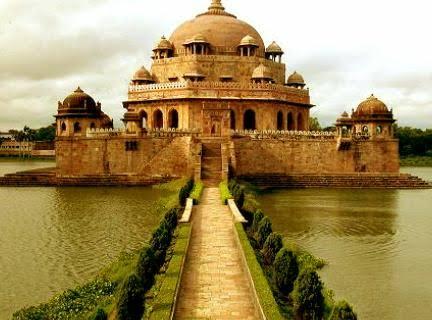
- The tomb of Sher Shah Suri is a mausoleum located in Sasaram, in the Indian state of Bihar. Sher Shah Suri, who was the founder of the Sur Empire, commissioned the tomb for himself.
Ques.9: Which of the following were the causes for the rapid dissolution of the Mughal empire?
1. Degeneration of the Mughal nobility
2. The absence of the Law of Succession
3. Foreign invasion
Select the correct answer from the codes given below:
(a) 2 and 3 only (b) 1 and 3 inly
(c) 3 only (d) 1, 2 and 3
Ans: (d)
- When rulers and the nobles became unworthy of their position, the Mughal army too became weak and inefficient. The Inspiration, which was seen among the Jats, Bundelas, Sikhs, Rajputs and Marathas, was not seen among the Mughals. The military weakness became a potential cause of the decline of the Mughals Empire.
Certainly, here’s more information about each of the options:
1. Degeneration of the Mughal nobility:
- The Mughal nobility, including various regional governors and officials, became increasingly corrupt, power-hungry, and focused on their personal interests rather than the welfare of the empire.
- This led to factionalism, infighting, and weakened central control.
2. The absence of the Law of Succession:
- The Mughal Empire did not have a clear and stable law of succession in place.
- This lack of a defined succession system resulted in disputes, power struggles, and conflicts among Mughal princes, which weakened the empire.
3. Foreign invasion:
- The Mughal Empire faced foreign invasions from various external powers, including the Persian Empire, Afghan invaders, and later European colonial powers like the British and the French.
- These invasions and conflicts further drained the resources and stability of the empire.
- The combination of these factors contributed to the rapid decline and dissolution of the once-mighty Mughal Empire in India.
Ques.10: Akbar’s mausoleum is situated at
(a) Sasaram (b) Sikandraa
(c) Agra (d) New Delhi
Ans: (b)
- Akbar’s tomb is located at Sikandra, on the outskirts of Agra, Uttar Pradesh, India. The tomb is surrounded by a wall enclosure; the gate towards the south is the largest with four white marble topped minarets which you will find similar to Taj Mahal. The entire building is constructed from red stones along white marble. Akbar’s mausoleum was built by his son Jahangir as a tribute to his father and his great reign.
- Earlier Jahangir rebelled against his father in an attempt to capture the throne as he was considered unworthy of it but when Jahangir’s wife killed herself he regretted the deed and was embarrassed. Unfortunately, on 3 october1605, Akbar’s health started to decline and he fell ill due to dysentery from which he never recovered. As a result of this he died on 27 October 1605 and his body was later buried at a mausoleum at Sikandra, Agra.
- So, the correct option is B. Sikandra. Mughal Emperor Akbar’s mausoleum is located at Sikandra.

Ques.11: Assertion (A): Babur wrote his memoirs in Turki
Reason (R): Turki was the official language of the Mughal court
In the context of the above two statements which one of the following is correct?
(a) Both A and R are true and R is the correct explanation of A
(b) Both A and R are true but R is not a correct explanation of A
(c) A is true but R is false
(d) A is false but R is true
Ans: (c)
- Babur’s Memoirs: Babur, the founder of the Mughal Empire in India, wrote his memoirs known as the “Baburnama” or “Tuzk-e-Babri.” He wrote it in a language that is often referred to as Turki, which is a form of Chagatai Turkic. This memoir provides valuable insights into his life, his conquests, and his thoughts. It is considered one of the most important autobiographical works in world literature.
- Official Language of the Mughal Court:The official language of the Mughal court was Persian. Persian was widely used for administrative purposes, official correspondence, and literary endeavors during the Mughal Empire. It was a language of culture and learning in the Mughal courts.
- So, while Babur did write his memoirs in Turki, it’s important to note that Turki was not the official language of the Mughal court; that distinction belongs to Persian.
Ques.12: The first Indian ruler to organize Haj pilgirimage at the expense of the state was
(a) AlauddinKhilji (b) FerozTughlaq
(c) Akbar (d) Aurangzeb
Ans: (c)
- Akbar, the third Mughal emperor, was the first Indian ruler to organize the Haj pilgrimage at the expense of the state. Akbar was known for his policy of religious tolerance and inclusivity, and he implemented several measures to promote harmony among different religious communities in his empire. One such measure was the organization of the Haj pilgrimage for Muslims. Akbar provided financial assistance and logistical support to ensure that Muslims could undertake the pilgrimage to Mecca. This initiative was part of his efforts to foster religious unity and demonstrate his respect for diverse faiths within his empire.
Ques.13: Who among the following ladies wrote a historical account during the Mughal period?
(a) Gulbadan Begum (b) Nurjahan Begum
(c) Jahanara Begum (d) Zbunnissa Begum
Ans: (a)
- Gulbadan Begum, the daughter of Emperor Babur and the sister of Emperor Humayun, wrote a historical account during the Mughal period. Her historical work is known as “Humayun-nama” or “Humayun-nama-i-Gulbadan” (The Book of Humayun) and provides insights into the life and reign of her brother, Emperor Humayun. Gulbadan Begum’s account is considered an important Sourceof historical information about the early Mughal period. Her work offers a unique perspective from a female author, providing valuable insights into the political and social dynamics of the time.
Ques.14: The head of the military department under the reorganised central machinery of administration during Akbar’s reign was
(a) Diwan (b) Mir Bakshi
(c) Mir Saman (d) Bakshi
Ans: (b)
- During Akbar’s reign, the head of the military department under the reorganized central machinery of administration was the Mir Bakshi. The Mir Bakshi held a high-ranking position in the Mughal administration and was responsible for overseeing the military affairs of the empire. The position was similar to the modern-day role of a military secretary or commander-in-chief.
- The Mir Bakshi had various responsibilities, including maintaining records of the soldiers (military accounts), organizing military campaigns, supervising the recruitment and promotion of soldiers, and managing the payment of salaries and allowances to the military personnel. The Mir Bakshi played a vital role in the smooth functioning of the Mughal military and ensuring the efficiency and discipline of the troops.
Ques.15: The medieval Indian writer who refers to the discover of America is
(a) Malik Muhammad Jayasi (b) Amir Khusrau
(c) Raskhan (d) AbulFazl
Ans: (d)
- Abul Fazl, the medieval Indian writer, refers to the discovery of America in his book, Ain-i-Akbari. This book is a historical document that details the reign of the Mughal Emperor Akbar. Abul Fazl was one of Emperor Akbar’s courtiers and he wrote this book in the 16th century. Discovery of America in Ain-i-Akbari Abul Fazl mentions the discovery of America in the Ain-i-Akbari in the following passage: “New lands have been discovered in the midst of the ocean, and it has become known that in the excellence of its productions it is more valuable than the land of Hindustan, which is the Sourceof so much wealth.” Significance of this Mention Abul Fazl’s mention of the discovery of America is significant as it shows the global awareness of Indian scholars during the medieval period. It also highlights the fact that India had trade relations with countries beyond its borders. Conclusion In conclusion, Abul Fazl, the medieval Indian writer, refers to the discovery of America in his book, Ain-i-Akbari. This passage is significant as it shows the global awareness of Indian scholars during the medieval period and highlights the fact that India had trade relations with countries beyond its borders.
Ques.16: Assertion (A): During the reign of Shahjahan, Dara Sikoh was sent on expedition to Balkha, Badakhshan and Qandahar.
Reason (R): The expedition sent by Shahjahan to the Middle-East was a marvellous success.
(a) Both A and R are true, and R is the correct explanation of A
(b) Both A and R are true, but R is not a correct explanation of A
(c) A is true, but R is false
(d) A is false, but R is true
Ans: (c)
- The Mughal–Safavid War of 1649–1653 was fought between the Mughal and Safavid empires in the territory of modern Afghanistan. While the Mughals were at war with the Janid Uzbeks, the Safavid army captured the fortress city of Kandahar and other strategic cities that controlled the region. The Mughals attempted to regain the city, but their efforts were proven unsuccessful statement 1 is correct.
- Statement 2 is incorrect as Mughals never sent an expedition to Middle East .
Ques.17: The loss of Qandahar was a big blow to the Mughal empire from the view point of
(a) Natural resources (b) Buffer territory
(c) Communication (d) Strategic stronghold
Ans: (d)
- Shah Jahan recovered Kandhar in 1638 from the Iranians but lost it again in 1649 despite three campaigns. The loss of Kandhar was a big blow as it was a strategic stronghold as loss of Qandahar was a big blow to the Mughal empire from the viewpoint of:
(d) Strategic stronghold
- Qandahar was strategically important because of its location as a stronghold in the western border regions of the Mughal Empire. It served as a crucial defensive and strategic point in the empire’s efforts to maintain control over its western territories and safeguard its frontiers. Losing Qandahar weakened the Mughal Empire’s strategic position in the region.
Ques.18: Consider the following statements: Ahadis were those troopers who
1. Offered their services singly
2. Did not attach themselves to any chief
3. Had the emperor as their immediate colonel
4. Attached themselves to Mirzas
Of these statements
(a) 1, 3 and 4 are correct (b) 1, 2 and 3 are correct
(c) 2 and 3 are correct (d) 1 and 4 are correct
Ans: (b)
- Ahadis were a group of professional soldiers who served the Mughal Empire during the medieval period. They were known for their loyalty, bravery, and skills in warfare. Let’s discuss each option to understand why option ‘D’ is not true about Ahadis.
- (a) Offered their services singly: Ahadis were independent soldiers who offered their services individually. They did not serve as part of any specific military unit or group. They were renowned for their individual skills and were hired by the Mughal emperors based on their reputation and abilities. They were not required to serve in any organized group, but rather served as individual soldiers.
- ( b) Did not attach themselves to any chief: Ahadis were not attached to any chief or commander. They were not under the direct command of any specific leader or officer. Instead, they were hired directly by the Mughal emperors or other high-ranking officials. They enjoyed a considerable degree of autonomy and were known for their independent spirit.
- (c) Had the emperor as their immediate colonel: This statement is true. Ahadis considered the Mughal emperor as their immediate colonel. They served the emperor directly and were loyal to him. They were often deployed to protect the emperor, his family, and the imperial court. Their primary duty was to ensure the safety and security of the emperor. They acted as a personal bodyguard and participated in battles on behalf of the emperor.
- ( d) Attached themselves to Mirzas: This statement is not true. Ahadis did not attach themselves to Mirzas. Mirzas were a noble rank within the Mughal Empire, and they held administrative positions. Ahadis were soldiers who served the empire, and their loyalty was to the emperor. They were not specifically associated with any noble or administrative rank, including the Mirzas. In conclusion, the statement that is not true about Ahadis is option ‘D’: Attached themselves to Mirzas. Ahadis served individually, did not attach themselves to any chief, and considered the emperor as their immediate colonel.
Ques.19: Assertion (A): During the time of Akbar, for every ten cavalrymen, the mansabdars had to maintain twenty horses.
Reason (R): Horses had to be rested while on march and replacements were necessary in times of war.
(a) Both A and R are true, and R is the correct explanation of A
(b) Both A and R are true, but R is not a correct explanation of A
(c) A is true, but R is false
(d) A is false, but R is true
Ans: (d)
(d) A is incorrect as Du aspa Sih aspa system was introduced by Jahangir (not Akbar)The system of ranking of Do-Aspa and Si-Aspa was introduced by the emperor Jahangir. It was an honourable ranking given to Mansabdars who owned horses. Shahjahan was the emperor who used it extensively and formalised it after being established by his father.
Ques.20: Which among the following ports was called BabuMakka (Gate of Makka) during the Mughal period?
(a) Calicut (b) Broach
(c) Cambay (d) Surat
Ans: (d)
- During the Mughal period, the port of Surat was referred to as Babul Makka, which means the Gate of Makka. This name was given to Surat due to its importance as a major trading port and its role in facilitating the pilgrimage to Makka.
- Importance of Surat as a Trading Port: Surat was situated on the western coast of India and had a strategic location that made it an important trading port during the Mughal period. It was well-connected to other parts of India and had access to the Arabian Sea, which allowed for easy transportation of goods. The port of Surat served as a gateway for trade between India, the Middle East, and Europe. It attracted merchants from various parts of the world, including Portuguese, Dutch, English, and Persian traders.
- Role in Facilitating the Pilgrimage to Makka: Surat played a crucial role in facilitating the pilgrimage to Makka, the holiest city for Muslims. Many Muslims from India and other parts of the world would embark on a journey to Makka for Hajj, the annual pilgrimage. Surat served as a starting point for these pilgrims, as they would depart from the port and travel by sea to their final destination. The city of Surat provided the necessary facilities and infrastructure to accommodate these pilgrims, including lodging, food, and transportation arrangements.
- Cultural and Religious Significance: The name Babul Makka reflects the cultural and religious significance of Surat during the Mughal period. It highlights the city’s role in connecting India to the Islamic world and its importance as a hub for trade and pilgrimage. The Mughal rulers recognized the significance of Surat and invested in its development, making it a prosperous and thriving city. The presence of diverse communities, including Muslims, Hindus, and foreigners, contributed to the cultural vibrancy of Surat during that time.
- In conclusion, the port of Surat was called Babul Makka during the Mughal period because of its importance as a major trading port and its role in facilitating the pilgrimage to Makka. The name reflects the cultural and religious significance of Surat and highlights its position as a gateway to the Islamic world.
Ques.21: The motive behind Shahjahan’s Balkh campaign was to
(a) Secure a friendly ruler in Balkh and Badakshan which bordered Kabul
(b) Conquer Samarqand and Farghana, the Mughal homelands
(c) Fix the Mughal frontier on the ‘scientific line’, the Amu Daria
(d) Expand the Mughal Empire beyond the sub-continent
Ans: (a)
- In the middle of 1646, an army of 50,000 horses and 10,000 footmen, including musketeers, rocketeers, and gunners, as well as a contingent of Rajputs, left Kabul.
- Shah Jahan had carefully instructed prince Murad to treat Nazr Muhammad with respect and to return Balkh to him if he acted modestly and submittedly.
- In addition, if Nazr Muhammad expressed a desire to reclaim Samarqand and Bokhara, the prince was to do everything in his power to assist him.
- Clearly, Shah Jahan desired a friendly ruler in Bokhara who looked to the Mughals for assistance and support.
- Murad’s hastiness, however, derailed the plan. He marched on Balkh without waiting for orders from Nazr Muhammad and ordered his men to enter the Balkh fort, where Nazr Muhammad was staying.
- Nazr Muhammad fled, unsure of the prince’s intentions. The Mughals were forced to occupy and hold Balkh in the face of a hostile populace. There was no easy substitute for Nazr Muhammad.
- Abdul Aziz, son of Nazr Muhammad, rallied the Uzbek tribes against the Mughals in Trans-Oxiana, amassing a force of 120,000 men across the Oxus River.
- Meanwhile, prince Aurangzeb took over for prince Murad, who had been missing home. Because the Oxus was easily forded, the Mughals made no effort to defend it.
- Instead, they strategically placed pickets and kept the main force together so that it could march easily to any threatened point.
- Abdul Aziz crossed the Oxus, but the Mughals routed the Uzbeks outside Balkh in a running battle (1647).
Negotiations with Uzbeks
- The Mughals’ victory at Balkh paved the way for negotiations with the Uzbeks. Abdul Aziz’s Uzbek supporters dwindled, and he began making overtures to the Mughals.
- Nazr Muhammad, who had sought refuge in Persia, also sought the restoration of his empire from the Mughals.
- Following careful consideration, Shah Jahan chose Nazr Muhammad. However, Nazr Muhammad was first asked to apologise and make a humble submission to Prince Aurangzeb.
- This was a mistake because the proud Uzbek ruler was unlikely to humiliate himself in this way, especially since he knew the Mughals would not be able to hold on to Balkh for long.
- After waiting in vain for Nazr Muhammad to appear personally, the Mughals left Balkh in October 1647 because winter was approaching and there were no supplies in Balkh.
- With hostile bands of Uzbeks hovering around, the retreat nearly turned into a rout.
- Despite the Mughals suffering heavy losses, Aurangzeb’s firmness prevented a disaster.
Shah Jahan’s Balkh Campaign – Significance
- The Balkh campaign of Shah Jahan has sparked considerable debate among modern historians.
- The preceding account makes it clear that Shah Jahan was not attempting to fix the Mughal frontier on the so-called “scientific line,” the Amu Darya (the Oxus). The Amu Darya was hardly a defendable line.
- Neither was Shah Jahan motivated by a desire to conquer Samarqand and Farghana, the Mughal ‘homelands,’ though the Mughal emperors frequently mentioned it.
- Shah Jahan’s goal, it appears, was to secure a friendly ruler in Balkh and Badakhshan, the areas bordering Kabul and ruled by Timurid princes until 1585.
- This, he believed, would help to control the discontent of the Afghan tribes living around Ghazni and in the Khyber Pass.
Shah Jahan’s Balkh Campaign – Military Success
- In terms of military success, the Mughals conquered Balkh and defeated Uzbek attempts to depose them.
- This was the first significant victory of Indian arms in the region, and Shah Jahan had reason to rejoice.
- However, the Mughals’ ability to maintain their influence at Balkh for an extended period of time was beyond their capabilities.
- Politically, it was also difficult to do so in the face of sullen Persian hostility and an unfriendly local population.
- Overall, while the Balkh campaign raised the prestige of Mughal arms for a time, it provided them with little political advantage.
- Perhaps it would have been more advantageous to the Mughals, and would have saved significant expenditure of men and money, if Shah Jahan had firmly adhered to Akbar’s laboriously established Kabul-Ghazni-Qandahar line.
Ques.22: Alam khan, one of those who invited Babur to invade India was:
(a) An uncle of Ibrahim Lodi and a pretender to the throne of Delhi
(b) A cousin of Ibrahim Lodi who was illtreated and expelled from the country
(c) The father of Dilawar Khan to whom cruel treatment was meted out by Ibrahim Lodi
(d) A high official in Punjab province who was very much discontented with Ibrahim Lodi’s treatment to his tribe
Ans: (a)
- Alam Khan, one of those who invited Babur to invade India, was an uncle of Ibrahim Lodi, the ruler of the Delhi Sultanate. Alam Khan had a claim to the throne of Delhi and was dissatisfied with Ibrahim Lodi’s rule. He sought to overthrow Ibrahim Lodi and invited Babur, the founder of the Mughal Empire, to invade India.
- Alam Khan’s invitation to Babur was driven by his own ambitions to gain power and become the ruler of Delhi. He saw an opportunity in Babur’s military prowess and sought his assistance in challenging Ibrahim Lodi’s authority.
- This invitation eventually led to the First Battle of Panipat in 1526, where Ibrahim Lodi was defeated by Babur’s forces, and the Mughal Empire was established in India.
Ques.23: The battle of Dharmat was fought between
(a) Muhammad Ghori and Jai Chand
(b) Babur and the Afghans
(c) Aurangzeb and Dara Shikoh
(d) Ahmad Shah Durrani and the Marathas
Ans: (c)
- The Battle of Dharmat was fought between Aurangzeb and Dara Shikoh on April 30, 1658. It was a significant battle that determined the fate of the Mughal Empire. Reason for the Battle The battle of Dharmat was fought between two brothers, Aurangzeb and Dara Shikoh, who were both vying for the Mughal throne. After the death of their father, Emperor Shah Jahan, in 1666, a power struggle ensued between the two brothers. The Battle The battle of Dharmat took place near Indore in central India. The two armies were evenly matched, with Aurangzeb commanding 30,000 troops and Dara Shikoh commanding 40,000 troops. The battle was fierce and lasted for several hours. Aurangzeb’s army managed to outmanoeuvre Dara Shikoh’s army, and they were able to gain the upper hand. Outcome Aurangzeb emerged victorious in the battle of Dharmat. This victory gave him the momentum he needed to march towards Agra and eventually capture the Mughal throne. Dara Shikoh was defeated, and he fled to Delhi. Aurangzeb pursued him and eventually captured him, leading to his execution. Significance The battle of Dharmat was a pivotal moment in Mughal history. It marked the beginning of Aurangzeb’s reign, which lasted for almost 50 years. Aurangzeb was a controversial figure in Indian history, and his reign was marked by religious intolerance and political instability. However, he was also a great military strategist and was able to expand the Mughal Empire to its greatest extent. Conclusion The battle of Dharmat was a significant event in Indian history. It marked the beginning of Aurangzeb’s reign and determined the fate of the Mughal Empire. The battle was a fierce and bloody affair, with both sides fighting for control of the throne. In the end, Aurangzeb emerged victorious, and he went on to rule India for almost 50 years.
Ques.24: How did the Mughal emperor Jahandar Shah’s reign come to an early end?
(a) He was deposed by his Wazir
(b) He died due to a slop while climbing down steps
(c) He was defeated by his nephew in a battle
(d) He died of sickness due to too much consumption of wine
Ans: (c)
- The reign of Mughal Emperor Jahandar Shah came to an early end when he was defeated by his nephew in a battle. Jahandar Shah, who ruled the Mughal Empire from 1712 to 1713, faced challenges to his authority and power during his short reign.His nephew, Farrukhsiyar, conspired against him and gathered support from various factions within the empire. Ultimately, Jahandar Shah’s forces were defeated in a battle against Farrukhsiyar’s forces, leading to his downfall and the end of his reign. It is worth noting that the Mughal Empire during this period witnessed frequent conflicts and power struggles among different factions and contenders for the throne. Jahandar Shah’s defeat by his nephew Farrukhsiyar was one such example of internal strife within the Mughal dynasty.
Ques.25: Assertion (A): Emperor Akbar marched towards Afghanistan in 1581 with a huge army
Reason (R): He was on his way to reclaim his ancestral of Farghana in Central Asia.
Ans: (c)
(c) A is true but R is false A is correct as Akbar marched towards Afghanistan in 1581 to conquer Kabul to expand his kingdom. R is incorrect as he had no intention to reclaim his ancestral country of Ferghana.
Ques.26: How did the dynasty of NizamShahis of Ahmadnagar come to an end?
(a) Ahmadnagar was annexed into Mughal empire and Husain Shah was consigned to life imprisonment
(b) Mughal troops destroyed Daulatabad fort and killed Nizam-ulMulk of Ahmadnagar
(c) Fateh Khan usurped the throne from Nizam-ul-Mulk
(d) Malik Ambar was defeated in a battle with Mughals in 1631 and the entire royal family was killed by the Mughal troops
Ans: (a)
- The dynasty of Nizam Shahis of Ahmadnagar was established in 1490 by Ahmad Nizam Shah I. They ruled over the Ahmadnagar Sultanate, which was located in the present-day Indian state of Maharashtra. The dynasty was known for its military prowess and cultural patronage. However, the dynasty came to an end in the 17th century due to various reasons. Annexation into Mughal empire The main reason for the end of the Nizam Shahi dynasty was the annexation of Ahmadnagar into the Mughal empire. In 1595, the Mughal emperor Akbar sent an army to conquer the Ahmadnagar Sultanate, but the Nizam Shahi forces, led by Chand Bibi, managed to repel the invasion. However, after the death of Chand Bibi, the Mughals continued their attempts to conquer Ahmadnagar. In 1600, the Mughals besieged Ahmadnagar, and after a long and bloody battle, they managed to capture the city. The Nizam Shahi ruler, Murtaza Nizam Shah II, was forced to surrender and was taken as a prisoner to the Mughal court. His successor, Burhan Nizam Shah II, tried to rebel against the Mughals, but was defeated and killed in battle. In 1633, the last Nizam Shahi ruler, Husain Shah, was accused of conspiring against the Mughals and was consigned to life imprisonment. With this, the dynasty of Nizam Shahis of Ahmadnagar came to an end. Other factors Apart from the Mughal invasion, there were other factors that contributed to the downfall of the Nizam Shahi dynasty. These include: – Weak rulers: Some of the Nizam Shahi rulers were weak and ineffective, which led to internal strife and conflicts among the nobles. – External attacks: The dynasty faced attacks from other regional powers such as the Bijapur Sultanate and the Mysore Kingdom, which weakened their military and political strength. – Economic decline: The Ahmadnagar Sultanate faced economic decline due to various factors such as drought, famine, and corruption, which affected the revenue and resources of the state. In conclusion, the dynasty of Nizam Shahis of Ahmadnagar came to an end due to a combination of factors such as external invasion, weak rulers, external attacks, and economic decline. The annexation of Ahmadnagar into the Mughal empire was the final blow that sealed the fate of the dynasty.
Ques.27: Consider the following statements about Sikh Gurus:
1. Banda Bahadur was appointed as the military leader of the Sikhs by guru Tegh Bahadur.
2. Guru Arjan Dev became the Sikh guru after Guru Ram Das.
3. Guru Arjan Dev gave to Sikhs their own scipt Gurumukhi.
Which one of the statements given above is/are correct?
(a) 1 only (b) 2 and 3 only
(c) 1 and 3 (d) 1 and 2
Ans: (b)
The correct statement is:
(B) 2 and 3
Explanation:
1. Banda Bahadur was appointed as the military leader of the Sikhs by Guru Gobind Singh, not Guru Tegh Bahadur.
2. Guru Arjan Dev became the Sikh guru after Guru Ram Das, so statement 2 is correct.
3. Guru Arjan Dev did indeed give the Sikhs their own script, known as Gurumukhi. So, statement 3 is also correct.
Ques.28: In Indian history, who was Abdul Hamid Lahori?
(a) An important military commander during Akbar’s reign
(b) An official historian of the reign of Shah Jahan
(c) An important noble and condfidant of Aurangzeb
(d) A chronicler and poet during the reign of Muhammad Shah
Ans: (b)
- Abdul Hamid Lahori was an official historian during the reign of Shah Jahan, the fifth Mughal Emperor. He served as the court historian and chronicler, responsible for recording and documenting important events, royal activities, and the architectural projects undertaken during Shah Jahan’s rule.
- Abdul Hamid Lahori is particularly known for his work called “Padshahnama,” which is an official chronicle of the reign of Shah Jahan. The Padshahnama provides valuable insights into the administration, court life, and significant events of the Mughal Empire during that period. It also describes the construction of famous monuments like the Taj Mahal, which was commissioned by Shah Jahan.
Ques.29: Assertion (A): Muhammad bin Tuglaq issued a new gold coin which was called Dinar by Ibn Batutah.
Reason (R): Muhammad bin Tughlaq wanted to issue token currency in gold coins to promote trade with west Asian and North African countries.
Ans: (c)
(c) A is correct but R is wrong as he issued bronze coins as the token currency which was a great fiasco.
Ques.30: During the time of which Mughal emperor did the English East India company establish its first factor in India?
(a) Akbar (b) Jahangir
(c) Shah Jahan (d) Aurangzeb
Ans: (b)
- The first factory in Surat was established by East India Company Treaty signed with Mughal Emperor Jahangir.The beginning and growth of East India Company led to the establishment of factories at Surat Ahmedabad Agra and masulipatam.
Ques.31: With whose permission did the English set up their first factor in Surat?
(a) Akbar (b) Jahangir
(c) Shahjahan (d) Aurangzeb
Ans: (b)
- During the Mughal Empire, the English East India Company sought permission to establish a factory in Surat, a major port city located in present-day Gujarat, India. The English were interested in setting up a trading post in Surat to engage in lucrative trade with the Mughal Empire. Under the reign of Emperor Jahangir, the English East India Company was granted permission to establish their first factory in Surat. Jahangir, also known as Prince Salim, was the fourth Mughal Emperor who ruled from 1605 to 1627. He succeeded his father, Emperor Akbar, and was known for his interest in art, culture, and trade. The English East India Company, which was established in 1600, had already been trading with the Mughal Empire for some time. However, the establishment of a factory in Surat marked a significant milestone in their commercial activities in India. The permission to set up the factory in Surat was granted by Emperor Jahangir due to several factors. Firstly, the Mughal Empire saw the English as potential allies against their Portuguese and Dutch rivals who were also vying for dominance in the Indian Ocean trade. Secondly, Emperor Jahangir was interested in acquiring new goods and technologies from the English, such as firearms and textiles. Thirdly, the English East India Company offered valuable gifts and tribute to the Mughal court, further strengthening their relationship with the emperor. Establishing a factory in Surat allowed the English to engage in trade with the Mughal Empire more effectively. Surat was a thriving centre of commerce and was strategically located near important trade routes. The English East India Company used the factory as a base to import goods from England and other European countries and export Indian textiles, indigo, spices, and other commodities. Over time, the English East India Company expanded its presence in India, establishing more factories and eventually gaining political control over large parts of the country. The establishment of their first factory in Surat under the permission of Emperor Jahangir was a significant step in this process.
Ques.32: Consider the following:
The arrival of Babur into India led to the
1. Introduction of gunpowder
2. Introduction of the arch and dome in the region’s architecture
3. Establishment of Timurid dynasty.
Select the correct answer using the code given below:
(a) 1 and 2 only (b) 3 only
(c) 1 and 3 only (d) 1, 2 and 3
Ans: (b)
- The correct answer is option ‘B,’ i.e., III only. Babur’s arrival into India led to the establishment of the Timurid dynasty in the region. This event occurred in the year 1526, and it marked the beginning of the Mughal Empire. Babur’s victory over the Sultan of Delhi, Ibrahim Lodi, at the Battle of Panipat paved the way for the Mughals to rule over India for the next three centuries. While Babur’s arrival did not directly lead to the introduction of gunpowder in the subcontinent, it did play a role in the spread of firearms technology in India. Babur’s army used firearms and artillery in the Battle of Panipat, which helped him secure victory. However, gunpowder and firearms were already present in India before Babur’s arrival. The arch and dome were also present in the region’s architecture before Babur’s arrival. The use of these architectural features became more prominent during the Mughal era, which followed Babur’s reign. Conclusion In conclusion, Babur’s arrival into India led to the establishment of the Timurid dynasty in the region, which marked the beginning of the Mughal Empire. While his victory at the Battle of Panipat played a role in the spread of firearms technology, it did not directly lead to the introduction of gunpowder in the subcontinent. The use of the arch and dome in the region’s architecture also predated Babur’s arrival.
Ques.33: With reference to Mughal India, what is/are the difference/differences between jagirdar and Zamindar?
1. Jagirdars were holders of land assignments in lieu of judicial and police duties, whereas Zamindars were holders of revenue rights without obligation to perform any duty other than revenue collection.
2. Land assignments to Jagirdars were hereditary and revenue rights of Zamindars were not hereditary.
Select the correct answer using the code given below:
(a) 1 only (b) 2 only
(c) Both 1 and 2 (d) Neither 1 nor 2
Ans: (d)
- Two classes shared power of the State with Mughal emperor zamindars and the nobles. The zamindars were hereditary owners of their lands who enjoyed certain privileges on hereditary basis. They occupied an important place in the empire because they helped in the collection of revenue and in local administration, for which they maintained soldiers. The nobility comprised people who were either assigned large jagirs/Mansabs or appointed Subahdars.
- Hereditary Rights: – Land assignments to Jagirdars were hereditary, which means they could pass on the land to their heirs after their death or retirement. – However, revenue rights of Zamindars were not hereditary, which means the Mughal emperor could revoke their rights at any time and transfer them to someone else.
- Rank and Status: – Jagirdars were considered higher in rank and status than Zamindars because they had additional duties and responsibilities. – Zamindars were considered lower in rank and status than Jagirdars because they only had revenue collection rights.
Ques.34: Consider the following statements:
1. Saint Nimbarka was a contemporary of Akbar
2. Saint Kabit was greatly influenced by Shaikh Ahmad Sirhindhi.
Which of the statements given above is/are correct?
(a) 1 only (b) 2 only
(c) Both 1 and 2 (d) Neither 1 nor 2
Ans: (d)
- In the 13th century, Nimbarka and Vallabhacharya were also other preachers of Vaishnavite Bhakti in the Telangana region. Akbar was 15th Century, so unlikely to be contemporaries. 1 is wrong. “Naqshbandi school degraded Sufism to the status of a handmaid of orthodox Islam. Shaikh Ahmad Sirhindi (1563-1624) became the leading spokesman of this school after Akbar’s death. His teachings were not confined to the reform of Islam; he advocated a crusade against the Hindus. So, it’s unlikely that Kabir would be ‘greatly influenced’ by such hardcore radical element 2 is wrong. Besides, Kabir Das timeline is (1398 or 1440-1518) so he was long dead before Sirhindi was even born.
Ques.35: Who among the following Mughal Emperor shifted emphasis from illustrated manuscripts to album and individual portrait?
(a) Humayun (b) Akbar
(c) Jahangir (d) Shah Jahan
Ans: (c)
- The Mughal Empire, which ruled over the Indian subcontinent from the 16th to the 19th century, was known for its rich cultural and artistic traditions. One of the most notable aspects of Mughal art was its emphasis on illustrated manuscripts, which featured intricate paintings and calligraphy. However, during the reign of Jahangir, the fourth Mughal Emperor, there was a shift in emphasis from illustrated manuscripts to album and individual portrait. Jahangir’s reign: Jahangir ruled from 1605 to 1627 and was known for his interest in art and culture. He was a patron of the arts and commissioned many paintings and other works of art during his reign. However, unlike his predecessors, Jahangir focused more on individual portraits and albums, rather than illustrated manuscripts. Albums and individual portraits: Albums were collections of paintings and calligraphy, often bound together in a book. They were popular among the Mughal elites and were used as gifts, as well as for personal enjoyment. Jahangir himself was an avid collector of albums and commissioned many of his own. Individual portraits were also popular during Jahangir’s reign. These were often commissioned by the emperor himself and featured members of the royal family, courtiers, and other important figures. They were often highly detailed and realistic, and were intended to capture the likeness and personality of the subject. Impact: Jahangir’s emphasis on individual portraits and albums had a significant impact on Mughal art. It led to the development of a new style of portraiture, which was more realistic and detailed than previous styles. It also helped to popularize the use of albums, which became an important part of Mughal art and culture. Conclusion: In conclusion, Jahangir shifted emphasis from illustrated manuscripts to album and individual portrait during his reign as the Mughal Emperor. This had a significant impact on Mughal art and helped to develop a new style of portraiture and popularize the use of albums.
