
Scramjet Engine
- The Scramjet engine designed by ISRO uses Hydrogen as fuel and the Oxygen from the atmospheric air as the oxidiser.
- The first experimental mission of ISRO’s Scramjet Engine towards the realisation of an Air Breathing Propulsion System was successfully conducted on August 28, 2016
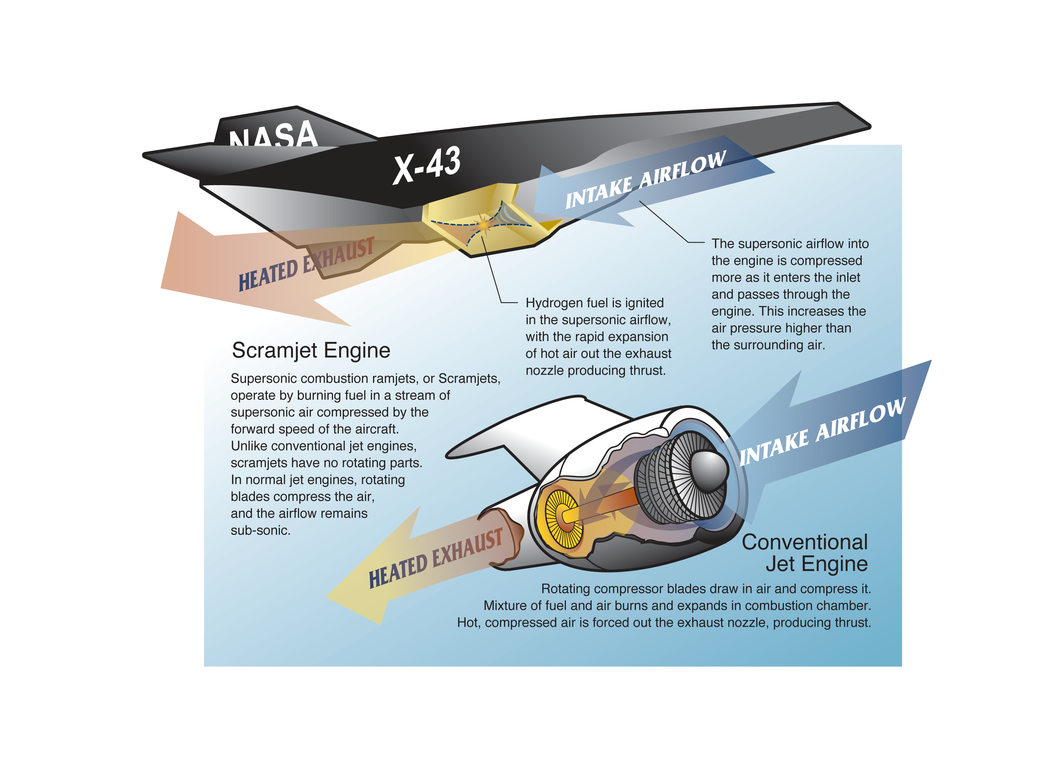
- A ramjet is a type of air-breathing jet engine that operates on the principle of the ram effect.
- It consists of an inlet, a combustion chamber, and a nozzle.
- The engine relies on the forward motion of the aircraft to compress incoming air before combustion.
- Ramjets are most efficient at high speeds, typically above Mach 2 (twice the speed of sound).
- They are not self-starting and require an initial acceleration to achieve the necessary air compression for combustion.
- A scramjet, or Supersonic Combustion Ramjet, is an advanced version of the ramjet.
- It operates on the same basic principles as a ramjet but can efficiently operate at even higher speeds.
Human Rated Launch Vehicle (HRLV)
- The primary mandate of HSFC is to spearhead ISRO’s Gaganyaan programme
- LVM3 rocket – The well proven and reliable heavy lift launcher of ISRO, is identified as the launch vehicle for Gaganyaan mission.
- It consists of solid stage, liquid stage and cryogenic stage. All systems in LVM3 launch vehicle are re-configured to meet human rating requirements and christened Human Rated LVM3.
- HLVM3 will be capable of launching the Orbital Module to an intended Low Earth Orbit of 400 km.
- HLVM3 consists of Crew Escape System (CES) powered by a set of quick acting, high burn rate solid motors which ensures that Crew Module along with crew is taken to a safe distance in case of any emergency either at launch pad or during ascent phase.
