
Precipitation
Precipitation occurs when condensed particles in the atmosphere grow in size and the air can no longer hold them against the force of gravity, causing them to fall to the Earth’s surface. This release of moisture can occur in liquid or solid form.
- Precipitation occurs only after the air reaches 100% relative humidity (saturation).
- The condensed water droplets must grow large enough to overcome air resistance and fall.
- It is a key component of the hydrological cycle and impacts climate, agriculture, soil formation, and ecosystems.
Forms of Precipitation
- Rainfall: Precipitation in the form of liquid water that occurs when the temperature is above 0°C.
- Snowfall: Precipitation in the form of fine snowflakes, occurring when the temperature is below 0°C. Moisture is released as hexagonal crystals that combine to form snowflakes.
- Sleet: Frozen raindrops or refrozen melted snow-water.It happens when a layer of air above the freezing point is situated over a sub-freezing layer close to the surface.Raindrops fall through the warmer air and freeze into small ice pellets upon encountering the colder air below.
- Hailstones: Solid, rounded pieces of ice. Formed when raindrops pass through colder air layers after being released from clouds, solidifying into ice. Hailstones develop multiple concentric layers of ice during this process.
☁️ Note: Fog and Mist are not precipitation, but rather suspended moisture, as they do not fall to the surface.
Mechanisms of Rainfall Formation
There are four main mechanisms that lead to vertical lifting of air and hence cooling, condensation, and precipitation:
- Convection (surface heating)
- Orographic uplift (mountain barrier)
- Frontal uplift (warm air rising over cold air)
- Convergence (air masses meeting and rising)
Types of Rainfall
1. Convectional Rainfall
Process:
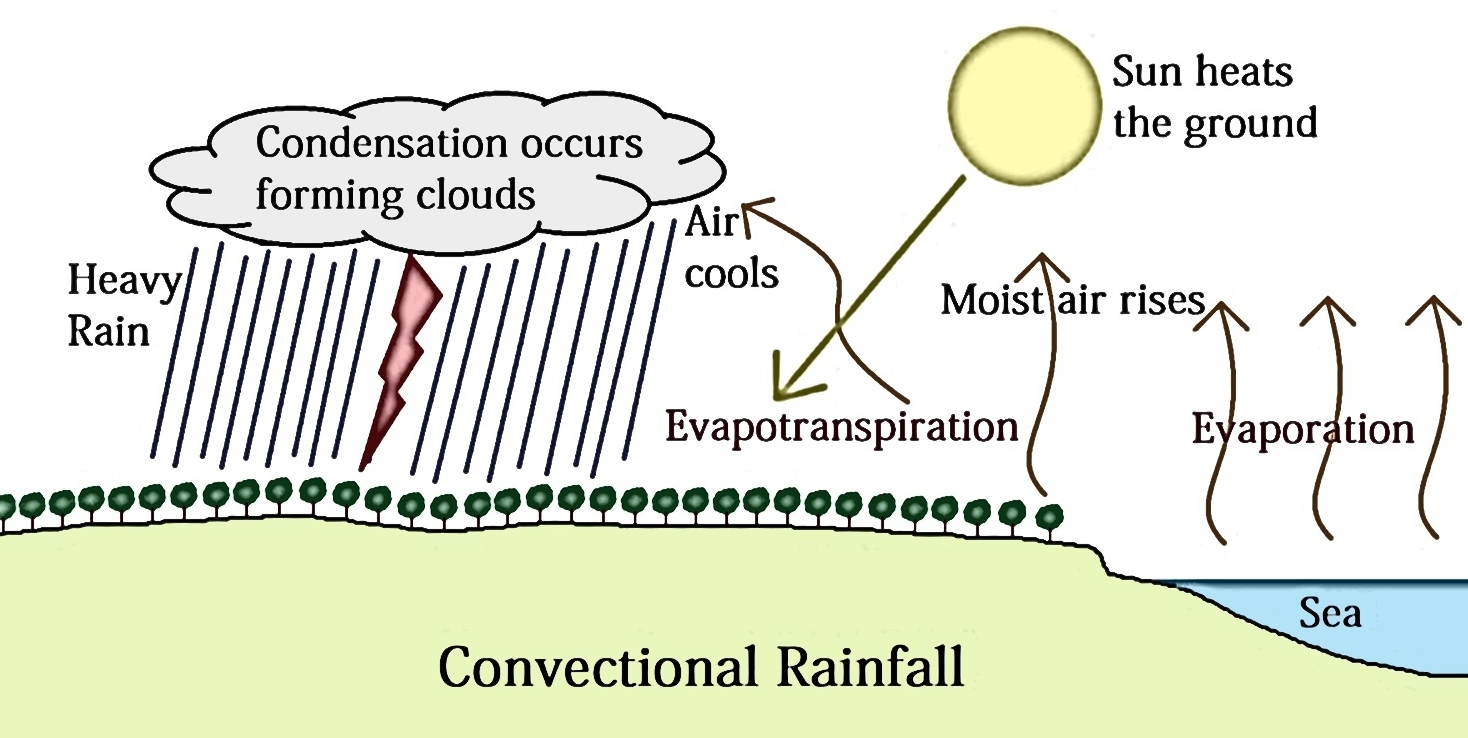
- Occurs due to intense surface heating of land.
- Warm air rises vertically in convection currents → expands, cools, and condenses.
- Leads to the formation of cumulus or cumulonimbus clouds.
Characteristics:
- Short-lived, intense, and localized showers.
- Often accompanied by thunder and lightning.
- Occurs mainly during afternoon or hot summers.
Examples:
- Equatorial regions: Amazon Basin, Congo Basin, Indonesia, Philippines.
2. Orographic (Relief) Rainfall
Process:
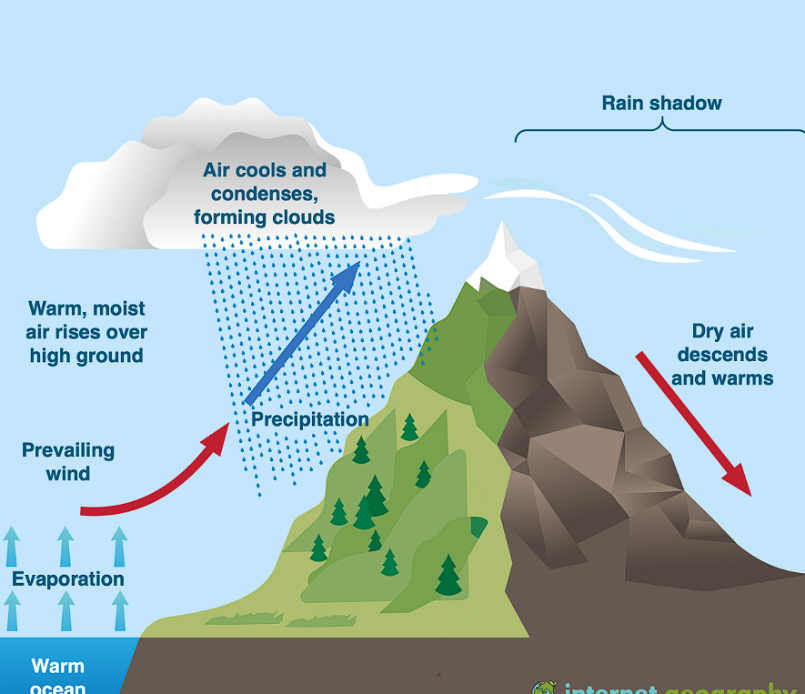 Moist winds strike mountain slopes, get forced upwards.
- Rising air cools adiabatically, leading to condensation and rain on the windward side.
- On descending the leeward side, air gets warmer → dry conditions prevail → Rain Shadow Zone.
Key Features:
- Heavy rainfall on windward slopes.
- Dry conditions (arid/semi-arid) on leeward slopes.
- Katabatic Winds: Downslope dry winds on leeward side.
Examples:
- Western Ghats: Mahabaleshwar (600+ cm), Pune (~70 cm).
- Patagonian Desert, Eastern Himalayas, Rain-shadow area of Andes.
3. Cyclonic (Frontal) Rainfall
 Process:
- Occurs along frontal boundaries between warm and cold air masses.
- Warm air, being lighter, rises over the cold air → condensation → rain.
Types:
- Tropical cyclones → Convectional rainfall over large scale.
- Temperate cyclones → Frontal rainfall due to interaction between maritime and continental air masses.
Characteristics:
- Widespread, moderate to heavy rainfall.
- Often prolonged, covering large areas.
Examples:
- NW Europe, Eastern USA, Japan, New Zealand.
4. Monsoonal Rainfall
Mechanism:
- Caused by seasonal reversal of winds (especially the SW monsoon in South Asia).
- Winds blow from ocean to land, carrying huge moisture → heavy rainfall.
Characteristics:
- Highly seasonal.
- Uneven distribution may lead to floods or droughts.
Examples:
- India, Bangladesh, Myanmar, Thailand.
World Distribution of Rainfall
1. General Trends
- Rainfall decreases from the Equator to the poles.
- Coastal areas receive more rain than interiors.
- Oceans receive more rainfall than continents.
- Mountain ranges cause orographic effects – rain on windward, dryness on leeward.
2. Rainfall Zones (Annual Average)
| Zone/Region | Rainfall (cm/year) | Notes |
| Equatorial belt | >200 cm | Uniform and heavy |
| Windward coastal zones (mid-latitudes) | >200 cm | Western Europe, Japan |
| Interior continental zones | 100–200 cm | Moderate (USA, Central Asia) |
| Tropical interiors, temperate interiors | 50–100 cm | Varies with season |
| Rain-shadow & Polar regions | <50 cm | Arid to semi-arid |
3. Seasonal Distribution
| Region | Rainfall Pattern |
| Equatorial | Year-round rainfall |
| Monsoon Asia | Seasonal (June–Sept) |
| Western Europe | Winter maximum |
| Mediterranean | Wet winters, dry summers |
| Central Asia | Very low, erratic |
