
Petro crops (Plants)
Definition of Petro-plants
Petroleum and wood are chief energy resources from time immemorial, but they have been overused and not being replenished fast enough. This is cause for concern. There is a need for alternative energy providing sources that can be regenerated. Recent researches suggest that hydrocarbon producing plants can become alternative energy sources, which can be inexhaustible and ideal for liquid fuel. These plants called Petro plants/Petro crops can be grown on land which are unfit for agriculture and not covered with forests.
Biocrude extraction & conversion
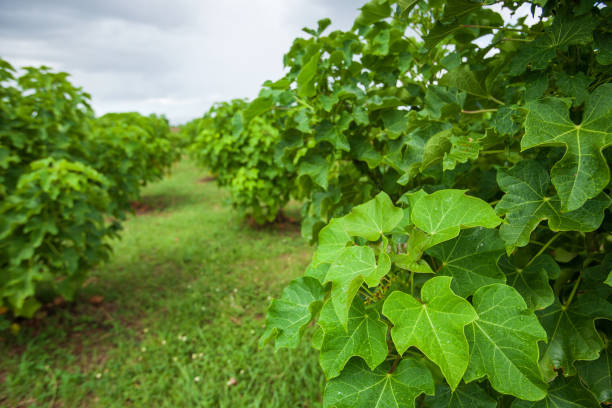
- The most critical step in bioenergy production is the selection of plant species that produce substances from which useful products can be extracted in an economically viable way. Many such promising species belong to the families Asclepiadaceae, Asteraceae, Anacardiaceae Euphorbiaceae, Convolvulaceae, Caprifoliaceae, Lamiaceae, and Moraceae. Jatropa curcas is an important petro plant.
- This biocrude can be obtained by tapping the latex, followed by coagulation, or by extraction of the dry biomass using a suitable solvent in cases where latex tapping is not possible. Biocrude is a complex mixture of liquids, terpenoids, triglycerides, phytosterols waxes, and other modified isoprenoid compounds. It can be catalytically upgraded for use as liquid fuels. Hydro cracking of biocrude can convert it into several useful products like gasoline (automobile fuel), gas oil and kerosene. Some potential Petro-crop species are:
Plant Species — Family Classification
| Plant Species | Family |
|---|---|
| Calotropis procera | Asclepiadaceae |
| Calotropis gigantea | Asclepiadaceae |
| Cryptostegia grandiflora | Asclepiadaceae |
| Asclepias curassavica | Asclepiadaceae |
| Euphorbia antisyphilitica | Euphorbiaceae |
| Euphorbia caducifolia | Euphorbiaceae |
| Pedilanthus tithymaloides | Euphorbiaceae |
| Jatropha curcas | Euphorbiaceae |
| Pittosporum resiniferum | Pittosporaceae |
| Copaifera longsdorfii | Fabaceae |
| Parthenium argentatum | Asteraceae |
| Simmondsia chinensis | Simmondsiaceae |
Mycoremediation and Mycofiltration
- Mycoremediation: Uses fungi to degrade contaminants in soil or water.
- Mycofiltration: Uses fungal mycelia to filter and remove toxins and pathogens from water or soil.
Advantages of Bioremediation
- Enables complete destruction of many contaminants.
- Less expensive than conventional methods.
- Eco-friendly, leaving no harmful residues.
- Useful for a variety of pollutants including hydrocarbons and heavy metals.
- Examples:
- Oilzapper: A bacterial mixture developed by TERI to clean oil-contaminated sites.
- Deinococcus radiodurans: A bacterium used to detoxify toluene and mercury in nuclear waste.
Disadvantages of Bioremediation
- Only effective for biodegradable compounds.
- Processes are often specific to particular contaminants.
- Pilot-scale results may not accurately predict large-scale field success.
- Generally slower than some other treatment methods.
