
Ocean Currents
- Ocean currents are continuous, directed movements of ocean water that flow in specific paths and directions, akin to rivers within the ocean.
Causes of Ocean Currents:
Primary Forces:
- Solar Heating: Solar energy causes water to expand near the equator, creating a gradient with water flowing toward the poles.
- Wind: Wind: Wind imparts momentum to the ocean’s surface, initiating water movement.
- Gravity: Water flows downhill due to sea level differences caused by temperature and salinity variations.
- Coriolis Force: Earth’s rotation deflects currents, causing circular patterns (gyres) in ocean basins, to the right in the Northern Hemisphere and left in the Southern Hemisphere.
Secondary Forces:
- Density Differences: Temperature and salinity variations cause vertical movement, with cold, dense water sinking at the poles and warmer, less dense water rising and flowing toward the poles.
Characteristics of Ocean Currents:
- Surface vs. Deep Currents:
- Currents are strongest near the surface, with speeds that can exceed 5 knots (nautical miles per hour).
- Deep currents, occurring below the surface, generally have slower speeds, typically less than 0.5 knots.
- Drift and Strength:
- The speed of a current, known as “drift,” is measured in knots.
- The strength of a current depends on its speed; faster currents are considered stronger.
- Current strength typically decreases with depth, with surface currents generally being the strongest.
Types of Ocean Currents:
Surface Currents:
- Located in the upper 400 meters, making up 10% of ocean water.
- Driven by wind and the Coriolis effect, deflecting currents right in the Northern Hemisphere and left in the Southern Hemisphere.
- Move horizontally and faster, redistributing heat globally.
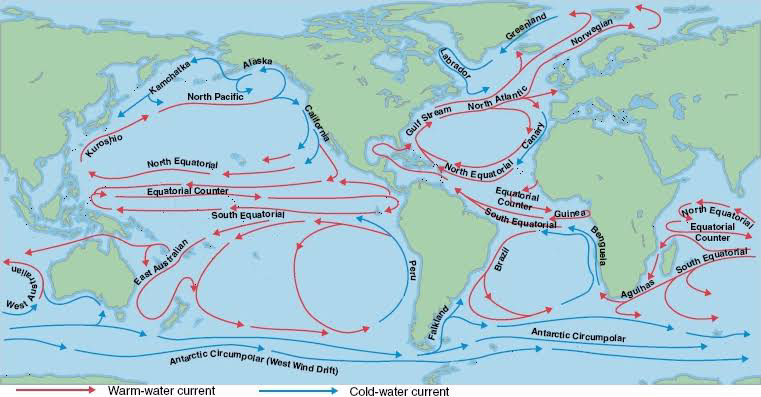
- Examples: Gulf Stream, Kuroshio Current, Agulhas Current.
Deep Water Currents:
- Comprise 90% of ocean water, circulating below the surface.
- Driven by density differences due to temperature and salinity, especially in high latitudes.
- Slower but essential for regulating climate and transporting heat and nutrients.
- Examples: North Atlantic Deep Water (NADW), Antarctic Bottom Water (AABW).
Classification Based on Temperature:
- Cold Currents:
- Characteristics:Cold currents carry cooler water from polar regions to lower latitudes.
- Distribution: Found on the western coasts of continents in the low and middle latitudes (both hemispheres) and on the eastern coasts in higher latitudes in the Northern Hemisphere.
- Examples: California Current off the western coast of North America and the Benguela Current off southwestern Africa.
- Warm Currents:
- Characteristics: Warm currents transport warmer water from lower latitudes towards higher latitudes.
- Distribution: Typically observed on the eastern coasts of continents in the low and middle latitudes (both hemispheres) and on the western coasts in higher latitudes in the Northern Hemisphere.
- Examples: Gulf Stream in the North Atlantic, Brazil Current along the eastern coast of South America, and the North Pacific Current in the western North Pacific.
Oceanic circulation patterns are influenced by:
-
- Prevailing Winds: Winds exert stress on the ocean surface, contributing to the formation and direction of major currents.
- Coriolis Force: Causes deflection of currents to the right in the Northern Hemisphere and to the left in the Southern Hemisphere, influencing their paths.
- Anticyclonic and Cyclonic Patterns: Similar to atmospheric circulation, oceanic circulation features anticyclonic (clockwise in Southern Hemisphere, counterclockwise in Northern Hemisphere) and cyclonic patterns.
- Monsoonal Winds: In regions with monsoonal climates, seasonal wind patterns influence the direction and strength of ocean currents.
- Heat Transport:
- Ocean currents play a critical role in transporting heat across latitudes, similar to atmospheric circulation, thereby influencing global climate patterns.
Circulation Patterns of Ocean Currents
- Gyres: In the major oceans, surface currents form large circular patterns called gyres.In the Northern Hemisphere, gyres spin clockwise, whereas in the Southern Hemisphere, they rotate counterclockwise.
Key gyres include:
-
- North Atlantic Gyre: Includes the Gulf Stream and the North Atlantic Drift, affecting the climate of Western Europe.
- South Atlantic Gyre: Involves the Brazil Current and the Benguela Current.
- North Pacific Gyre: Includes the Kuroshio Current and the California Current.
- Indian Ocean Gyre: Features the Agulhas Current and influences the monsoonal patterns.
- Equatorial Currents: These warm currents move from east to west along the equator, driven by trade winds. They play a vital role in distributing heat across the globe. The North Equatorial Current and South Equatorial Current are key examples.
- Thermohaline Circulation: This global conveyor belt involves the sinking of cold, dense water in the polar regions, which then flows along the ocean floor towards the equator, where it rises and warms, creating a continuous loop. This circulation pattern is vital for regulating global temperatures and transporting nutrients.
Pacific Ocean Currents:-
| Name | Nature | Force Responsible | Location |
| North Equatorial Current | Warm | Prevailing wind | West Coast of Mexico |
| Counter-equatorial Current | Warm | Water collecting and counter-Current balance | West Mindanav |
| Kuroshio Current | Warm | Prevailing wind | Philippine and China coastlines |
| Oyashio and Kurile Current | Cold | Temperature and density difference | Kurile Islands |
| Peru and Humboldt Current | Cold | Upwelling | Peruvian Coast |
| El Nino | Warm | Peruvian Coast | |
| La Nina | Cold | Peruvian Coast | |
| Eastern Australian Current | Warm | Prevailing wind | Near the Australian Coast |
| West wind Drift | Cold | Temperature and density flow | Around Antarctica |
Atlantic Ocean Currents:-
| Name | Nature | Force Responsible | Location |
| North Equatorial Current | Warm | Prevailing wind | Near the West Coast of Africa |
| South Equatorial Current | Warm | Prevailing wind | West Coast of Africa |
| Counter Equatorial Current | Warm | Water collecting and counter-Current balance | East Coast of Mexico |
| Gulf Stream | Warm | Prevailing wind | Near Florida |
| Florida Stream | Warm | Prevailing wind | Near Florida |
| Canary Current | Cold | Prevailing wind | West Coast of North Africa |
| Labrador Current | Cold | Temperature and density flow | Baffin Bay and Davis Strait |
| Brazilian Stream | Warm | Prevailing wind & Coast Guided | Near Brazil coast |
| Falkland Current | Cold | Near Falkland | |
| South Atlantic Drift | Cold | Temperature and density flow | Around Antarctic |
| Benguela Current | Cold | Coastal upwelling | South West Coast of Africa |
Effects of Ocean Currents:
- Temperature Regulation:
- Cool Waters on West Coasts: Cool ocean currents along the west coasts of tropical and subtropical regions lead to lower average temperatures, narrow temperature ranges, and arid conditions with occasional fog.
- Warm Waters on West Coasts: In higher latitudes, warm currents create a marine climate with cool summers, mild winters, and narrow annual temperature ranges.
- Climate Modulation:
- Warm Currents on East Coasts: Warm currents along east coasts in tropical and subtropical regions result in warm, rainy climates.
- Ecological Impact:
- Enhanced Marine Productivity: The mixing of warm and cold currents boosts biological productivity, promoting plankton growth and oxygen replenishment.
- Rich Fishing Grounds: Converging currents create fertile fishing zones, supporting diverse marine ecosystems crucial for fishing.
