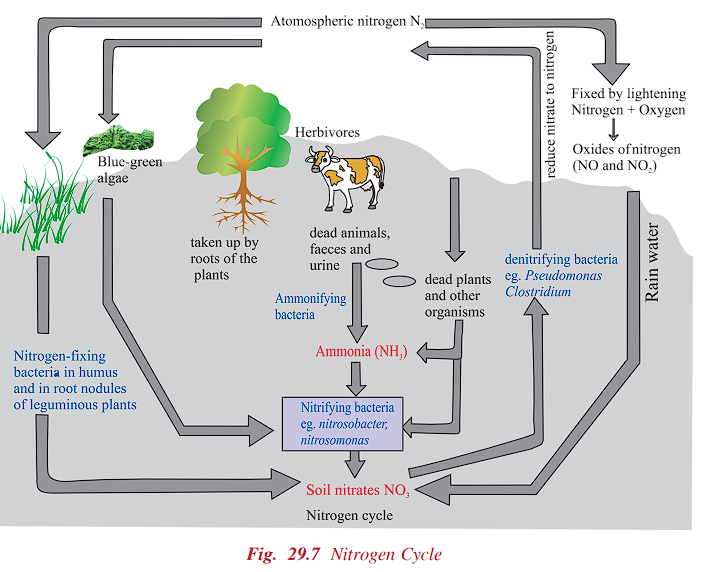
Nitrogen Cycle
Nitrogen is an essential element of proteins, DNA, and RNA, and is required by all living organisms, including humans.
- Although nitrogen makes up about 79% of the Earth’s atmosphere, most organisms cannot use it directly in its gaseous form (N₂).
- Nitrogen moves between the atmosphere, living organisms, and the soil through a series of biological, chemical, and physical processes — collectively known as the nitrogen cycle.
This cycle ensures that nitrogen becomes available to organisms in a usable form and is recycled back to the atmosphere.
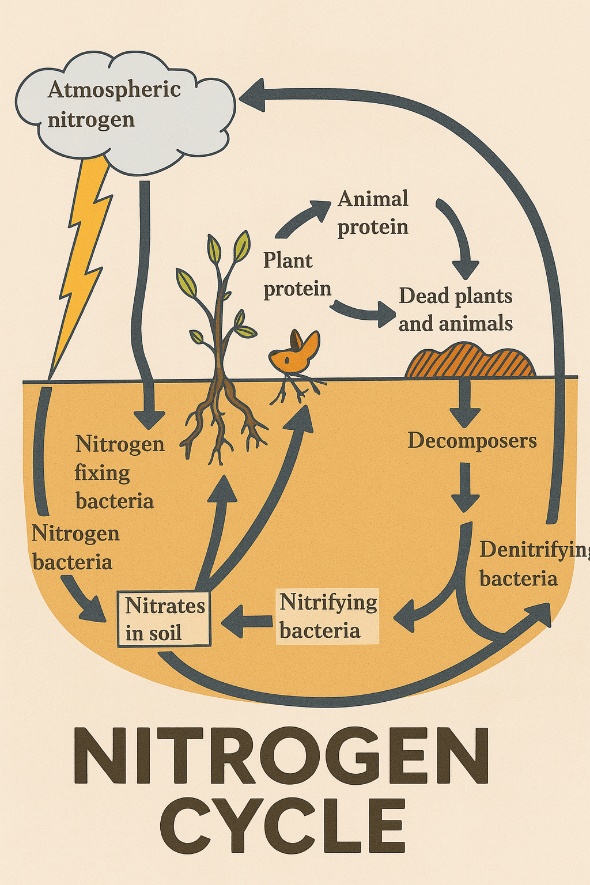
Key Processes of the Nitrogen Cycle:
1. Nitrogen Fixation
Conversion of atmospheric nitrogen (N₂) into ammonia (NH₃), a form that plants can absorb. This process happens in three main ways:
- Atmospheric Fixation: Natural phenomena like lightning, combustion, and volcanic activity break nitrogen molecules and allow them to combine with oxygen and water to form nitrates.
- Industrial Fixation: In industries, at high temperature (about 400°C) and high pressure (about 200 atm), molecular nitrogen is split and combined with hydrogen to produce ammonia (NH₃). This is the basis of the Haber-Bosch process used in fertilizer production.
- Biological Fixation: Microorganisms convert atmospheric nitrogen into ammonia.
There are two main types of nitrogen-fixing bacteria:- Symbiotic bacteria: e.g., Rhizobium, found in the root nodules of leguminous plants.
- Free-living or symbiotic bacteria: e.g., Nostoc, Azotobacter, Cyanobacteria, which also fix nitrogen independently in soil or water.
2. Nitrification
- Ammonia (NH₃) present in the soil is converted step by step into nitrites (NO₂⁻) and then nitrates (NO₃⁻) by soil bacteria.
- Nitrosomonas and Nitro coccus convert ammonia → nitrites.
- Nitrobacter converts nitrites → nitrates. Nitrates are readily absorbed by plants.
3. Assimilation
- The nitrates absorbed by plants are converted into organic molecules like proteins, DNA, RNA, and other compounds. When animals consume plants (or other animals), they too assimilate nitrogen into their tissues.Thus, nitrogen enters plant and animal tissue in organic form.
4. Ammonification
- When living organisms excrete nitrogenous wastes (e.g., urea, uric acid) or die, their nitrogen-rich organic matter is decomposed by ammonifying bacteria, releasing ammonia (NH₃) back into the soil. This is an important step that recycles nitrogen back into the ecosystem in an inorganic form.
5. Commensalism
In commensalism, one species (the commensal) benefits while the other (the host) is neither harmed nor benefited.
- Examples:
- The remora (suckerfish) attaches to a shark to gain protection, transport, and leftover food, while the shark remains unaffected.
- Epiphytes (mosses, ferns, orchids) grow on trees for support, sunlight, and moisture without harming the tree.
6. Denitrification
- Some soil bacteria (called denitrifying bacteria) convert soil nitrates (NO₃⁻) back into gaseous nitrogen (N₂), which is released into the atmosphere. Denitrification mainly occurs in oxygen-poor (anaerobic) soils, usually near the water table. This process is essentially the reverse of nitrogen fixation and closes the nitrogen cycle loop.