Nepenthes (Pitcher Plant)
Nepenthes (Pitcher Plant)
Nepenthes (Pitcher Plant)
Nepenthes (Pitcher Plant)
Nepenthes (Pitcher Plant)
-
Nepenthes (Pitcher Plant)
Nepenthes (Pitcher Plant)
Nepenthes (Pitcher Plant)
Nepenthes (Pitcher Plant)
Nepenthes (Pitcher Plant)
Nepenthes (Pitcher Plant)
Nepenthes (Pitcher Plant)
Nepenthes (Pitcher Plant)
Nepenthes (Pitcher Plant)
Nepenthes (Pitcher Plant)
Nepenthes (Pitcher Plant)
Habitat and Distribution
- Nepenthes, commonly known as the pitcher plant, is a genus of insectivorous plants adapted to humid, high-rainfall environments. In India, the only species found is Nepenthes khasiana, known locally as Ghatparni (Hindi), Kalaspatri (Bengali), and Tiew-rakot (Khasi). It is endemic to the northeastern hills of Meghalaya, particularly the Khasi, Jaintia, and Garo Hills, at elevations ranging from 100 to 1500 meters.
Morphological Characteristics
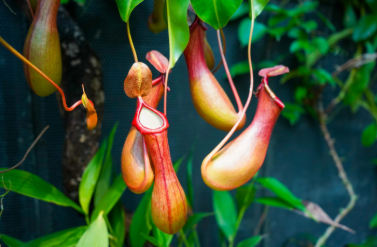
- Nepenthes khasiana is a short, prostrate to climbing undershrub. The leaves are modified to form pitchers, which act as trapping organs. The lower part of the petiole flattens into a leaf-like blade called a phyllode, while the upper part forms a coiled tendril that supports the hanging pitcher. These pitchers are brightly colored in red, green, yellow, or mixed hues, and can range from 5 to 30 cm in length. At the mouth of each pitcher is a half-open lid that aids in attracting insects.
Insect-Trapping Mechanism
- Nepenthes follows a pitfall trap mechanism. Insects are attracted to the pitcher by its bright colors and sweet nectar, secreted by glands at the entrance and underside of the lid. Once inside, the insects slip on the inner surface, which is waxy and slippery. Unable to escape, they fall into a fluid mixture at the base of the pitcher—composed of rainwater, enzymes, and mild acids. The glands inside the lower portion of the pitcher secrete proteolytic enzymes that digest the insect. The resulting nutrients are then absorbed by the plant.
Ethnomedicinal Uses
- Locally, Nepenthes has folk medicinal value. The pitcher contents, including partially digested insects, are ground into a paste and mixed with water to treat cholera. The fluid inside the pitcher is consumed for urinary problems and also used as eye drops to relieve redness and itching.