
Low-Earth Orbit Flight Test of an Inflatable Decelerator (LOFTID)
- LOFTID is a NASA project demonstrating inflatable aeroshell technology for aerodynamic deceleration during atmospheric re-entry.
- The large deployable aeroshell allows for efficient slowing down in thin atmospheres, like Mars, enabling landing heavy payloads at higher altitudes.
- The scalable technology has applications in missions to Mars and commercial uses, including space station down-mass and lower-cost access to space.
NASA launches mission to 20,000-year-old supernova remnant to understand life cycle of stars
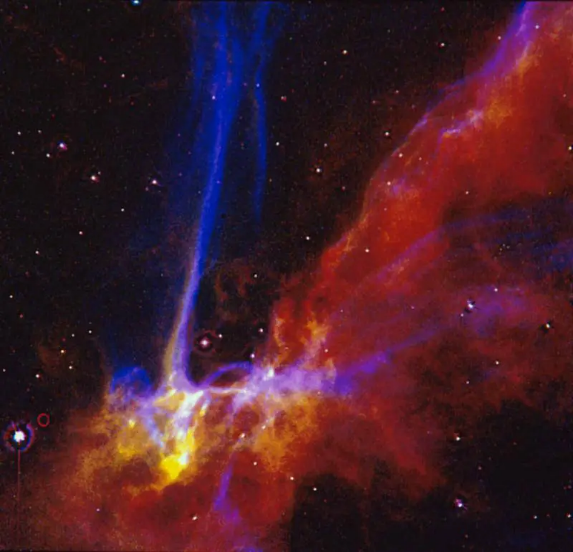
- NASA launched the Integral Field Ultraviolet Spectroscope Experiment (INFUSE) on a sounding rocket to study the Cygnus Loop, a supernova remnant that occurred 20,000 years ago.
- The Cygnus Loop, located about 2,600 light years away, resulted from the explosion of a massive star, possibly 20 times the size of the sun.
- The INFUSE mission aims to understand the life cycle of stars by studying the remnants of the supernova and its impact on the formation of galaxies.
- INFUSE will collect information about the remnant in far-ultraviolet wavelengths to observe how the supernova releases energy into the Milky Way.
Psyche – NASA 2023
- The Psyche spacecraft is traveling to a unique metal-rich asteroid with the same name, orbiting the Sun between Mars and Jupiter.
- By August 2029 the spacecraft will begin exploring the asteroid that scientists think – because of its high metal content – may be the partial core of a planetesimal, a building block of an early planet.
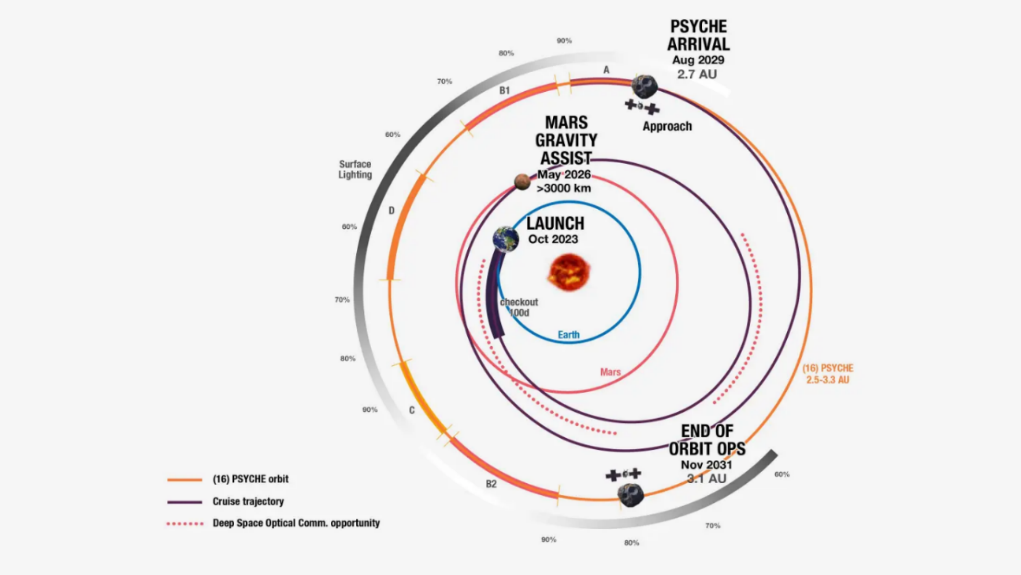
- Psyche is the 16th asteroid discovered, named after the Greek goddess of the soul.
- It orbits in the asteroid belt between Mars and Jupiter, about three times farther from the Sun than Earth.
- Psyche is irregular, resembling a potato, with dimensions of 173 miles by 144 miles. It is dense and may contain significant metal from a planetesimal core.
- Estimated metal content ranges from 30% to 60%. The upcoming Psyche spacecraft mission aims to provide a closer examination of the asteroid’s composition and surface features.Top of Form
