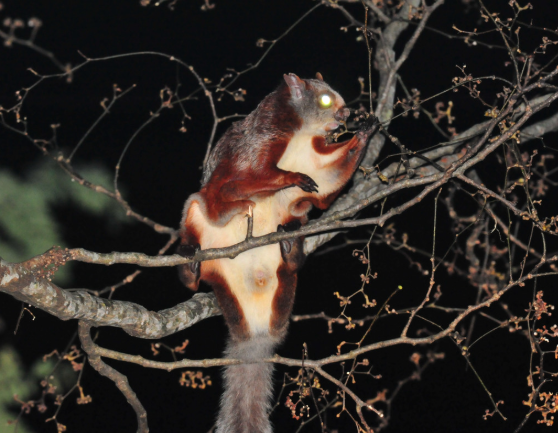
- IUCN Red List: Critically Endangered
- Wildlife (Protection) Act, 1972: Schedule II
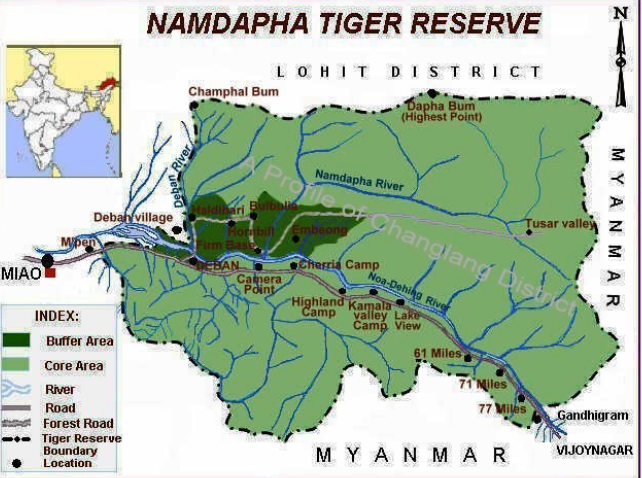
· Namdapha National Park, located in the Changlang district of Arunachal Pradesh, is a significant protected area in northeast India that doubles as both a National Park and a Tiger Reserve. Situated along the India–Myanmar international border, the park spans approximately 1985.23 square kilometres. It lies a few kilometres from Miao, nestled among the misty blue hills and along the banks of the turbulent Noa-Dihing River, enveloped in dense tropical rainforest. The Indian government declared it a Tiger Reserve in 1983 under Project Tiger. · Namdapha is acclaimed for its immense biodiversity, although comprehensive scientific documentation is still incomplete. It is considered a “botanist’s paradise” due to the presence of over 150 timber-yielding species. Unique flora like Pinus merkusii and Abies delavayi, which are not found elsewhere in India, thrive in this ecosystem. The park is also home to the rare and endangered orchid species Blue Vanda, and the Mishmi Teeta (Coptis teeta), a local medicinal plant used extensively by indigenous communities, whose export is currently banned. · What makes Namdapha exceptional is that it is the only park in the world to shelter all four species of big cats: the Tiger (Panthera tigris), Leopard (Panthera pardus), Snow Leopard (Panthera uncia), and the Clouded Leopard (Neofelis nebulosa), along with several lesser cat species. The park also hosts several primates, including the Assamese macaque, pig-tailed macaque, stump-tailed macaque, and the endangered Hoolock gibbon, which is notably the only ape species found in India. · Among the park’s numerous other faunal inhabitants are elephants, Indian bison, black bears, and various deer species. It is equally rich in avian diversity, with key species like the White-winged Wood Duck (rare and endangered), the Great Indian Hornbill, pheasants, jungle fowl, and many other colourful birds. · Due to its inaccessibility and rugged terrain, large portions of Namdapha remain pristine and untouched, preserving its natural habitats in an undisturbed state. The forest features an impressive undergrowth of canes, bamboos, wild bananas, and other wet tropical vegetation, making it a thriving breeding ground for a variety of wildlife. This unique combination of climate, vegetation, and geography makes Namdapha one of the most important biodiversity hotspots in the Eastern Himalayas and a priority area for conservation and ecological research.
|