
- There was an outburst of many-sided cultural activity in India under the Mughal rule. The traditions in the field of architecture, painting, literature and music created during this period set a norm and deeply influenced the succeeding generations. In this sense, the Mughal period can be called a second classical age following the Gupta age in northern India. In this cultural development, Indian traditions were amalgamated with the Turko-Iranian culture brought to the country by the Mughals.
- Architectural progress during the Mughals is a landmark in world art. Mughal buildings were noted for the massive structures decorated with bulbous domes, splendorous minarets, cupolas in the four corners, elaborate designs, and pietra dura (pictorial mosaic work). The mosques built during the time of Babur and Humayun were not of much architectural significance.
- The Sur dynasty left behind a few spectacular specimens in the form of the Purana Qila at Delhi, and the tombs of Sher Shah and Islam Shah at Sasaram in Bihar. The Purana Qila with a raised citadel and the tombs on a terraced platform surrounded by large tanks were novel features.
- Humayun’s mausoleum was situated on an elevated platform and surrounded by gardens during the rule of Akbar.Built by Indian artisans and designed by Persian architects it set a pattern to be followed in the future. It was built by Indian craftsmen and designed by Persian architects. One example of Rajput architectural influences being used is the red sandstone fort in Agra. The walls of Akbar Fatehpur Sikri’s new capital city had a number of impressive structures. The Buland
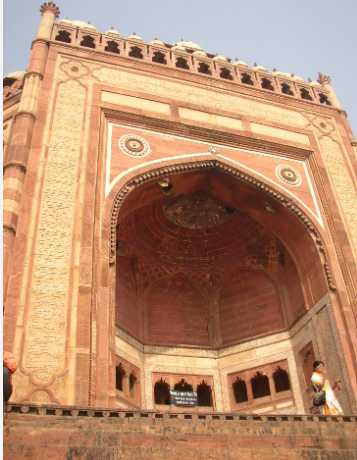 Darwaza, a beautiful gateway to Fatehpur Sikri constructed by Akbar out of red sandstone and marble, is regarded as a masterpiece of architecture.
Fig: Buland Darwaza
- The mausoleum of Akbar at Sikandra near Agra started by Akbar and completed by Jahangir includes some Buddhist architectural elements. The tomb of Itimad-ud-daula, father of Nurjahan, built by Jahangir was the first Mughal building built completely with white marble.
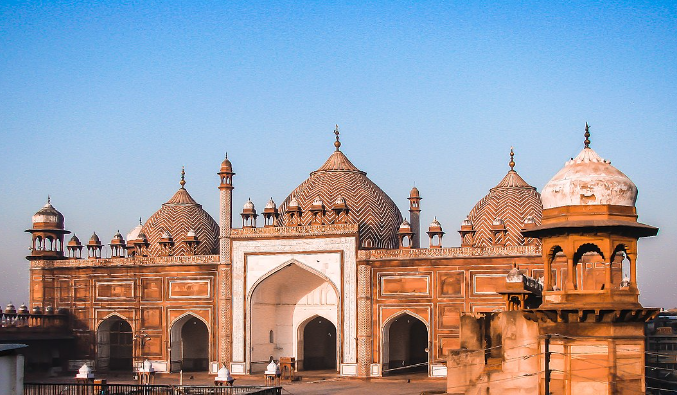
Fig : Jama Masjid
- Mughal architecture reached its apex during the reign of Shah Jahan. The Taj Mahal is a marble structure on an elevated platform, the bulbous dome in the centre rising on a recessed gateway with four cupolas around the dome and with four free-standing minarets at each of its corners is a monument of universal fame. The Red Fort in Delhi, encompassed by magnificent buildings like Diwan-i Aam, Diwan-i-Khas, Moti Mahal and Hira Mahal reflect the architectural skills of the times of Shah Jahan. The Moti Masjid inside the Agra Fort made exclusively of marble, the Jama Masjid in Delhi, with its lofty gateway, series of domes and tall and slender minarets are the two significant mosques built by Shah Jahan.
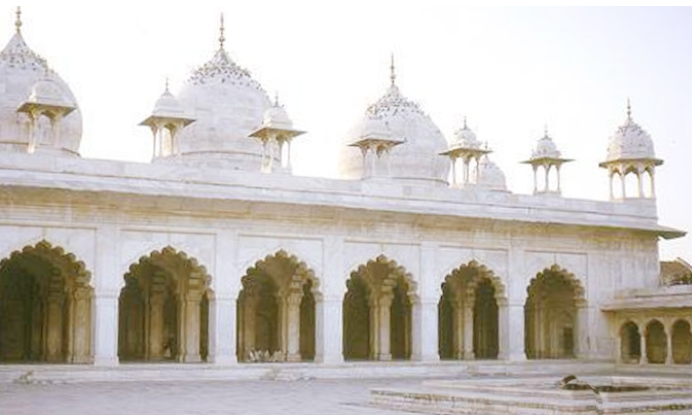
Fig: Moti Masjid
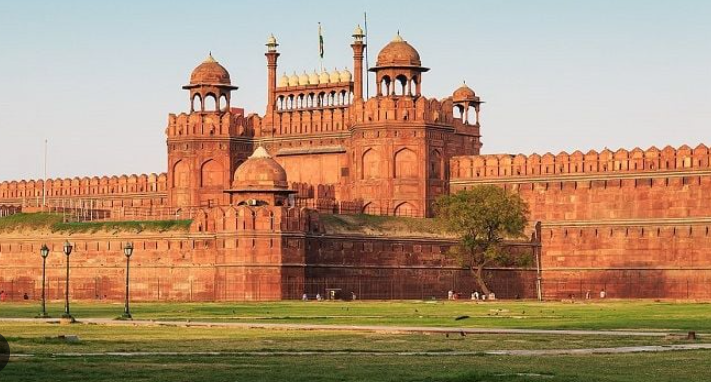
Fig: Red Fort
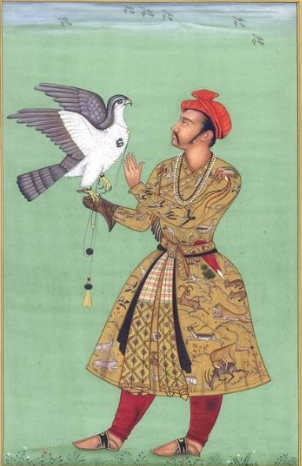 The Mughals made distinctive contribution in the field of painting. They introduced new themes depicting the court, battle scenes and the chase, and added new colours and new forms. Also the Mughal miniatures are an important part of the museums of the world. Ancient Indian painting traditions kept alive in provinces like Malwa and Gujarat along with the central Asian influences created a deep impact in the world of painting. The masters of miniature painting, Abdu’s Samad and Mir Sayyid Ali, who had come to India from Central Asia along with Humayun inspired Indian painters. The primary objective of painting was to illustrate literary works. The Persian text of Mahabharata and Akbar Namah were illustrated with paintings by various painters.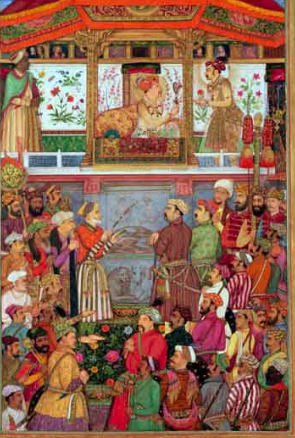
Under Akbar, European painting was introduced at the court by the Portuguese priests. Under their influence, the principles of foreshortening, whereby near and distant people and things could be placed in perspective was quietly adopted.
- Mughal painting reached a climax under Jahangir who had a very discriminating eye. It was a fashion in the Mughal school for the faces, bodies and feet of the people in a single picture to be painted by different artists. Jahangir claims that he could distinguish the work of each artist in a picture. Apart from painting hunting, battle and court scenes, under Jahangir special progress was made in portrait painting and paintings of animals. Mansur was the great name in this field. Portrait painting also became fashionable.
- According to Ain-i-Akbari, Tansen of Gwalior, credited with composing of many ragas, was patronised by Akbar along with 35 other musicians. Jahangir and Shah Jahan were patrons of music. Though there is a popular misconception that Aurangzeb was against music, a large number of books on Indian classical music were written during his regime. His queens, princes and nobles continued to patronise music. The later Mughal Muhammad Shah was instrumental in inspiring important developments in the field of music. Paintings in Babur Namah and Padshah Namah depict woman dancing to the accompaniment of musical instruments.
- Persian, Sanskrit and regional languages developed during the Mughal rule. Persian was the language of administration in Mughal Empire and the Deccan states. It influenced even the Rajput states where Persian words were used in administration. Abul Fazal patronised by Akbar compiled the history of Akbar in Akbar Nama and described Mughal administration in his work Ain-i-Akbari. The Ain-i-Akbari is commendable for its interest in science, statistics, geography and culture.
- The greatest contribution in the field of literature during the Mughal rule was the development of Urdu as a common language of communication for people speaking different dialects. Regional languages acquired stability and maturity and some of the finest lyrical poetry was produced during this period.
- Abdur Rahim Khan-e-Khanan composed Bhakti poetry with a blend of Persian ideas of life and human relations in the Brij form of Hindi.
- Tulsidas who wrote in Awadhi, the Hindi dialect spoken in the eastern Uttar Pradesh, was very popular for his devotional ideals.
- Marathi literature had an upsurge due to the literary contribution of Eknath, Tukaram, Ramdas and Mukteshwar during this period.
- Eknath questioned the superiority of Sanskrit over other languages. The verses of Tukaram kindled monotheism. Mukteshwar composed Ramayana and Mahabharata in literary Marathi
- Thus the empire the Mughals built at the national level made an everlasting impact on India as they knit the fragments into a single political unit, well aided by an effective central administration. Multiple identities also got synthesized in the process leading to the evolution of a unique culture that is Indian.
- The religious policies of the Mughal emperors varied significantly from one ruler to another, with some showing greater tolerance and inclusivity, while others adopted more aggressive approaches.
- Akbar is known for his policy of religious tolerance, which allowed for the peaceful coexistence of different religious communities within the empire. His policy was based on the principle of Sulh-i-Kul (universal peace) and aimed at promoting harmony and unity among the diverse population.Few policies include:
- Abolition of Pilgrim Tax (1563)
Though it involved a great financial loss, Akbar abolished the tax.
- Abolition of Jizya (1564)
In 1564, Akbar abolished Jizya. It was a poll tax which was levied from all non-Muslims.
- Liberty of Worship
Akbar was in favour of granting perfect liberty of conscience to his non-Muslim subjects.
- No Force to Convert
- Akbar issued an other royal order by which he discourged the use of force for converting people from one religion to another. As a result of this order, the religion even of prisoners of war could not be changed by force.
- Jahangir continued Akbar’s policy of religious tolerance, maintaining a liberal character in the state and allowing people from different religious backgrounds to coexist peacefully. However, there were instances of intolerance during his reign, such as the punishment of Guru Arjan Dev, a Sikh religious leader.
- Shahjahan initially leaned towards orthodoxy but later shifted towards tolerance. He maintained good relations with Hindu nobles and was influenced by his children, Dara Shikoh and Jahanara, who were known for their liberal views.
- Aurangzeb is known for his strict and aggressive religious views and policies. He aimed to convert non-Muslims to Islam and suppress Hinduism and Sikhism. His reign saw the destruction of temples, imposition of Jizya (a tax on non-Muslims), and forced conversion.
Ques.1: Which statement about Amir Khusrau is not true? (1981)
(a) He worked for the Hindu-Muslim unity.
(b) He was a great poet.
(c) He was a great historian.
(d) He wrote poetry in Hindi and Urdu.
Ques.2: Which of the chronological order for the construction of the following is correct? (1982)
1. Taj Mahal 2. QutabMinar
3. FatehpurSikri 4. Agra Fort
Select the correct answer from the codes given below:
(a) 2, 4, 3, 1 (b) 2, 4 ,1, 3
(c) 1, 2, 3, 4 (d) 2, 3, 4, 1
Ques.3: In whose reign Mughal painting art was at its zenith? (1984)
(a) Jahangir (b) Babur
(c) Shahjahan (d) Aurangzeb
Ques.4: Match the columns: (1985)
A. Amir Khusro 1. 16th Century
B. Din I Illahi 2. 12th Century
C. QutubMinar 3. 14th Century
D. Chand Bardai 4. 13th Century
Select the correct answer from the codes given below:
A B C D
(a) 4 1 2 3
(b) 4 1 3 2
(c) 3 2 4 1
(d) 2 3 4 1
Ques.5: Which of the following is wrongly matched? (1986)
(a) AbulFazl – ‘Baburnama’ (b) Kalhana – ‘Rajatarangini’
(c) MohdJayasi – ‘Padmavat’ (d) Abdul Hamid- ‘Badshahnama’
Ques.6: Which of the following is not included in Mughal paintings? (1986)
(a) Portraits (b) Islamic themes
(c) Flowers and plants (d) Hunting scenes
Ques.7: Musical instrument used by Amir Khusro was (1987)
(a) Sitar (b) Sarod
(c) Tabla (d) Flute
Ques.8: Which one of the following pairs is correctly matched? (1988)
(a) AbulFazal – Ain-i-Akbari
(b) Badauni – Akbar Nama
(c) Abdul Hamid Lahori – Tabkat-i-Akbari
(d) Nizamuddin Ahmad – Badshah Nama
Ques.9: Who among the following is said to have witnessed the reigns of eight Delhi Sultans? (1994)
(a) ZiauddinBarani (b) Shams-i-SirajAfif
(c) Mihaj-us-Siraj (d) Amir Khusrau
Ques.10: Consider the following: (1998)
1. Tughlaquabad Fort 2. Lodi Garden
3. QutubMinar 4. FatehpurSikri
The correct chronological order in which they were built is
(a) 3, 1, 4, 2 (b) 3, 1, 2, 4
(c) 1, 3, 2, 4 (d) 1, 3, 4, 2
Ques.11: Bhakta Tukaram was a contemporary of which Mughal Emperor? (2006)
(a) Babar (b) Akbar
(c) Jahangir (d) Aurangzeb
Ques.12: IbadatKhana at FatehpurSikri was (2014)
(a) The mosque for the use of Royal Family
(b) Akbar’s private chamber prayer
(c) The hall in which Akbar held discussions with scholars of various religions
(d) The room in which the nobles belonging to different religions gathered to discuss religious affairs
Ques.13: With reference to cultural history of India, consider the following statements: (2018)
1. Most of the Tyagaraja Kritis are devotional songs in praise of Lord Krishna.
2. Tyagaraja created several new ragas.
3. Annamacharya and Tyagaraja are contemporaries
4. Annamacharyakirtanas are devotional songs in praise of Lord Venkateshwara.
Which of the statements given above are correct?
(a) 1 and 3 only (b) 2 and 4 only
(c) 1, 2 and 3 (d) 2, 3 and 4
Ques.14: With reference to the cultural history of India, consider the following statements: (2018)
1. White marble was used in making BulnadDarwaza and Khanakah at FatehpurSikri
2. Red sandstone and marble were used in making Bara Imambara and Rumi Darwaza at Lucknow.
Which of the statements given above is/are correct?
(a) 1 only (b) 2 only
(c) Both 1 and 2 (d) Neither 1 nor 2
Ques.15: With reference to Mian Tansen, which one of the following statements is not correct? (2019)
(a) Tansen was the title given to him by Emperor Akbar
(b) Tansen composed Dhrupads on Hindu gods and goddesses
(c) Tansen composed songs on his patrons
(d) Tansen invented many Ragas
Ques.16: With reference to the scholars/literatures of ancient India, consider the following statements: (2020)
1. Panini is associated with PushyamitraShunga.
2. Amarasimha is associated with Harshavardhana
3. Kalidasa is associated with Chandra Gupta 2
Which of the statements given above is/are correct?
(a) 1 and 2 only (b) 2 and 3 only
(c) 3 only (d) 1, 2 and 3
Ques.17: With reference to the history of ancient India, which of the following statements is/are correct? (2021)
1. Mitakshara was the civil law for upper castes and Dayabhaga was the civil law for lower castes.
2. In the Mitakshara system, the sons can claim right to the property during the lifetime of the father, whereas in the Dayabhaga system, it is only after the death of the father that the sons can claim right to the property.
3. The Mitakshara system deals with the matters related to the property held by male members only of a family, whereas the Dayabhaga system deals with the matters related to the property held by both male and female members of a family.
Select the correct answer using the code given below:
(a) 1 and 2 (b) 2 only
(c) 1 and 3 (d) 3 only
Ques.18: ‘Yogavasistha’ was translated into Persian by NizamuddinPanipati during the reign of: (2022)
(a) Akbar (b) Humayin
(c) Shahjahan (d) Aurangzeb
Ques.19: Whose name is associated with FatehpurSikri?
(a) Akbar (b) Babar
(c) Shah Jahan (d) Humayun
Ques.20: Which of the following is not true about the paintings of Mughal period?
(a) Religious scenes were depicted
(b) Scenes of nature were depicted
(c) Court and cultural scenes were depicted to balance communal harmony
(d) Scenes of battles were depicted
Ques.21: Assertion (A): Akbar introduced Din-i-Illahi which became more popular.
Reason (R): Din-i-Ilahi was a religious order, suitable for the people of all religions.
(a) If A and R both are correct and R is the correct explanation of A
(b) If A and R both are correct but R is not the correct explanation of A
(c) If A is incorrect but R is correct
(d) If A is correct but R is incorrect
Ques.22: Who among the following accepted Din-i-Ilahi?
(a) Raja Man Singh (b) Birbal
(c) Raja Tansen (d) Raja Todarmal
Ques.23: Which of the following is located in Aurangabad?
(a) Shahjahan’s tomb (b) Tomb of Aurangzeb’s queen
(c) Akbar’s tomb (d) Babur’s tomb
Ques.24: Mughal painting reached its zenith under
(a) Humayun (b) Akbar
(c) Jahangir (d) Shahjahan
Hint & Solution
Previous Year
1. (a)
- Amir Khusro (1251-1325 A.D.) – He was a mystic and a spiritual disciple of Nizamuddin Auliya of Delhi, India.
- He lived for 72 years, out of which 60 years he lived in the courts of as many as ten different rulers of the Delhi Sultanate. His primary language to write poems was Persian but he composed almost half a million verses in Persian, Turkish, Arabic, Braj Bhasha, Hindavi as well as the Khadi Boli.
- Hence statement 2 is correct. His Khaliq-e-bari, which is known as the oldest printed dictionary of the world deals with Hindi and Persian words. He is regarded as the “father of qawwali”.
- Hence statement 3 is correct. He is also credited with enriching Indian classical music by introducing Persian and Arabic elements in it and was the originator of the khayal and Tarana styles of music. Khusrau is sometimes referred to as the “voice of India” or “Parrot of India” and has been called the “father of Urdu literature. He was a historian and wrote a book known as Tughlaq Nama (Ghiyas-ud-din-Tughlaq). He was a pioneer of Qawwali singing in India. (Qawwali is a chorus in praise of Sufi saints in the shrines). He is also credited with the invention of the Sitar (a three-stringed instrument). He was also credited with 3 Ragas (Yaman, Sanam and Ghora). He was popularly known as Tootai-e-Hind (Parrot of India). He was a contemporary of Balban, Jalaluddin Khilji and Alauddin Khilji. He began his career as a court poet with King Balban’s nephew Malik Chhajju and then served under Balban.
2. (a)
- Taj Mahal was commissioned in 1632 by the Mughal emperor, Shah Jahan, to house the tomb of his favourite wife, Mumtaz Mahal.
- Qutab minar was built in 1193 by Qutab-ud-din Aibak immediately after the defeat of Delhi’s last Hindu kingdom.
- Fatehpur Sikri was founded as the capital of Mughal Empire in 1571 by Emperor Akbar.
- Agra Fort was built in 1565.
3. (a)
There are a number of fine Akbar portraits, but it was under his successors Jahangir and Shah Jahan that the ruler’s portrait became firmly known in Indian miniature painting as a leading subject. This is not the correct answer.
(b) Jahangir-
- European art was also strongly inspired by Jahangir. He came into close contact with the English Crown during his reign and was given gifts of oil paintings involving portraits of the King and Queen.
- Unlike the flattened multi-layered form seen in traditional miniatures, he inspired his royal studio to take up the single point perspective preferred by European artists.
(c) Both A and B-
- This is not the correct answer, Hence Option C. is an incorrect option.
(d) Shah Jahan-
- While during the reign of Shah Jahan, Mughal painting continued to develop, the paintings exhibited in the court became increasingly static and formal. This is not the correct answer, Hence Option D. is an incorrect option.
4. (b)
- Ab’ul Hasan Yamin ud-Din Khusrau is better known as Amir Khusrow was a Sufi musician, poet and scholar from India.
- The Din-I-ilahi was a syncretism religion propounded by the Mughal emperor Akbar in 1582 CE, intending to merge some of the elements of the religions of his empire, and thereby reconcile the differences that divided his subjects.
- The qutub Minar is a towering 73 meter high tower built by Qutub minar a back in 1193. The tower was built to celebrate Muslim dominance in Delhi after the defeat of Delhi’s last Hindu ruler. This tower is the highest tower in India, complete with five storey’s and projecting balconies.
- Chan Bardai was a court poet of the king. The earliest extant copy of the text dates back to the 13th century.
5. (a)
(a) Abul Fazl – ‘Baburnama’ (Mismatched):
- As mentioned earlier, Abul Fazl is not associated with the ‘Baburnama.’
- The ‘Baburnama’ is an autobiography of Emperor Babur, the founder of the Mughal Empire. It is one of the earliest and most important sources for the history of the early Mughal period.
(b) Kalhana – ‘Rajatarangini’ (Correctly Matched):
- Kalhana is the correct author of the ‘Rajatarangini.’
- The ‘Rajatarangini’ is a historical chronicle of the kings of Kashmir and is considered one of the most significant works of Sanskrit literature.
(c) Mohd Jayasi – ‘Padmavat’ (Correctly Matched):
- Mohammad Jayasi is indeed the author of ‘Padmavat.’
- ‘Padmavat’ is a Sufi-inspired epic poem written in Awadhi language, narrating the legend of Rani Padmini and the siege of Chittorgarh by Alauddin Khilji.
(d) Abdul Hamid – ‘Badshahnama’ (Correctly Matched):
- Abdul Hamid is correctly associated with the ‘Badshahnama.’
- The ‘Badshahnama’ is a historical chronicle written in Persian during the reign of Shah Jahan, covering the events of his rule.
- So, the only mismatched pair in the options is (a) Abul Fazl – ‘Baburnama.’
6. (b)
- The thing which is not included in the Mughal paintings is the Islamic Themes. Mughal paintings are a particular style of South Asian painting. These paintings were evolved during the rule of Mughal Emperors in India and revolved around themes like battles, legendary stories, hunting scenes, wildlife, royal life, mythology, etc.
7. (a)
- Abu’l Hasan Yaminuddin Khusro, who is better known by the name – Amir Khusro (also Khusrau, Khusrow) Dehlavi, was the poet laureate of the subcontinent of India and enjoys an ever-lasting fame as one of the very versatile poets and prolific prose-writers that were present in the 13th and 14th centuries. Khusrau is specially credited for the invention of the ‘sitar’. At the time, there existed numerous forms of the Veena in India. He relabeled the triple stringed Tritantri Veena as a Sehtaar (Persian for 3 stringed), which eventually became known as the Sitar. The Sitar holds a place of pride among all the Indian musical instruments. It is easily the most charming of all instruments. The Sitar was known in ancient India by various names like devadattaa, maruyashti, mahati, parivaadini, saptatantri.
8. (a)
(a) Abul Fazal – Ain-i-Akbari (Correctly Matched):
- Abul Fazal was a prominent court historian and the author of the “Ain-i-Akbari.”
- The “Ain-i-Akbari” is a comprehensive document that records various aspects of the administration, culture, and society during the reign of Emperor Akbar in the Mughal Empire.
(b) Badauni -Muntakhab-ut-Tawarikh
- Badauni, whose full name is ‘Abdul-Qadir Badauni,’ is known for his work on the “Muntakhab-ut-Tawarikh,” which is a historical account.
- The “Akbar Nama” was actually authored by Abu’l-Fazl ibn Mubarak, who was another historian in Akbar’s court.
(c) Abdul Hamid Lahori – padshanama.
- Abdul Hamid Lahori was also a historian in Akbar’s court.
- He is known for his contributions to the “Padshahnama,” which is a historical work on the reign of Shah Jahan, not Akbar.
(d) Nizamuddin Ahmad –
- Nizamuddin Ahmad was a historian during the Mughal era.
- He is known for his work, the “Tabaqat-i-Akbari,” which provides information about the reign of Emperor Akbar.
- So, the correctly matched pair is (a) Abul Fazal – Ain-i-Akbari.
9. (d)
- Amir Khusrau (1253-1325). He is regarded as the “father of qawwali” .He was an Indian musician, scholar and poet. He was an iconic figure in the cultural history of the Indian subcontinent.He is said to have witnessed the reigns of eight Delhi Sultans from ‘Ghiyasuddin Balban to Sultan Muhammad bin Tughluq’.
- Certainly, here’s more information about each of the options:
(a) Ziauddin Barani:
- Ziauddin Barani was a 14th-century Indian historian and political thinker.
- He is known for his work “Tarikh-i-Firoz Shahi,” which covers the reign of Sultan Firoz Shah Tughlaq and provides historical insights into the Delhi Sultanate.
(b) Shams-i-Siraj Afif:
- Shams-i-Siraj Afif, commonly known as Afif, was a medieval historian.
- He authored the “Tarikh-i-Firuz Shahi,” a historical account that covers the reigns of several Delhi Sultans, including Firoz Shah Tughlaq.
(c) Mihaj-us-Siraj:
- Mihaj-us-Siraj was a Persian historian who lived in the 16th century.
- He is known for his work “Tabaqat-i-Akbari,” which is a historical chronicle covering the reign of Akbar the Great in the Mughal Empire.
(d) Amir Khusrau:
- Amir Khusrau Dehlavi, commonly known as Amir Khusrau, was a 13th-century Sufi poet, musician, and historian.
- He served in the courts of several Delhi Sultans, including Alauddin Khilji and Muhammad bin Tughlaq, and authored numerous works, including poetry and historical accounts.
10. (b)
1. Qutab Minar (1193):
- Qutab Minar is a UNESCO World Heritage Site located in Delhi, India.
- It was constructed by Qutb al-Din Aibak, the founder of the Delhi Sultanate, in 1193. It is a prominent example of Indo-Islamic architecture.
2. Tughlaqabad Fort (1321):
- Tughlaqabad Fort is a historic fort in Delhi, built by Ghiyas-ud-din Tughlaq, the founder of the Tughlaq dynasty, in 1321.
- The fort served as a strategic military stronghold during its time.
3. Lodhi Garden (1444):
- Lodhi Garden, officially known as “Lodhi Gardens” or “Lodhi Gardens Park,” is a public park in Delhi, India.
- It is laid out around the tombs of the Lodhi dynasty rulers and was commissioned by Sikandar Lodhi in 1444.
4. Fatehpur Sikri (1569):
- Fatehpur Sikri is a historical city in Uttar Pradesh, India, located near Agra.
- It was founded by Emperor Akbar in 1569 and served as the Mughal capital for a brief period before being abandoned.
11. (c)
- Tukaram was a Marathi Bhakti poet and a devotee of Lord Krishna born in 1608 and died in 1649. And the time period of Jahangir rule was 1605-1627 hence Bhakta Tukaram was a contemporary of Jahangir.
- Certainly, here’s more information about each of the options:
(a) Babar:
- Babar was the founder of the Mughal Empire in India.
- He ruled from 1526 to 1530 and is known for his victory in the First Battle of Panipat, which marked the establishment of the Mughal dynasty in India.
(b) Akbar:
- Akbar, also known as Akbar the Great, was one of the most influential Mughal emperors.
- He ruled from 1556 to 1605 and is known for his efforts to promote religious tolerance and cultural integration during his reign.
(c) Jahangir:
- Jahangir was the fourth Mughal emperor, reigning from 1605 to 1627.
- His reign is noted for its cultural richness, and he was known for his patronage of the arts and his keen interest in painting and the sciences.
(d) Aurangzeb:
- Aurangzeb, full name Aurangzeb Alamgir, was the sixth Mughal emperor, ruling from 1658 to 1707.
- He is known for his long and contentious reign, marked by his efforts to expand the Mughal Empire and his strict adherence to Islamic orthodoxy.
- Bhakta Tukaram’s life and teachings were primarily associated with the reign of Jahangir (option c), during the early 17th century in Maharashtra, India.
12. (c)
- Ibadat Khana, also known as the House of Worship, is a significant building located in Fatehpur Sikri, which was built by the Mughal emperor Akbar in the 16th century. It was a place where Akbar held discussions with scholars of different religions and debated on various religious topics.

- Historical Significance: – Ibadat Khana was built in 1575 by Akbar, who was known for his religious tolerance and interest in various religions. – It was a place where scholars of different religions, including Hindus, Muslims, Jains, Christians, and Zoroastrians, would gather to discuss their beliefs and philosophies. – The discussions held in Ibadat Khana were aimed at promoting religious harmony and understanding between different communities.
- Architecture: – Ibadat Khana is a small, rectangular building located near the Diwan-i-Am in Fatehpur Sikri. – The building has a simple design and is made of red sandstone and white marble. – It has a flat roof and a central hall with four rooms on either side. – The central hall was used for discussions and debates, while the rooms on either side were used as living quarters for the scholars.
- Role of Ibadat Khana: – Ibadat Khana was an important institution in the Mughal court, and its discussions had a significant impact on Akbar’s policies and decisions. – It played a key role in promoting religious harmony and tolerance in the Mughal Empire, which was known for its diverse population and religious plurality. – The debates and discussions held in Ibadat Khana were a reflection of Akbar’s vision of a tolerant and inclusive society, where people of different religions could coexist peacefully.
- Ibadat Khana was a unique and significant institution in the Mughal Empire, which played a key role in promoting religious harmony and understanding. Its legacy continues to inspire people today, as a symbol of tolerance and inclusivity.
13. (b)
- Most of the Tyagaraja Kritis are devotional songs in praise of Lord Krishna. This statement is incorrect. Most of the Tyagaraja Kritis are devotional songs in praise of Lord Rama, not Lord Krishna.
- Tyagaraja created several new ragas. This statement is correct. Tyagaraja is known for creating several new ragas, including Chintamani, Gowrimanohari, and Varali.
- Annamacharya and Tyagaraja are contemporaries. This statement is incorrect. Annamacharya and Tyagaraja were not contemporaries. Annamacharya lived in the 15th century, while Tyagaraja lived in the 18th and 19th centuries.
- Annamacharya kirtana are devotional songs in praise of Lord Venkateshwara. This statement is correct. Annamacharya is known for composing devotional songs, or kirtanas, in praise of Lord Venkateshwara, who is also known as Lord Balaji or Lord Vishnu.
14. (d)
- Statement 1: White marble was used in making Buland Darwaza and Khankah at Fatehpur Sikri. – Fatehpur Sikri is a UNESCO World Heritage Site located in Uttar Pradesh, India. – Buland Darwaza is a monument located at the entrance of the Jama Masjid in Fatehpur Sikri. It was built in 1601 AD by Mughal Emperor Akbar to commemorate his victory over Gujarat. – Khankah is a shrine located in Fatehpur Sikri, built in the 16th century for the Sufi saint Sheikh Salim Chishti. – Both Buland Darwaza and Khankah were built using red sandstone, not white marble.

- The use of red sandstone is a characteristic feature of Mughal architecture in India. – Therefore, statement 1 is incorrect.

- Statement 2: Red sandstone and marble were used in making Bara Imambara and Rumi Darwaza at Lucknow. – Bara Imambara is a complex of buildings located in Lucknow, Uttar Pradesh. It was built in the 18th century by the Nawab of Awadh, Asaf-ud-Daula. – Rumi Darwaza is a monument located in Lucknow, built in the 18th century by the same Nawab. – Both Bara Imambara and Rumi Darwaza were built using red sandstone, not white marble. The use of red sandstone is a characteristic feature of Awadhi architecture in India. – Therefore, statement 2 is also incorrect.

15. (a)
- Mian Tansen was one of the most renowned musicians of the Mughal era. He was a composer, singer, and instrumentalist who played a vital role in the development of Hindustani classical music.
- Incorrect Statement: Tansen was the title given to him by Emperor Akbar. Explanation: Tansen was born in Gwalior and his real name was Ramtanu Pandey. He was appointed as a court musician in the court of Raja Ramchandra of Rewa. Later, he moved to the court of King Akbar and became one of the Navaratnas (nine jewels) of his court. Emperor Akbar was impressed by his talent and bestowed upon him the title of Mian Tansen. Mian was a Persian honorific title, which means ‘learned man’ or ‘expert’. Therefore, the statement that Tansen was the title given to him by Emperor Akbar is incorrect.
Correct Statements:
- Tansen composed Dhrupads on Hindu gods and goddesses: Dhrupad is one of the oldest forms of Hindustani classical music. It is a devotional form of music that is based on the classical Sanskrit poetry of ancient India. Tansen composed many Dhrupads on Hindu gods and goddesses, which became very popular during his time.
- Tansen composed songs on his patrons: Tansen was a versatile musician who composed songs on various themes. He also composed songs on his patrons, including Emperor Akbar and other members of the Mughal court. His compositions were known for their intricate melodies and soulful lyrics.
- Tansen invented many Ragas: Tansen was not only a composer but also a great innovator. He is credited with the invention of many new Ragas, which enriched the Hindustani classical music tradition. Some of the Ragas attributed to him include Miyan ki Todi, Darbari Kanada, and Deepak.
16. (c)
- Panini is associated with Pushyamitra Shunga: Panini was a Sanskrit grammarian who lived in ancient India, and he is known for his work on Sanskrit grammar, named Ashtadhyayi. Pushyamitra Shunga was the founder of the Shunga dynasty, who ruled from 185 BCE to 73 BCE. However, there is no historical evidence that suggests any association between Panini and Pushyamitra Shunga. Therefore, the statement 1 is incorrect.
- Amarasimha Amarasimha (IAST: Amara-siṃha, c. CE 375) was a Sanskrit grammarian and poet from ancient India, of whose personal history hardly anything is known. He is said to have been “one of the nine gems that adorned the throne of Vikramaditya, not Harshavardhana.
- Kalidasa is associated with Chandra Gupta – II: Kalidasa was an ancient Indian poet and playwright, who is known for his works like Abhijnanasakuntalam, Meghadutam, and Raghuvamsham. Chandra Gupta – II was a king of the Gupta dynasty, who ruled from 375 CE to 415 CE. There is historical evidence that suggests that Kalidasa was a court poet of Chandra Gupta – II, and he wrote some of his masterpieces during the king’s reign. Therefore, the statement 3 is correct.
17. (b)
- Mitakshara Law: It is based on the Yajvavalkya Smriti about the laws of inheritance Under this law, as it existed until the amendments made by The Hindu Succession (Amendment) Act, 2005, the son acquires by birth an interest in the ancestral property. In Mitakshara law, on the death of a coparcener, his interest became merged with that of the surviving coparceners. A coparcener is a person who shares equally with others in the inheritance of an undivided estate or in the rights to it. Dayabhaga Law: Dayabhaga (c 12th century) is the code of Hindu inheritance of property by jimutavahana. In Dayabhaga, a son does not automatically get a share of his father’s inheritance while the father is alive. Hence statement 2 is correct. It mostly prevailed in Bengal. Applicability of either of the laws is not exclusive to any specific caste(s). Hence statement 1 is not correct. Therefore, the correct answer is Option 2.
18. (a)
- Coinciding with the foundation of Ibadat Khana, Akbar established his translation bureau (maktab khana) in 1574-1575 at Fathpur Sikri and attached it to the royal library. Largely Sanskrit texts were translated into Persian. However, Persian translations of some Arabic and Turkish texts were also carried out. The translation project in Akbar’s court probably began in 1575-1576 with the arrival of Shaikh Bhawan, a Brahman convert, to Akbar’s court.
- Nizam Panipati translated Yogavasistha (a treatise on Vedantic philosophy) as an appendix to Ramayana and dedicated it to Prince Salim during the Akbars reign.
19. (a)
- Fatehpur Sikri is a historical city located near Agra, in the state of Uttar Pradesh, India. It was built by the Mughal emperor Akbar the Great in the 16th century. Akbar made Fatehpur Sikri his capital from 1571 to 1585 before moving his capital back to Agra.
- Fatehpur Sikri is renowned for its magnificent architecture, including structures like the Buland Darwaza, Jama Masjid, Diwan-i-Khas, and Panch Mahal, among others. It showcases a unique blend of various architectural styles, including elements of Persian, Central Asian, and Indian architecture.
- Akbar envisioned Fatehpur Sikri as a planned city, and it served as a cultural and administrative center of the Mughal Empire during his reign. However, the city was eventually abandoned due to a scarcity of water.
20. (c)
- Generally made as miniatures either as book illustrations or as single works, Mughal painting evolved from the Persian school of miniature painting with Hindu, Buddhist and Jain influences. These paintings evolved during the rule of various Mughal Emperors in India. The paintings often revolved around themes like battles, legendary stories, hunting scenes, wildlife, royal life, mythology, etc. These paintings also became an important medium to narrate the tall tales of the Mughal emperors.
21. (c)
- Akbar, the Mughal emperor, did not found Din-e-Ilahi. Din-e-Ilahi was a syncretic religious movement that was initiated by Akbar, but it did not gain much popularity and did not have a lasting impact. Therefore, Assertion (A) is false. Akbar was motivated by a desire for religious harmony and tolerance, rather than self-glorification. He was known for his policy of religious tolerance and his efforts to create a multicultural and pluralistic society. He abolished the Jizya tax on non-Muslims, promoted interfaith dialogue, and invited scholars from different religious backgrounds to his court. Therefore, Reason (R) is false
22. (b)
- Din-i-Ilahi was a syncretic religious doctrine promoted by Emperor Akbar, the third Mughal emperor. It aimed to create a fusion of different religious beliefs and practices, drawing elements from Islam, Hinduism, Christianity, and Zoroastrianism.
- Birbal, whose real name was Mahesh Das, was a close advisor and confidant of Emperor Akbar. He was known for his wit, intelligence, and wisdom. Birbal embraced the ideas and principles of Din-i-Ilahi and became one of its prominent followers.
- As a trusted courtier, Birbal played an important role in Akbar’s court and participated in discussions and debates on religious and philosophical matters. His acceptance of Din-i-Ilahi exemplifies his support for Akbar’s religious syncretism and his commitment to Akbar’s vision of religious tolerance and unity
23. (b)
The tomb located in Aurangabad is:
(b) Tomb of Aurangzeb’s queen
- Aurangzeb’s queen, Rabia-ud-Durrani, is buried in a tomb in Aurangabad, Maharashtra, India. This tomb is one of the historical monuments in the city.
- Certainly, here’s more information about each of the options:
- Shahjahan’s Tomb:
- Shahjahan’s tomb is not located in Aurangabad. It is situated in Delhi, within the premises of the Taj Mahal complex. Shahjahan, the Mughal emperor who commissioned the construction of the Taj Mahal, is buried alongside his wife Mumtaz Mahal in this mausoleum.¡
(b) Tomb of Aurangzeb’s queen:
- The tomb of Aurangzeb’s queen, Rabia-ud-Durrani, is indeed located in Aurangabad, Maharashtra. It is known as the Bibi Ka Maqbara and is often referred to as the “Mini Taj” due to its architectural resemblance to the Taj Mahal.
(c) Akbar’s Tomb:
- Akbar’s tomb, also known as Sikandra, is located in Agra, not in Aurangabad. It is the final resting place of the great Mughal Emperor Akbar and is known for its impressive architecture.
(d) Babur’s Tomb:
- Babur’s tomb is located in Kabul, Afghanistan, not in Aurangabad. It is the mausoleum of Zahir-ud-din Muhammad Babur, the founder of the Mughal Empire.
24. (c)
(a) AkbarThere are a number of fine Akbar portraits, but it was under his successors Jahangir and Shah Jahan that the ruler’s portrait became firmly known in Indian miniature painting as a leading subject. This is not the correct answer.
(b) Jahangir– European art was also strongly inspired by Jahangir. He came into close contact with the English Crown during his reign and was given gifts of oil paintings involving portraits of the King and Queen.
Unlike the flattened multi-layered form seen in traditional miniatures, he inspired his royal studio to take up the single point perspective preferred by European artists.
(d) Shah Jahan- While during the reign of Shah Jahan, Mughal painting continued to develop, the paintings exhibited in the court became increasingly static and formal. This is not the correct answer.
