
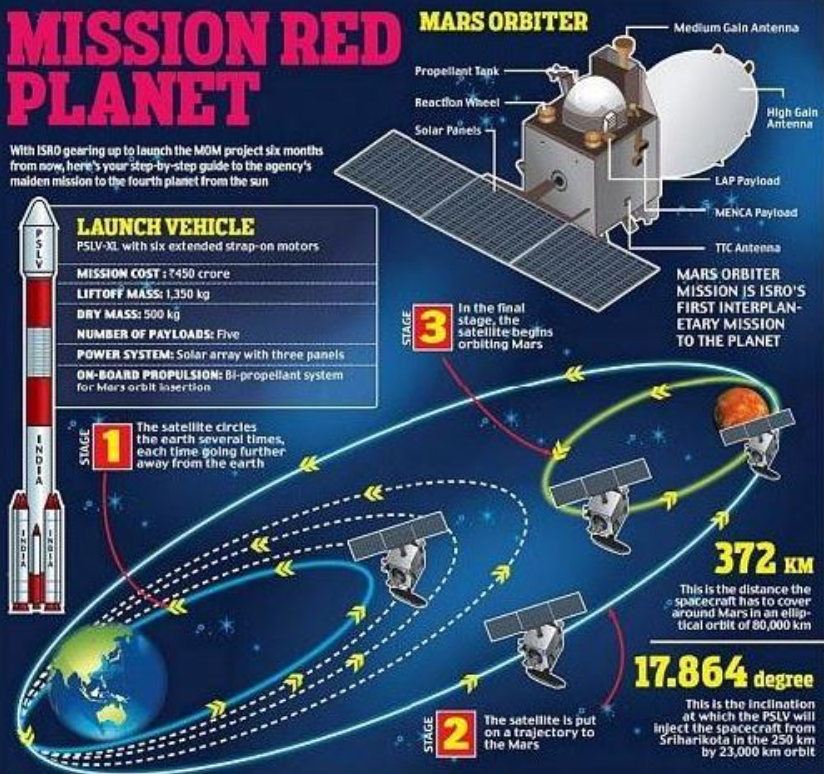
- Mars Orbiter Mission (MOM), India’s first interplanetary mission to planet Mars was launched on board PSLV-C25 on November 05, 2013.
- ISRO has become the fourth space agency to successfully send a spacecraft to Mars orbit after Roscosmos, NASA, and the European Space Agency.
- Though the designed mission life is 6 months, MOM completed 7 years in its orbit on Sept 24, 2021.
- PSLV-C25, twenty fifth flight of PSLV launched Mars Orbiter Mission Spacecraft
Scientific payloads
Mars continues to be an object of keen interest to scientists in the context of planetary evolution and extra-terrestrial life. Based on our understanding of Mars, which was thought to be probably a warm and wet planet earlier, is now seen to be dry with a thin atmosphere.
How this evolution has taken place is still a topic of research. In this backdrop, the Indian Mars Orbiter Mission carried the following five scientific payloads:
- Mars Color Camera (MCC)
The Mars Colour Camera is a versatile and multi-purpose snap shot camera with R-G-B Bayer pattern to map various morphological features on Mars and return visual images of Mars and its environs.
- Thermal Infrared Imaging Spectrometer (TIS)
The Thermal Infrared Imaging Spectrometer is a grating based spectrometer which will measure the thermal emission from Martian surface.
- Methane Sensor for Mars (MSM)
It can measure CH4 concentration in the Martian atmosphere with few parts-per-billion accuracy.
- Mars Exospheric Neutral Composition Analyser (MENCA)
The main scientific objective of the Mars Exospheric Neutral Composition Analyser (MENCA) is to study the neutral composition and density distribution of the Martian exosphere and to study its radial, diurnal, and possibly seasonal variations.
- Lyman Alpha Photometer (LAP)
The Mars Orbiter Mission (MOM) has various achievements to its credit after it was inserted into Mars orbit on September 24, 2014. The details of significant achievements of MOM include –
- First interplanetary mission realized by India and first Indian spacecraft to incorporate full scale on-board autonomy to overcome the long distances and the communication gaps due to non-visibility periods.
- First Indian spacecraft to successfully survive Van Allen belt crossing 39 times.
- First mission to use Ship Borne Terminals to track the launch vehicle and satellite over Pacific Ocean by ISRO.
- First Indian spacecraft to escape the Sphere Of Influence of Earth and orbit Sun.
- First Mars mission in the world to succeed Mars Orbit Insertion in first attempt.
- Most economical interplanetary mission in the world and paved way for cost-effective access to deep space. The launch vehicle, Spacecraft and Ground Segment have been realised with a budget of Rs 450 Cr.
Indian Space Research Organization (ISRO) – Mars Orbiter Mission (MOM) has been awarded “Space Pioneer Award” for science and engineering category for the year 2015 by the US based National Space Society.
The Indira Gandhi Prize for Peace, Disarmament and Development is awarded to ISRO in recognition of its path-breaking achievement, culminating in Mars Orbiter Mission, its significant contribution in strengthening international cooperation in peaceful use of outer space.
