

Marine resources are materials and attributes found in the ocean with intrinsic or monetary value. These resources encompass a wide range of elements such as biological diversity, fish and seafood supplies, oil and gas, minerals, sand and gravel, renewable energy resources, tourism potential, and unique ecosystems like coral reefs. The monetary value of these resources can be significant, but even when not monetized, their uniqueness and potential for education and human enrichment are invaluable. Therefore, the management and utilization of marine resources are crucial.
Biological Resources:
Fish and Marine Life:
These resources have developed through the evolutionary processes that have taken place over millions of years. Marine organisms have evolved to thrive in a diverse array of ecological niches and habitats, spanning from the shallow waters of coastal regions to the depths of the ocean floor. The diverse species of fish, molluscs, and marine mammals form an integral part of the marine ecosystem and are crucial for both biodiversity and human consumption.
Non-Biological Resources:
Oil and Gas:
These resources are formed from the remains of marine plants and animals that settled on the ocean bed millions of years ago. Over time, these remains were buried under layers of sediment, subjected to increasing pressure and heat. The organic material was transformed into hydrocarbons, forming oil. With further heat and compression, oil can eventually be converted into natural gas. This process takes millions of years and contributes significantly to the global energy supply today.
Sand and Gravel:
Fast-flowing rivers carry sediments, such as broken-down rock and soil, to the sea. Over time, this material accumulates on the seafloor and forms sand and gravel deposits. These resources are essential for the construction industry, used in building roads, concrete, and other infrastructure projects.
Minerals:
A significant portion of ocean minerals are created by volcanic activity. When underwater volcanoes erupt, they emit lava that cools and hardens. The rate at which the lava cools affects the size of the crystals that develop, with slower cooling leading to the formation of larger crystals. These crystals constitute valuable minerals such as manganese, copper, and nickel, which can be found in nodules on the seafloor.
Water (with dissolved minerals):
Seawater holds various dissolved minerals, including salt, magnesium, and calcium. Under certain conditions, these minerals can precipitate from the water and create solid deposits. For example, in salt flats where water evaporates, salt can be deposited as a solid resource that is then harvested for various uses. Another example is the formation of calcium carbonate deposits, which can accumulate to form limestone or other sedimentary rocks.
Coral Reefs:
Coral reefs are among the most diverse and productive ecosystems on Earth known for their vibrant biodiversity, they provide critical ecological, economic, and social benefits. Coral reefs are primarily found in shallow, tropical marine waters and are constructed from calcium carbonate secreted by coral polyps.
Formation: Coral reefs are formed by the accumulation of coral skeletons made of calcium carbonate (CaCO₃). This process typically occurs in tropical and subtropical waters where conditions are ideal for coral growth. The formation of coral reefs involves several stages:
- Polyp Growth: Coral polyps, tiny marine organisms, secrete calcium carbonate to build their protective skeletons. Over time, these polyps multiply and their skeletons accumulate, forming the structure of the reef.
- Symbiosis with Algae: Corals have a symbiotic relationship with zooxanthellae, a type of algae that lives within coral tissues. Zooxanthellae perform photosynthesis, providing the coral with energy, while the coral provides the algae with a protected environment and necessary nutrients.
- Reef Development: As more and more polyps grow, die, and leave their skeletons behind, coral reefs expand. Reefs can take thousands of years to develop fully, and their growth is slow, often ranging from 1 to 3 cm per year.
Characteristics of Coral Reefs
Coral reefs are known for a variety of physical and ecological characteristics that make them unique:
- Biodiversity Hotspots: Coral reefs support a wide variety of marine life. They host over 25% of all marine species, despite covering less than 1% of the ocean floor.
- Complex Structures: The calcium carbonate skeletons of corals create complex, three-dimensional structures. These structures provide habitats and protection for various marine species, ranging from fish to crustaceans.
- Temperature Sensitivity: Corals are highly sensitive to temperature changes. They thrive in waters between 23°C and 29°C, and prolonged exposure to temperatures outside this range can lead to coral bleaching, a process where corals expel zooxanthellae, causing them to lose color and often die.
- Types of Reefs: Coral reefs can be categorized into three main types:
- Fringing Reefs: These reefs develop near the shore of islands or continents.Example: Ningaloo Reef, Australia: Located off the western coast of Australia, Ningaloo is one of the longest fringing reefs in the world, stretching over 260 kilometers.
- Barrier Reefs: Separated from the shore by a lagoon, barrier reefs form a protective barrier around a coastline.
- Great Barrier Reef, Australia: The largest coral reef system globally, stretching over 2,300 kilometers along the northeastern coast of Australia. It forms a natural barrier, protecting the coastline.
- Atolls: Circular or oval reefs that form around a submerged volcanic island, creating a lagoon in the center.
- Example: Maldives Atolls: The Maldives in the Indian Ocean is home to 26 atolls, with coral reefs forming rings around shallow lagoons.These atolls are a top attraction for divers because of their abundant marine life.
- Calcium Carbonate Deposition: Coral reefs are formed through the continuous deposition of calcium carbonate by coral polyps, which harden into the reef structure.
- Types of Reefs:
- Fringing Reefs: Found along coastlines, extending directly from the shore into the sea.
- Barrier Reefs: Located further offshore than fringing reefs, separated from the shore by deeper water.
- Atoll Reefs: Initially formed as fringing reefs around an underwater volcano. As the volcano recedes, a barrier reef is formed, and eventually, when the reef reaches the water surface, it becomes a circular atoll reef.
Distribution of Coral Reefs
Coral reefs are found primarily in tropical and subtropical regions between 30°N and 30°S latitudes. They thrive in shallow, warm, clear waters where sunlight can penetrate, providing energy for the zooxanthellae to photosynthesize. The major coral reef systems are distributed as follows:
- The Great Barrier Reef (Australia): The largest coral reef system in the world, located off the coast of Queensland. It spans over 2,300 km and consists of over 2,900 individual reefs.
- The Coral Triangle (Southeast Asia): Encompassing the waters of Indonesia, Malaysia, the Philippines, Papua New Guinea, and Timor-Leste, this region is known for its incredible coral diversity and is considered the “Amazon of the seas.”
- The Caribbean Reef System: Found throughout the Caribbean Sea, this reef system stretches from Florida to Venezuela and includes famous reefs like the Belize Barrier Reef.
- The Red Sea Reefs: Located in the Red Sea, these reefs are notable for their unique adaptation to higher salinity levels and relatively warm temperatures.
- Indian Ocean Reefs: Found along the coastlines of East Africa, the Maldives, and parts of India, these reefs are among the most biodiverse in the world.
Ocean deposits
Formation and Classification of Marine Sediments
Marine sediments originate from various sources and are transported to the oceans through rivers, winds, and volcanic eruptions. The breakdown and decay of marine life also contribute to the sediment load. These sediments are essential for understanding the geological history and functioning of marine ecosystems. Marine sediments are classified into four types based on their origin:
- Lithogenic Sediments: Derived from the weathering and erosion of terrestrial rocks.
- Biogenic Sediments: Composed of the remains of marine organisms, such as shells and skeletons.
- Hydrogenic Sediments: Formed from chemical precipitation of minerals in seawater.
- Cosmogenic Sediments: Originating from extraterrestrial sources, such as meteorite debris.
Types and Classification of Ocean Deposits
Ocean deposits are categorized based on the nature of sediments and their location within the marine environment.
Classification Based on Residues:
- Pelagic Deposits: Located in the open ocean, far from coastal areas. Examples include:
- Red Clay
- Radiolarian Slime
- Diatom Slime
- Pteropod Slime
- Globigerina Slime
- Seaside Deposits: Located close to the shore. Examples include:
- Gravel
- Sand
- Mud
- Hemipelagic Deposits: Found between littoral (coastal) and pelagic (open sea) zones.
- Epipelagic Deposits: Located at the highest point in the ocean zone, above the mesopelagic area, where sufficient sunlight is received.
Classification Based on Sediment Type:
- Terrigenous Sediments: Derived from the erosion of land, composed of clay, silt, sand, and gravel.These sediments are carried to the ocean by rivers, wind, and glaciers.They are most abundant near the continental margins and provide insights into the geological history of surrounding land masses.
- Pelagic Sediments: Derived from the deposition of biogenic and mineral particles in the water column. Biogenic particles include remains of marine organisms such as plankton and shells, while mineral particles are derived from volcanic activity and chemical precipitation. Pelagic sediments are abundant in the open ocean and offer insights into marine ecosystem functioning.
Classification by Location:
- Continental Deposits: Found on the continental shelf and slope.
- Neritic Deposits: Located in shallow seas.
- Pelagic Deposits: Located in the deep sea.
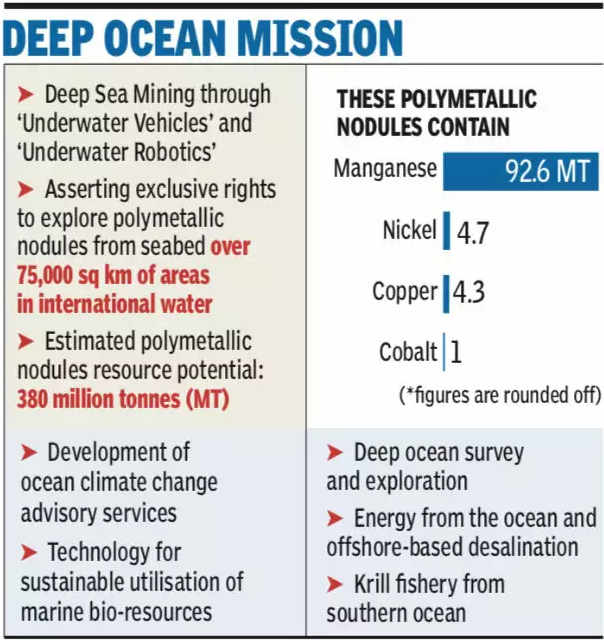 Deep ocean mission
Deep Ocean Mission (DOM) Overview:
The Cabinet Committee on Economic Affairs has recently given approval to the Ministry of Earth Sciences’ (MoES) Deep Ocean Mission (DOM). Unveiled in 2018, the DOM aims to explore the deep ocean and support India’s Blue Economy initiatives, focusing on sustainable use of ocean resources for economic growth, improved livelihoods, jobs, and ocean ecosystem health.
About the Mission:
- Cost and Implementation: Estimated at Rs. 4,077 crores over five years, implemented in phases by MoES.
- Mission Mode Project: Supports the Blue Economy Initiatives of the Government of India.
- Global Technology: India joins the US, Russia, France, Japan, and China in having the technology and expertise for deep ocean exploration.
Major Components:
- Development of Technologies for Deep Sea Mining and Manned Submersible:
- Manned Submersible: Designed to carry three people to a depth of 6,000 meters with scientific sensors and tools.
- Integrated Mining System: For mining polymetallic nodules in the central Indian Ocean. These nodules contain iron, manganese, nickel, and cobalt.
- Commercial Exploitation: Exploration studies will lead to commercial exploitation once the International Seabed Authority evolves the commercial exploitation code.
- Development of Ocean Climate Change Advisory Services: To understand and project future climate variables on seasonal to decadal time scales.
- Technological Innovations for Exploration and Conservation of Deep-Sea Biodiversity:
- Bio-Prospecting: Focus on deep sea flora and fauna, including microbes, and sustainable utilization of bio-resources.
- Deep Ocean Survey and Exploration:
- Hydrothermal Sulphides: Identify potential sites of multi-metal mineralization along the Indian Ocean mid-oceanic ridges.
- Energy and Freshwater from the Ocean: Engineering design for offshore Ocean Thermal Energy Conversion (OTEC) powered desalination plants. OTEC uses ocean temperature differences from the surface to depths over 1,000 meters to extract energy.
- Advanced Marine Station for Ocean Biology: Development in ocean biology and engineering, translating research into industrial applications and product development through on-site business incubator facilities.
Significance
The Deep Ocean Mission aims to enhance India’s capabilities in deep-sea exploration and resource utilization, placing the country among the global leaders in oceanic technology and research. This mission is crucial for India’s sustainable development and economic growth through the Blue Economy, ensuring the health of ocean ecosystems while harnessing their vast resources.
Deep sea mining
Deep sea mining refers to the process of retrieving mineral deposits from the ocean floor below 200 meters, an area covering two-thirds of the total seafloor. This practice targets valuable minerals and metals found in the deep ocean.
- Depth and Extent:
- Deep sea mining operates in ocean depths greater than 200 meters.
- The area targeted by deep sea mining covers two-thirds of the total seafloor.
- International Seabed Authority (ISA):
- The ISA, an agency under the United Nations Convention on the Law of the Sea (UNCLOS), oversees activities related to mineral resources in the deep sea.
- The international seabed, also known as “the Area,” lies beyond national jurisdiction and covers around 50% of the world’s oceans.
- The ISA has issued 32 contracts for deep sea mineral exploration, covering more than 1.5 million square kilometers of the seabed.
- Environmental Concerns:
- Recent studies suggest that commercial-scale deep sea mining operations could potentially harm ocean ecosystems and endangered species, including cetaceans like blue whales and several dolphin species.
- The need for continued conservation efforts to protect these species is emphasized.
Environmental Impact
Deep sea mining poses significant risks to the marine environment:
 Habitat Destruction:
- Mining activities can lead to the destruction of seabed habitats, affecting the organisms that live there.
- The removal of sediment and disruption of the seabed can have long-lasting impacts on the ecosystem.
- Species at Risk:
- Endangered species such as cetaceans (e.g., blue whales and dolphins) are particularly vulnerable to disturbances caused by mining operations.
- Noise pollution from mining activities can interfere with the communication and navigation of these species.
- Sediment Plumes:
- Mining can create sediment plumes, which can spread over large areas, smothering marine life and disrupting the food chain.
- These plumes can also affect photosynthetic organisms by reducing light penetration in the water.
- Chemical Pollution:
- The release of toxic chemicals and heavy metals during mining can contaminate the water, affecting both marine life and human health.
