Major East Flowing Rivers
Major East Flowing Rivers
Major East Flowing Rivers
Major East Flowing Rivers
Major East Flowing Rivers
-
Major East Flowing Rivers
Major East Flowing Rivers
Major East Flowing Rivers
Major East Flowing Rivers
Major East Flowing Rivers
Major East Flowing Rivers
Major East Flowing Rivers
Major East Flowing Rivers
Major East Flowing Rivers
Major East Flowing Rivers
- East flowing rivers flow from west to east due to the natural gradient of the land and eventually drain into the Bay of Bengal.
- These rivers carry large amounts of sediment, leading to the formation of deltas on the eastern coast (while west-flowing rivers typically form estuaries).
Mahanadi
 Origin: Near Sihawa, Raipur district, Chhattisgarh
- Course:
- Flows through Odisha and discharges into the Bay of Bengal
- Initially flows northward through Raipur district
- Shifts to an easterly direction, joined by Jonk and Hasdeo rivers before entering Odisha
- Enters the Bay of Bengal via several channels near Paradeep at False Point, Jagatsinghpur, Odisha
- Length: Approximately 851 km
- Drainage Basin: Shared by Maharashtra, Chhattisgarh, Jharkhand, and Odisha
- Major Dam:Hirakud Dam (Located near Sambalpur, Odisha), the largest earthen dam in the world, constructed to control the river and mitigate flooding
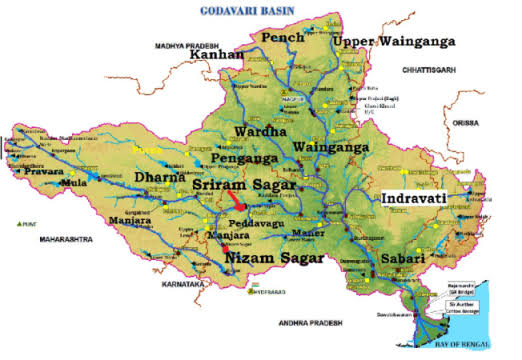 Godavari
- Significance:Largest Peninsular river system, Also known as the Dakshin Ganga (Ganga of the South)
- Origin: Western Ghats, near Nashik, Maharashtra
- Course:
- Flows eastwards into Telangana (Nizamabad district)
- Continues southeast, flows through a gap in the Eastern Ghats
- Crosses Andhra Pradesh
- After Rajahmundry, splits into several branches, forming a large delta along the Bay of Bengal coast
- Delta: The delta, along with the Krishna river delta, is known as the Rice Granary of South India
- Length: Approximately 1,465 km
- Drainage Basin: Shared by Maharashtra, Madhya Pradesh, Chhattisgarh, Odisha, and Andhra Pradesh
- Major Dam:Sir Arthur Thomas Cotton’s Dam: Constructed below Rajahmundry in Andhra Pradesh in the mid-19th century; first major irrigation project on the Godavari
- Principal Tributaries:Penganga, Indravati, Pranhita, Manjra
Krishna
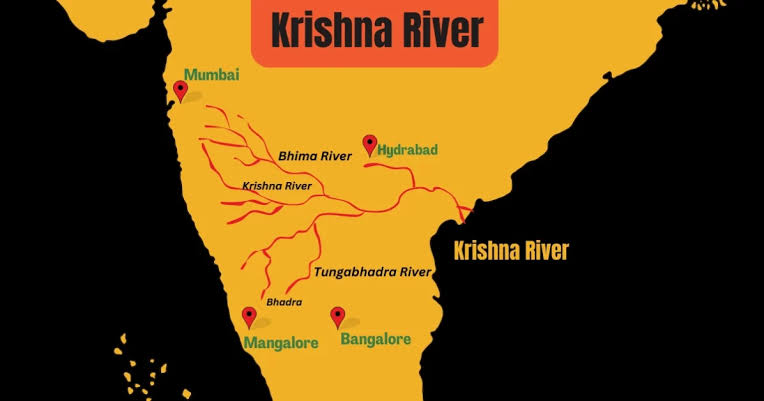 Origin: Near Mahabaleshwar, Sahyadri Range, Maharashtra
- Course: Flows eastward and empties into the Bay of Bengal at Hamsaladeevi, near Koduru in Andhra Pradesh
- Length: Approximately 1,401 km
- Drainage Basin: Shared by Maharashtra, Karnataka, Andhra Pradesh, and Telangana
- Important Tributaries:Tungabhadra, Dudhganga, Koyna, Ghatprabha, Musi, Bhima
Kaveri/Cauvery
- Origi
- n: Brahmagiri Range, Western Ghats, Kodagu district, Karnataka
- Course: Flows through Karnataka and Tamil Nadu
- Length: Approximately 800 km
- Basin: Shared by Tamil Nadu, Karnataka, Kerala, and Puducherry
- Significant Features:Shivasamudram Falls: Second biggest waterfall in India, located on the Kaveri River. The hydroelectric power generated here supplies Mysore, Bengaluru, and the Kolar Gold Fields.
- Rainfall and Flow: Receives rainfall during summer monsoon, retreating monsoon, and winter monsoon. This ensures a steady flow throughout the year with comparatively less fluctuation than other Peninsular rivers.
- Important Tributaries:Kabini, Bhavani, Amravati, Hemavati
East-Flowing Small Rivers
- Subarnarekha: Originates in Jharkhand, flows through Odisha and West Bengal before draining into the Bay of Bengal.
- Baitarani: Rises in Odisha and flows eastwards into the Bay of Bengal.
- Brahmani: Formed by the confluence of the Sankh and South Koel rivers in Odisha, flowing into the Bay of Bengal.
- Vamsadhara: Originates in Odisha, flows through Andhra Pradesh, and empties into the Bay of Bengal.
- Penner: Starts in Karnataka, flows through Andhra Pradesh into the Bay of Bengal.
- Palar: Originates in Karnataka and flows southeast through Tamil Nadu into the Bay of Bengal.
- Vaigai: Rises in the Western Ghats, flowing through Tamil Nadu before emptying into the Palk Strait.

