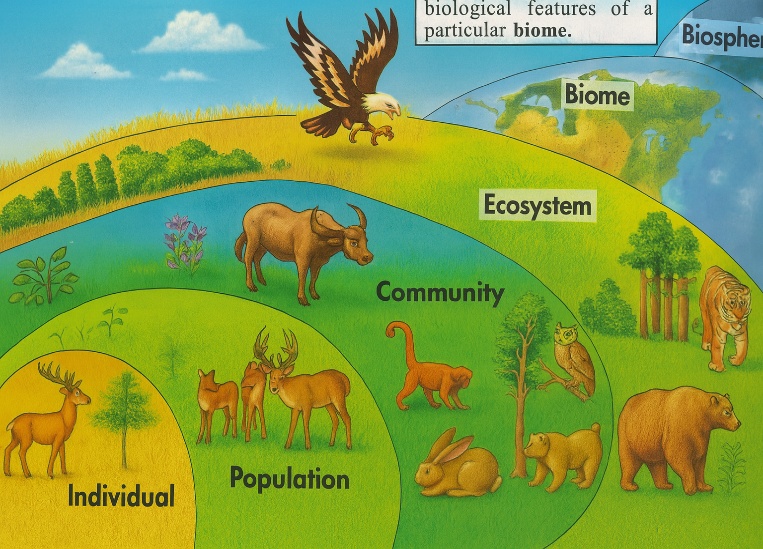
Levels of Ecological Organization
Ecology encompasses not only the study of the relationship between individual organisms and their environment, but also extends to understanding how organisms exist and interact at higher levels of organization such as populations, communities, ecosystems, biomes, and ultimately the biosphere.
- A biome is defined as a large ecological community characterized by dominant vegetation types and the animal species associated with them, typically found within a particular climatic region. While biomes generally refer to terrestrial regions (e.g., deserts, grasslands, forests), aquatic systems such as oceans, lakes, and rivers are also categorized into distinct life zones based on factors such as salinity and depth.
- Ecology focuses on how organisms adapt to their surroundings and how they utilize environmental resources like energy flow and mineral cycling.
Definition: Ecology is the scientific study of the relationship of living organisms with each other and with their environment |
The levels of ecological organization and their respective focuses of study are as follows:
Organism (Individual):
- This is the basic unit of ecological study. It involves understanding the form, physiology, behaviour, distribution, and adaptations of a single organism in response to its environment.
Population:
- A population is a group of individuals of the same species living in a defined area at a specific time. At this level, ecology examines the interaction between individuals within the same species and explores intraspecific relationships such as competition, cooperation, and reproduction.
Community:
- A community consists of different populations of various species inhabiting a common environment. The focus here is on the structure and composition of communities, along with interspecific interactions (i.e., relationships between different species), including predation, mutualism, and competition.
Ecosystem:
- An ecosystem includes the community of living organisms and their non-living (abiotic) environment, interacting as a functional unit. Ecosystem studies involve examining nutrient cycling, climate influences, and energy flow between the biotic and abiotic components.
Biome:
- At a broader level, the study focuses on physical and biological features of entire biomes. Biomes represent major regional systems shaped by climate, soil, and vegetation
Biosphere:
- This is the highest level of ecological study, encompassing the sum of all ecosystems on Earth. It involves examining global phenomena such as climate change, ozone depletion, and human impact on the Earth’s natural systems.