
Launchers or Launch Vehicles are used to carry spacecraft to space. India has three active operational launch vehicles:
- Polar Satellite Launch Vehicle (PSLV),
- Geosynchronous Satellite Launch Vehicle (GSLV),
- Geosynchronous Satellite Launch Vehicle Mk-III (LVM3).
The rockets (launch vehicles) have powerful propulsion systems that generate the huge amount of energy required to lift heavy objects like satellites into space, overcoming the gravitational pull of the earth.
Sounding Rockets
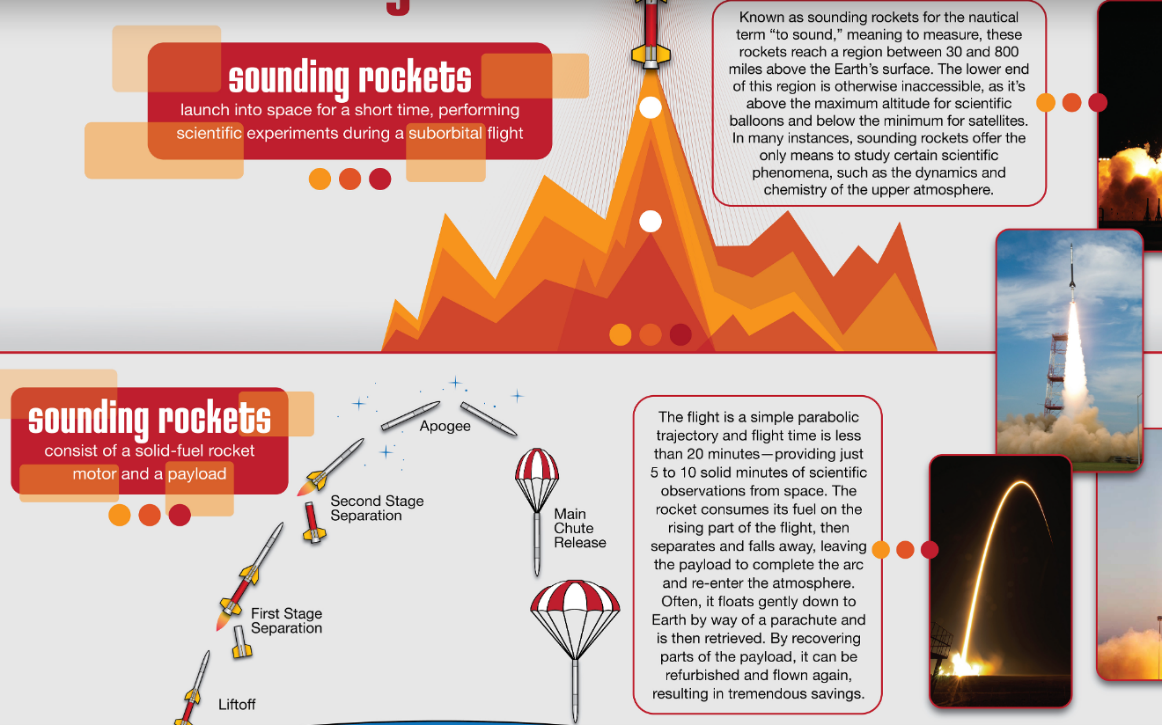
- Sounding rockets are one or two stage solid propellant rockets used for probing the upper atmospheric regions and for space research.
- They also serve as easily affordable platforms to test or prove prototypes of new components or subsystems intended for use in launch vehicles and satellites.
- With the establishment of the Thumba Equatorial Rocket Launching Station (TERLS) in 1963 at Thumba, a location close to the magnetic equator, there was a quantum jump in the scope for aeronomy and atmospheric sciences in India.
- The launch of the first sounding rocket from Thumba near Thiruvananthapuram, Kerala on 21 November 1963, marked the beginning of the Indian Space Programme.
- Sounding rockets made it possible to probe the atmosphere in situ using rocket-borne instrumentation.
Satellite Launch Vehicle-3
- Satellite Launch Vehicle-3 (SLV-3) was India’s first experimental satellite launch vehicle, which was an all solid, four stage vehicle.
- SLV-3 was successfully launched on July 18, 1980 from Sriharikota Range (SHAR), when Rohini satellite, RS-1, was placed in orbit, thereby making India the sixth member of an exclusive club of space-faring nations.
- The first experimental flight of SLV-3, in August 1979, was only partially successful.
- The successful culmination of the SLV-3 project showed the way to advanced launch vehicle projects such as the Augmented Satellite Launch Vehicle (ASLV), Polar Satellite Launch Vehicle (PSLV) and the Geosynchronous satellite Launch Vehicle (GSLV).
