
LVM3(Geosynchronous Satellite Launch Vehicle Mk III)
- LVM3 is the new heavy lift launch vehicle of ISRO for achieving a 4000 kg spacecraft launching capability to GTO (Geosynchronous Transfer Orbit) in a cost effective manner.
- LVM3 is a three stage launch vehicle with two solid strap-on motors (S200), one liquid core stage (L110) and a high thrust cryogenic upper stage (C25).
- The C25 is powered by CE-20, India’s largest cryogenic engine, designed and developed by the Liquid Propulsion Systems Centre.
- Payload to LEO (Low Earth Orbit): 8,000 kg
Small Satellite Launch Vehicle (SSLV)
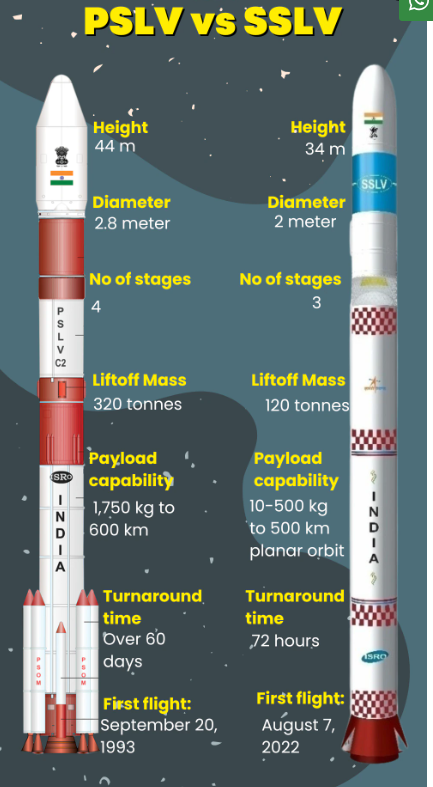
- Small Satellite Launch Vehicle (SSLV) is a 3 stage Launch Vehicle configured with three Solid Propulsion Stages and liquid propulsion based Velocity Trimming Module (VTM) as a terminal stage.
- SSLV is 2m in diameter and 34m in length with lift off weight of ~120 tonnes. SSLV is capable of launching ~500kg satellite in 500km planar orbit from SDSC/SHAR.
- The key features of SSLV are Low cost, with low turn-around time, flexibility in accommodating multiple satellites, Launch on demand feasibility, minimal launch infrastructure requirements, etc.
Reusable launch vehicle
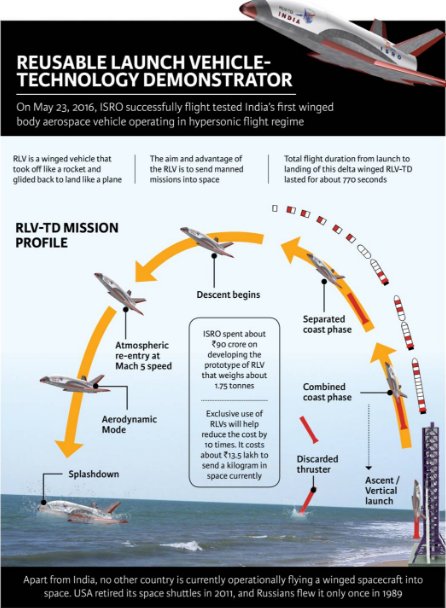
- A reusable launch vehicle is a spacecraft or rocket that can be recovered and reused for multiple missions, reducing the overall cost of space exploration. In simple terms, it’s like a space vehicle that can be used more than once.
- Example from ISRO (Indian Space Research Organisation): ISRO developed a reusable launch vehicle named the “Reusable Launch Vehicle-Technology Demonstrator” (RLV-TD).
- The program aimed to test and validate technologies for future reusable launch vehicles, with the goal of making space missions more cost-effective.
- The RLV that ISRO is building has only two stages to propel the vehicle into orbit.
- Once the fuel in the first stage has been expended, the vehicle will shed it, and carry on with the second stage. Once it has been shed, the first stage will re-enter the atmosphere and land in an autonomous fashion at a pre-determined location. After some maintenance, it will be available for reuse.
- Currently, ISRO is working on the ‘Orbital Re-entry Experiment’ (ORE), which will be taken to orbit by a modified launch vehicle comprising existing GSLV and PSLV stages.
- The vehicle will stay in orbit for a stipulated period, re-enter, and finally land autonomously on a runway, with landing gear.
