
Landforms Created by Wind (Aeolian Processes)
Definition
- Aeolian processes refer to the geomorphic work of wind, especially in arid and semi-arid regions where vegetation is sparse and dry, loose materials are exposed.
- These processes lead to the formation of distinct erosional and depositional landforms in deserts and sandy plains.
Refers to
Aeolian processes involve:
- Erosion: Removal of loose, fine particles through deflation and abrasion.
- Transportation: Movement of particles by rolling, saltation (bouncing), and suspension.
- Deposition: Laying down of materials when wind speed reduces and particles can no longer be carried.
These processes are most prominent in deserts, but also occur in coastal areas, dry lake beds, and semi-arid regions.
Aeolian Process (Mechanisms)
a) Deflation
- Lifting and removal of fine dust, silt, and sand from land surfaces.
- Creates features like deflation hollows and blowouts.
b) Abrasion
- Wind-driven sand grains strike rock surfaces, gradually wearing them down.
- Similar to sandblasting, it polishes and sculpts rock faces.
c) Impact
- Direct collision of sand grains with rock surfaces causes breakdown of particles, contributing to erosion.
Erosional Landforms Formed by Wind
1. Pediments
- Gently sloping rocky surfaces found at the base of desert mountains.
- Formed due to:
- Sheet floods washing away loose material
- Backwasting of slopes due to parallel retreat
- Represent the initial stage of desert landform development.
2. Pediplains
- Result from the coalescence of multiple pediments.
- Formed as mountain fronts retreat, leaving behind a flat, featureless plain.
- Often dotted with inselbergs – isolated remnants of former hills.
3. Playas
- Flat-floored desert basins or shallow lakes that appear temporarily after rainfall.
- Characterized by:
- Rapid evaporation
- Salt crusts and deposits
- Also called alkali flats when salt concentration is high.
- Located in interior desert basins.
4. Deflation Hollows
- Depressions formed by the removal of fine particles through persistent wind action.
- May deepen over time to form blowouts.
- Common in sandy deserts with minimal vegetation.
5. Mushroom Rocks (Rock Pedestals)
- Formed by differential erosion:
- Lower part of the rock is abraded more due to sand-carrying wind close to the ground.
- Result: A rock with a narrow stalk and broad cap, resembling a mushroom.
- Occurs in semi-resistant rock formations.
6. Yardangs
- Streamlined, elongated ridges aligned parallel to prevailing wind.
- Formed by abrasion and deflation in regions with alternating hard and soft rock layers.
- The softer layers erode faster, leaving sharp ridges.
- Yardangs may be several meters high and hundreds of meters long.
7. Zeugen
- Similar to yardangs but form under different erosional conditions.
- Zeugen are formed when horizontal rock strata with hard caps over softer layers are subjected to abrasion.
- The softer layer beneath is eroded faster, creating a ridge with an overhanging hard layer.
- Eventually forms mushroom-like profiles, but generally broader and more massive than yardangs.
8. Caves and Table Rocks
- Caves:
- Formed when wind-borne sand erodes weaker portions of rock surfaces or into existing blowouts.
- Can develop into rock shelters or niches.
- Table Rocks:
- Flat-topped erosional remnants resembling table surfaces.
- Resistant to erosion due to a hard cap rock.
Depositional Landforms Formed by Wind
1. Sand Dunes
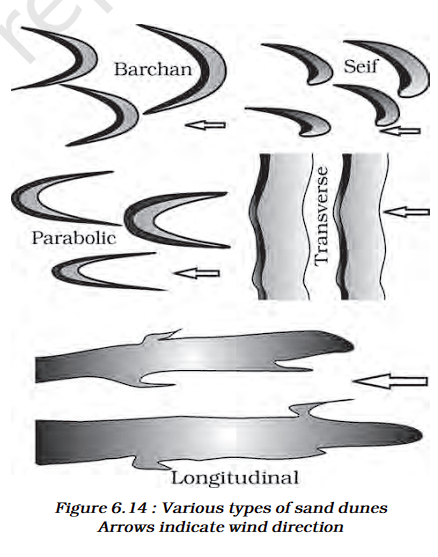 Form when wind loses energy, causing sand to settle.
- Obstacles such as rocks or vegetation help initiate sand accumulation.
- Various types depending on wind direction, velocity, and sand supply.
a) Barchan Dunes
- Crescent-shaped, horns pointing downwind.
- Form in areas with:
- Unidirectional winds
- Moderate sand supply
- Move slowly across desert surfaces.
b) Parabolic Dunes
- Reverse of barchans — horns point upwind.
- Form in areas with:
- Partial vegetation cover
- Sandy, semi-stable terrain
- Common near coastal deserts.
c) Seif Dunes
- Long, narrow ridges with one horn.
- Form due to shifting wind directions.
- Can be very high and elongated.
d) Longitudinal Dunes
- Also called linear dunes.
- Run parallel to prevailing wind direction.
- Occur in areas with:
- Limited sand
- Strong, steady wind
- Appear as long, narrow ridges.
e) Transverse Dunes
- Oriented perpendicular to wind direction.
- Form where:
- Sand is abundant
- Wind is strong and unidirectional
- Appear as wave-like ridges across desert plains.
2. Loess
- Fine-grained dust and silt carried by wind and deposited over large areas.
- Deposited far from the source (often from deserts or glacial outwash plains).
- Characteristics:
- Highly fertile
- Easily erodible
- Major Loess regions: North China Plain, Mississippi River basin, Northern India (Gangetic plains).
3. Ripples
- Small-scale depositional features formed on sandy surfaces.
- Formed by gentle winds.
- Appear as regular, wave-like ridges, a few centimeters high.
- Indicate wind direction and recent deposition.
Aeolian Landforms
| Type | Landform | Description |
| Erosional | Pediment | Gently sloping bedrock at mountain base |
| Pediplain | Coalesced pediments forming plains | |
| Playa | Shallow ephemeral lake with salt crust | |
| Deflation Hollow | Depression formed by removal of fine particles | |
| Mushroom Rock | Rock shaped like a mushroom due to differential erosion | |
| Yardang | Streamlined ridge parallel to wind | |
| Zeugen | Eroded horizontal rock strata with hard cap | |
| Caves/Table Rocks | Hollowed rock shelters or flat rock remnants | |
| Depositional | Sand Dunes | Various types shaped by wind direction and sand supply |
| Loess | Fine silt deposits forming fertile plains | |
| Ripples | Small, wave-like sand formations |
