
How Groundwater Moves Through the Earth’s Surface
- Surface water percolates into the ground when:
- The rocks are permeable (allow water to pass through).
- The rock layers are thinly bedded (arranged in layers).
- The rocks are highly jointed or cracked.
- Once water seeps vertically down:
- It moves horizontally along bedding planes, joints, or pores in the rock.
- This horizontal and vertical movement enables chemical weathering and erosion of soluble rocks like limestone.
Nature of Groundwater Erosion
- Mechanical (physical) erosion by groundwater is minimal or insignificant.
- The dominant form of erosion is chemical, mainly through:
- Solution – Dissolving soluble minerals like calcium carbonate.
- Precipitation – Re-depositing the dissolved material under certain conditions.
- These processes are particularly effective in rocks like:
- Limestone
- Dolomite
- Which are rich in calcium carbonate (CaCO₃)
Karst Topography
- Landforms developed due to the chemical action of groundwater in limestone or dolomite regions are collectively known as Karst Topography.
- The name originates from the Karst region in the Balkans, near the Adriatic Sea.
- Karst topography is known for:
- Distinctive surface and underground landforms
- Created by the processes of solution and deposition
- Found where limestone or dolomite is present either exclusively or along with other rock types
Erosional Landforms Created by Groundwater
a) Swallow Holes (Solution Holes)
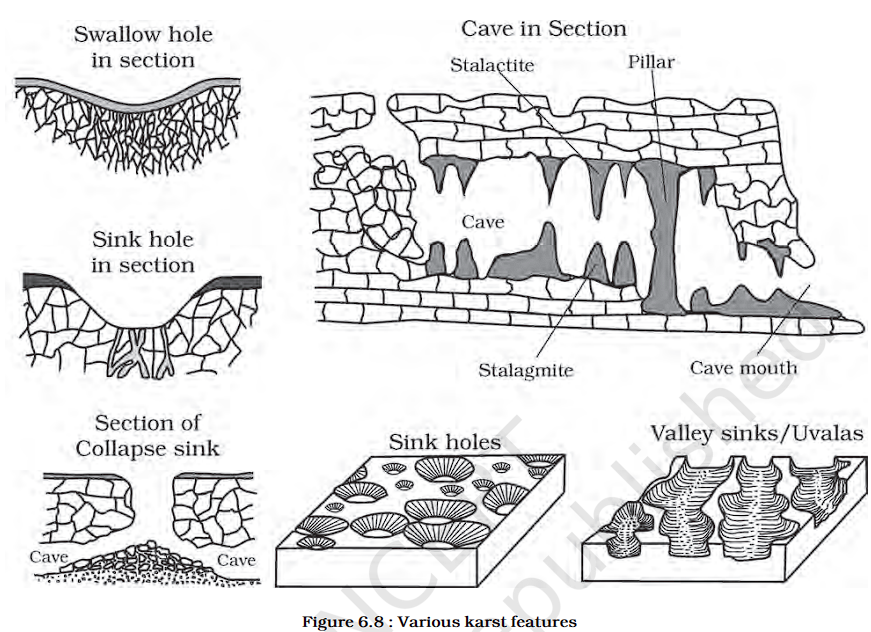
- These are shallow, round or sub-rounded depressions formed on the limestone surface.
- Created by the chemical solution of calcium carbonate by water.
- Water enters underground through these openings.
b) Sinkholes
- Common in limestone regions.
- Appear as circular depressions at the surface, funnel-shaped towards the base.
- Size:
- Area: Ranges from a few square meters to several hectares
- Depth: Can be less than half a meter to over 30 meters
Types of Sinkholes:
1. Solution Sinks:
-
-
- Formed entirely due to the dissolving action of water.
- More common in nature.
- 2. Collapse Sinks (Dolines):
- Begin as solution sinks.
- When the roof of an underground cave collapses, it forms a large depression.
- These are dangerous if hidden beneath soil – stepping on them is like stepping into quicksand.
-
- In some cases, sinkholes may accumulate rainwater, forming shallow pools on the surface.
c) Uvalas (Valley Sinks)
- Formed when multiple sinkholes and dolines merge together.
- Causes include:
- Collapse of cave roofs
- Slumping or erosion of the edges of nearby sinkholes.
- Result: Creation of long, narrow to wide trenches, known as valley sinks or uvalas.
d) Lapies
- Created due to differential solution along joint lines in limestone.
- The surface becomes rugged and irregular, resembling a maze of grooves, ridges, and pits.
- This rough terrain is referred to as Lapies.
- Over time, Lapies fields may become smooth and are known as limestone pavements.
e) Limestone Pavements
- These are flat, smooth surfaces created when the rugged lapies are further weathered.
- Result from continuous solution action, which wears down surface irregularities.
Formation of Caves
a) Conditions Favoring Cave Formation
- Found in areas with:
- Alternating layers of limestone and other rocks like shales, sandstones, quartzites.
- Or where limestone is massive, dense, and forms thick beds.
b) Process
- Groundwater seeps through joints and cracks in the rock.
- It moves horizontally along bedding planes.
- Over time, limestone dissolves, forming long, narrow or wide cavities, known as caves.
c) Features of Caves
- Maze of caves can form at different depths, depending on:
- Thickness of limestone
- Arrangement of rock beds
- Many caves have entrances and exits for underground streams.
- If caves have openings at both ends, they are known as tunnels.
Depositional Landforms Inside Caves
a) Process of Deposition
- Limestone is rich in calcium carbonate (CaCO₃).
- Rainwater absorbs carbon dioxide (CO₂), forming carbonic acid.
- This acid dissolves calcium carbonate and carries it in solution.
- When the water evaporates or loses CO₂:
- Calcium carbonate is precipitated and gets deposited inside the cave.
 b) Stalactites
- Hang from the roof of caves like icicles.
- Formed when mineral-rich water drips down, depositing CaCO₃.
- Appear in various shapes, usually broad at the base, tapering downward.
c) Stalagmites
- Grow from the cave floor, formed by water droplets falling from stalactites.
- Appear as:
- Columns
- Discs
- May have smooth rounded ends or crater-like tops.
d) Pillars or Columns
- When a stalactite and stalagmite meet, they fuse together.
- The resulting structure is called a pillar or column.
- These can vary in thickness and shape.
