
ISRO
Introduction
- Indian Space Research Organisation (ISRO) is the space agency of India. The organisation is involved in science, engineering and technology to harvest the benefits of outer space for India and the mankind.
- ISRO is a major constituent of the Department of Space (DOS), Government of India. The department executes the Indian Space Programme primarily through various Centres or units within ISRO.
- ISRO was previously the Indian National Committee for Space Research (INCOSPAR), set up by the Government of India in 1962, as envisioned by Dr. Vikram A Sarabhai.

- ISRO was formed on August 15, 1969 and superseded INCOSPAR with an expanded role to harness space technology. DOS was set up and ISRO was brought under DOS in 1972.
- The prime objective of ISRO/DOS is the development and application of space technology for various national needs.
- To fulfil this objective, ISRO has established major space systems for communication, television broadcasting and meteorological services; resources monitoring and management; space-based navigation services.
- ISRO has developed satellite launch vehicles, PSLV and GSLV, to place the satellites in the required orbits.
- The activities of ISRO are guided by its Chairman, who would also be the secretary of DOS and Chairman of Space commission – the apex body that formulates the policies and overseas the implementation of the Indian Space Programme.
Organisation associated with ISRO

- ISRO has its headquarters in Bengaluru.
- Its activities are spread across various centres and units.
- Launch Vehicles are built at Vikram Sarabhai Space Centre (VSSC), Thiruvananthapuram;
- Satellites are designed and developed at U R Rao Satellite Centre (URSC), Bengalure;
- Integration and launching of satellites and launch vehicles are carried out from Satish Dhawan Space Centre (SDSC), Sriharikota;
- Development of liquid stages including cryogenic stage is carried out at Liquid Propulsion Systems Centre (LPSC), Valiamala& Bengaluru;
- Sensors for Communication and Remote Sensing satellites and application aspects of the space technology are taken up at Space Applications Centre (SAC), Ahmedabad and
- Remote Sensing satellite data reception processing and dissemination is entrusted to National Remote Sensing Centre (NRSC), Hyderabad.
- The Physical Research Laboratory (PRL), Ahmedabad is an autonomous unit of DOS and a premier research institute engaged in basic research in the areas of Astronomy and Astrophysics, etc.

Indian National Space Promotion and Authorization Center (IN-SPACe)
- Indian National Space Promotion and Authorisation Centre (IN-SPACe) is a single-window, independent, nodal agency that functions as an autonomous agency in the Department of Space (DOS).
- It is formed following the Space sector reforms to enable and facilitate the participation of private players in 2020.

- IN-SPACe is responsible to promote, enable authorize and supervise various space activities of non-governmental entities including building launch vehicles & satellites and providing space-based services; sharing space infrastructure and premises under the control of DOS/ISRO; and establishing of new space infrastructure and facilities.
- The agency acts as an interface between ISRO and Non-Governmental Entities (NGEs) and assesses how to utilize India’s space resources better and increase space-based activities.
- It also assesses the needs and demands of private players, including educational and research institutions, and explores ways to accommodate these requirements in consultation with ISRO.
- HQ- Ahmedabad

- Antrix Corporation Limited (ACL), Bengaluru is a wholly owned Government of India Company under the administrative control of the Department of Space.
- Antrix Corporation Limited was incorporated as a private limited company owned by Government of India in September 1992 as a Marketing arm of ISRO for promotion and commercial exploitation of space products, technical consultancy services and transfer of technologies developed by ISRO.
- Another major objective is to facilitate development of space related industrial capabilities in India.
- As the commercial and marketing arm of ISRO, Antrix is engaged in providing Space products and services to international customers worldwide.
New Space India Limited (NSIL)
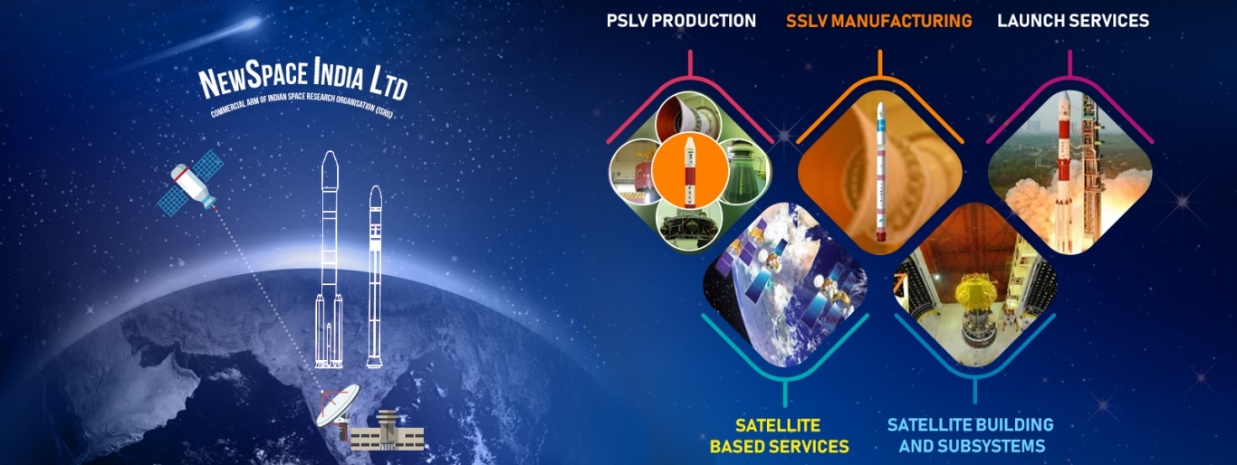
- NewSpace India Limited (NSIL), incorporated on 6 March 2019 (under the Companies Act, 2013) is a wholly owned Government of India company, under the administrative control of Department of Space (DOS).
- NSIL is the commercial arm of Indian Space Research Organisation (ISRO) with the primary responsibility of enabling Indian industries to take up high technology space related activities and is also responsible for promotion and commercial exploitation of the products and services emanating from the Indian space programme.
- To satisfy the needs of its customers, NSIL draws upon the proven heritage of the Indian Space Program and ISRO’s vast experience in diverse branches of Space Technology.
The major business areas of NSIL include:
- Production of Polar Satellite Launch Vehicle (PSLV) and Small Satellite Launch Vehicle (SSLV) through industry;
- Production and marketing of space-based services, including launch services and space-based applications like transponder leasing, remote sensing and mission support services;
- Building of Satellites (both Communication and Earth Observation) as per user requirements.
- Transfer of technology developed by ISRO centres/ units and constituent institutions of Dept. of Space;
- Marketing spin off technologies and products/ services emanating out of ISRO activities
- Consultancy services
National Atmospheric Research Laboratory (NARL)
- At Gadanki near Tirupati, an autonomous society supported by DOS, is a centre for atmospheric research.
- NARL is involved in technology development, observations, data archival, dissemination, assimilation and modeling.
- NARL carries out its research activities under seven major groups, namely, Radar Application and Development Group, Ionospheric and Space Research Group, Atmospheric Structure and Dynamics Group, Cloud and Convective Systems Group, Aerosols, Radiation and Trace Gases Group, Weather and Climate Research Group and Computers and Data Management Group.
- Apart from these groups, there are also specific projects such as the LiDAR project and Advanced Space-borne Instrument Development project.
Satish Dhawan Space Centre (SDSC)
- SHAR, Sriharikota, the Spaceport of India, is responsible for providing Launch Base Infrastructure for the Indian Space Programme.
- This Centre has the facilities for solid propellant processing, static testing of solid motors, launch vehicle integration and launch operations, range operations comprising telemetry, tracking and command network and mission control centre.

The Centre has two launch pads from where the rocket launching operations of PSLV and GSLV are carried out. The mandate for the centre is
- to produce solid propellant boosters for the launch vehicle programmes of ISRO
- to provide the infrastructure for qualifying various subsystems and solid rocket motors and carrying out the necessary tests
- to provide launch base infrastructure for satellites and launch vehicles.
SDSC SHAR has a separate launch pad for launching sounding rockets. The centre also provides the necessary launch base infrastructure for sounding rockets of ISRO and for assembly, integration and launch of sounding rockets and payloads.
Second spaceport of ISRO to be set up at Kulasekarapattinam in Tamil Nadu
The second spaceport of Indian Space Research Organisation (ISRO), which will be dedicated exclusively for Small Satellite Launch Vehicles (SSLVs) developed by the private sector, will come up in about two years at Kulasekarapattinam in Thoothukudi district of Tamil Nadu.
A small space manufacturing park would also come up near the spaceport in Kulasekarapattinam.
Dogleg maneuver
To avoid the risk of flying over another country, payloads for polar orbits are launched towards the East and follow a curved path to the South to avoid Sri Lanka’s landmass. This maneuver is known as a Dogleg maneuver. It utilizes significant fuel for smaller rockets.

